

What if the most dangerous part of your dream home in Bromley is the one thing you assume is perfectly fine? You’ve finally found the perfect Victorian terrace in Crystal Palace or a sleek flat in Croydon, and you’re eager to get those keys. It’s completely natural to feel like your surveyor has your back on every technical detail, especially when you’re navigating the stress of a high-stakes move. However, a huge point of confusion for many buyers is: does a RICS survey check the boiler? While a Level 2 or Level 3 survey is a vital tool for spotting structural gremlins, a surveyor isn’t a Gas Safe engineer. They’ll give the unit a visual once-over, but they won’t test if it’s actually safe or about to leak carbon monoxide.
We agree that the last thing you want is a surprise boiler replacement a week after moving into your new SM or CR postcode home. This guide promises to give you total peace of mind, ensuring you don’t inherit a lethal or broken heating system. We’ll preview the essential 2026 gas safety regulations, explain the limits of standard reports, and show you exactly how to negotiate with sellers so you aren’t left out in the cold.
Key Takeaways
- Learn why a visual inspection isn’t a safety test and answer the crucial question: does a RICS survey check the boiler for technical compliance or just visible wear?
- Discover how to decode “Condition 3” ratings in your building survey to avoid moving into a house with a broken or dangerous heating system.
- Understand the specific documentation your solicitor needs to request, from CP12 certificates to the latest 2026 gas tightness testing standards.
- Find out how to protect your household in SE and BR postcodes by identifying the warning signs of carbon monoxide risks before you exchange.
- Master the art of negotiating with stubborn sellers when your property survey highlights gas safety concerns in your prospective new home.
The Boiler Room Blues: Why Gas Safety Matters Before You Exchange
Buying a house in South London is a whirlwind of emotions, from the joy of finding a Victorian gem in Dulwich to the dread of the paperwork. One question that keeps savvy buyers awake at night is: does a RICS survey check the boiler? It’s a fair concern. You see a gleaming white box in the kitchen and assume it’s functional, but “functional” and “safe” are two very different things. A professional RICS Building Survey provides a comprehensive overview of the property’s health, but it doesn’t involve pulling apart the gas valves or testing combustion levels.
A gas safety check is a specific technical inspection. It goes beyond the visual checks of a surveyor to examine flues, ventilation, and internal components. Don’t be fooled by a seller claiming the unit was “serviced recently.” In the world of UK real estate, that’s often a red flag for “I haven’t looked at it in years.” You need documented proof, not a verbal promise over a cup of tea in a Bexleyheath kitchen.
To better understand the scope of professional property inspections, watch this helpful video:
Here is the legal kicker: unless your seller is a registered landlord, they aren’t actually required by law to provide you with a gas safety certificate. It’s a “buyer beware” situation. While a lethal carbon monoxide leak is the ultimate nightmare, the financial sting of a £4,000 replacement bill for an old system is a close second. You need to know if that boiler is a ticking financial time bomb before you exchange contracts and move into your new DA or BR postcode home.
The Difference Between a Service and a Safety Check
Think of a service as an oil change for your car; it keeps the gears turning and the efficiency high. A safety check is the MOT that ensures the unit won’t fail catastrophically. You want both records before committing to a purchase. If the property was previously rented, ask for the Landlord Gas Safety Record (CP12). It’s the gold standard for verifying that an engineer has actually tested the tightness of the pipes and the safety of the flues.
The Hidden Risks in South London’s Period Homes
Our local SE postcodes are famous for beautiful Victorian conversions, but these often hide ancient flues and questionable DIY gas work from decades ago. “Retro” is a great look for your furniture in Dulwich, but it’s terrifying when applied to gas pipes. We also frequently see the “Croydon Special” in SM and CR postcodes: 1970s back boilers hidden behind fireplaces. These relics often fail modern safety standards and require a specialist eye that a standard RICS survey simply cannot provide.
Does My RICS Survey Check the Boiler? (Spoiler: Not Entirely)
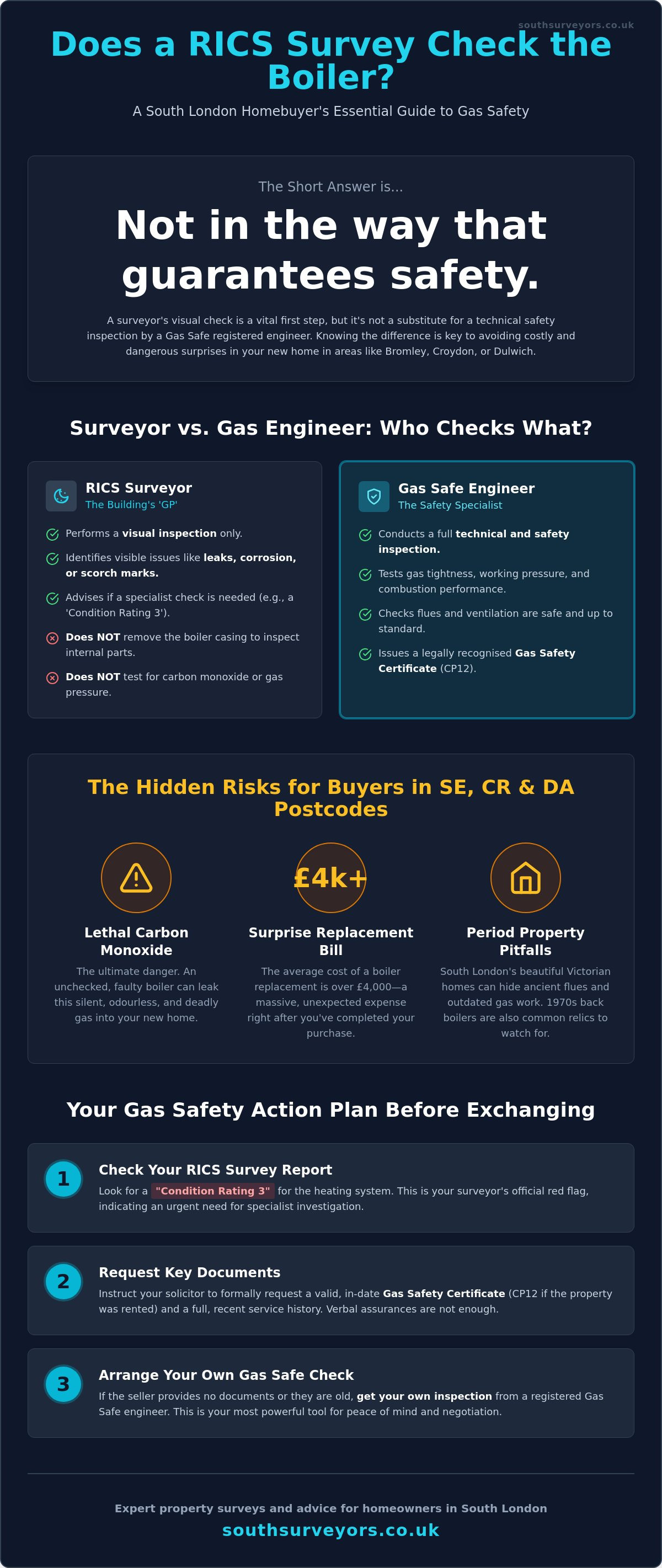
So, you’re standing in a kitchen in Sydenham, eyeing that boiler and wondering: does a RICS survey check the boiler? The short answer is yes, but probably not in the way you’re hoping. Think of your surveyor as a brilliant GP for buildings. They can spot the symptoms of a problem, but they aren’t the specialist surgeon who’s going to open up the patient to see what’s wrong. We understand the fabric of the building, from the foundations to the roof tiles, but gas engineering is a highly regulated, separate discipline.
During a level 2 survey, we’re looking for the obvious warning signs that suggest a system is struggling. This includes looking for scorching on the casing (a sign of overheating), checking for poor ventilation in the boiler cupboard, or identifying visible leaks and corrosion on the pipework. What we won’t do is take the casing off. We aren’t qualified or legally allowed to perform gas tightness tests or check the internal heat exchanger. If you want a deep dive into the technical health of the burner, that requires a Gas Safe registered engineer.
If you’re unsure which report fits your potential new home in the SE or BR postcodes, chatting with an expert surveyor can help demystify the process before you commit.
The ‘Visual Only’ Rule Explained
It’s a common frustration in the SM and CR postcodes. A buyer moves in, tries to turn the heating on in November, and finds it’s dead. They look at their report and see a ‘Condition Rating 3’ (Urgent). Why didn’t the surveyor catch the internal fault? Because our job is to flag the risk, not resolve it. We turn on the taps to see if hot water flows and feel the radiators to check they’re getting warm. If we see anything suspicious, we’ll mark it as a high priority. Always read the ‘Limitations’ section of your report; it’s where we clearly state that the gas system hasn’t been technically tested.
When to Upgrade to a Level 3 Survey
If you’re buying a sprawling 1920s detached house in Bromley or a converted flat in Herne Hill, a level 3 building survey is usually the smarter move. While it still doesn’t include a full gas safety test, it provides much more context on the age and likely lifespan of the heating system. We’ll look at the flue’s exit point and the overall integration of the system with the property’s structure. If we spot ‘Red Flags’ like soot marks around the boiler or an old, unlined chimney being used as a flue, we’ll insist you call in a specialist before you sign that contract.
The Big Three: CP12, Service Records, and Building Surveys
When you’re deep in the “buying a house” trenches, the paperwork starts to look like a mountain of confusing acronyms. To make sense of the chaos, you need a hierarchy of proof to ensure your new home is actually a sanctuary. Think of the CP12 (Landlord Gas Safety Record) as the gold standard. If you’re eyeing a flat in Morden, this document is a legal requirement for the current landlord. For a family home in Sutton, it’s a “nice to have” that proves the seller has been diligent. Next come the service records. These are the MOT history of your boiler. If there are gaps in the timeline, you’re looking at a system that’s likely been neglected and could be harboring expensive internal faults.
Finally, there’s your professional survey. As we’ve established when asking does a RICS survey check the boiler, this report acts as the “GP check-up” for the entire property. It looks at the big picture and the physical integration of the system. We check if the boiler is leaking onto the kitchen floor, if the ventilation is blocked, or if the flue is dangerously close to an opening window. It’s the final piece of the puzzle that tells you how the gas system interacts with the structure of your potential home.
Who Should Pay for the Gas Safety Check?
English property law operates on the “Buyer Beware” principle. In CR postcodes, this means the responsibility to ensure the house is safe usually falls on your shoulders. However, that doesn’t mean you can’t negotiate. If a seller in the DA postcode area won’t provide proof of safety, it’s perfectly standard practice to ask them to pay for a Gas Safe inspection. If they refuse, you have every right to lower your offer by the cost of a potential new system. It isn’t an insult; it’s just smart financial protection for your future.
What if the Seller Refuses?
If a seller blocks an engineer from entering, you need to start asking why. Are they hiding a cracked heat exchanger or a flue that vents directly into the loft? These are massive red flags. Some estate agents might suggest “indemnity insurance” as a quick fix for missing paperwork. Be very careful here. Insurance might cover legal hiccups, but it won’t fix a broken boiler in the middle of a freezing SE London winter. If the gas concerns are high and the seller is digging their heels in, it might be time to walk away. No period fireplace is worth a carbon monoxide risk.
A Survival Guide for South London Buyers: Post-Survey Steps
Once your report lands in your inbox, it’s time to play detective. The first thing you should do is scan your home survey for any ‘Condition 3’ ratings in the services section. This is the surveyor’s way of telling you that something is seriously amiss and requires urgent investigation. Because we know the answer to does a RICS survey check the boiler is limited to a visual assessment, that red rating is your professional signal to call in the cavalry. Don’t ignore it; it’s the essential gut-check you need before committing to a lifetime of mortgage payments.
Next, get your solicitor on the case. Ask them to demand the last three years of service records from the seller. If there’s a gap in that timeline, you’re likely looking at a boiler that’s been neglected. If the unit in that Sidcup semi is over ten years old, don’t even think about skipping a dedicated Gas Safe inspection. It’s the only way to ensure you aren’t moving into a property with a heat exchanger that’s about to give up the ghost. Finally, use every bit of this evidence to negotiate the repair or replacement costs before you exchange. It’s much easier to shave a few grand off the price now than to find the cash for a new system in the middle of February.
Local Experts You Can Trust
Whether you’re buying in Bromley (BR) or Dartford (DA), you need an engineer who works for you, not the seller. It’s a classic mistake to trust the ‘seller’s mate’ who happens to be a plumber. They might overlook a subtle fault to help the sale go through smoothly. Instead, head to the Gas Safe Register website. It takes thirty seconds to verify an engineer’s credentials, and it’s a simple task that can save you thousands in the long run. If you’re feeling overwhelmed by the technical jargon, booking a professional survey is the best way to start your journey with total confidence and a clear plan of action.
The ‘Ancient Boiler’ Negotiation Strategy
In Croydon (CR) and the surrounding SM postcodes, many period properties still feature older heating systems that are nearing their expiration date. In 2026, the cost of a new combi-boiler replacement in South London can easily hit £3,000 once you factor in local labour rates and parts. A £3,000 boiler replacement is a valid reason to renegotiate the purchase price of the house. Don’t be shy about presenting the surveyor’s findings as leverage. If the seller knows their system is outdated, they’re often willing to meet you halfway to keep the deal on track and avoid the property going back on the market.
Beyond the Blue Flame: Peace of Mind with South Surveyors
At South Surveyors, we believe there’s a massive difference between simply buying a house and finally owning a home. While we’ve spent this guide answering the burning question, does a RICS survey check the boiler, our role goes much deeper than just ticking boxes on a technical checklist. We’re here to provide the emotional security that comes from knowing your investment is sound. From the leafy streets of Greenwich to the family-friendly avenues of Sidcup, we help you understand the structural story of your property so you can move in with your eyes wide open. You aren’t just buying bricks and mortar; you’re buying a future, and we’re here to make sure it’s a safe one.
We don’t believe in corporate robots or alienating technical jargon. Instead, we take a “knowledgeable friend” approach to every instruction. If your report highlights a gas-related issue or a structural quirk in your new CR or SM postcode property, we won’t just leave you to figure it out alone. We’ll talk you through the scary bits over the phone, explaining the implications in plain English. Our goal is to demystify the complex world of property documentation, ensuring you feel empowered rather than overwhelmed by the paperwork. We bridge the gap between the surveyor’s clip-board and your peace of mind.
Regulated by RICS, Driven by Local Expertise
Our RICS accreditation isn’t just a badge; it’s your ultimate safety net during the high-stakes conveyancing process. It means we’re held to the highest industry standards for thoroughness, ethics, and accountability. Because we live and work in South East London, we know the specific quirks of the local housing stock. We know which SE postcodes are prone to certain types of damp and which Victorian conversions in Dulwich often have hidden flue issues. This local knowledge, paired with our professional regulation, allows us to provide a bespoke service that a national firm simply can’t match. We promise to give you the tools for a sound, safe decision for your family.
Take the Next Step Toward Your New Home
Ready to demystify your property purchase in Bromley or Sutton? Don’t let the uncertainty of a boiler casing or a hidden structural flaw dampen the excitement of your move. We’re here to answer your questions and provide a report that actually makes sense. You deserve a surveyor who is as invested in your peace of mind as you are. Get a transparent, expert-led survey quote today and take the first step toward a safe, warm, and legal new home. Let’s make sure your South London dream doesn’t turn into a technical nightmare.
Move into Your South London Home with Confidence
You’ve done the hard work of finding a place in Crystal Palace or Sidcup. Now, you just need to make sure the heating won’t let you down when the winter chill hits. We’ve cleared up the common confusion around the question: does a RICS survey check the boiler? While our surveyors will spot the visible warning signs and flag potential risks, remember that a technical safety test is a separate, vital step for your absolute peace of mind. By combining our professional oversight with proper gas documentation, you ensure your new home is a sanctuary, not a source of stress.
Don’t leave your family’s safety or your bank balance to chance. As a RICS Regulated Firm with deep roots across the SE, BR, DA, CR, and SM postcodes, we provide the detailed, jargon-free reports you need to negotiate with strength and sign your contract with total clarity. Our fast, hyper-local expertise means you won’t be kept waiting for the answers that matter most.
Book your RICS Building Survey with South Surveyors today to get the expert-led insights you deserve. You’re almost at the finish line; let’s make sure your new South London home is as warm and safe as it looks.
Frequently Asked Questions
Is a gas safety check a legal requirement when selling a house?
No, a gas safety check isn’t a legal requirement for a private homeowner selling their primary residence in the UK. However, if the property was previously rented, the seller must demonstrate compliance under the Renters’ Rights Act 2025 to prove they’ve maintained the property correctly. Even if it’s a standard sale in Bexley or Sidcup, we always suggest you ask your solicitor to request proof of safety as part of the standard conveyancing enquiries.
How much does a separate gas safety check cost in London in 2026?
In 2026, a standard Gas Safety Certificate (CP12) in London typically costs between £60 and £90. If the house has multiple gas appliances, like a fireplace in the lounge or a hob in the kitchen, expect to pay an extra £10 to £15 per item. While it feels like another expense on top of your move to Bromley, it’s a small price to pay for technical certainty and household safety.
Does a RICS Level 2 survey include testing the boiler?
A RICS Level 2 survey does not include technical testing of the gas system or internal boiler components. If you’re asking does a RICS survey check the boiler, the answer is that we perform a visual inspection only. We check for obvious signs of trouble like scorching or poor ventilation. To know if the internal burner is actually safe, you must hire a Gas Safe registered engineer for a dedicated inspection.
What happens if a gas appliance is found to be unsafe before I buy?
If an appliance is flagged as “At Risk” or “Immediately Dangerous,” you should pause the exchange immediately. Under the latest IGEM/UP/1B Edition 4 standards mandatory from October 2026, engineers have strict protocols for shutting down unsafe systems. You should insist that the seller pays for the necessary repairs or provide a quote to reduce the purchase price. Never move into a home in the SE postcode area with a known gas leak.
Can I ask the seller to pay for a new boiler if the gas check fails?
You absolutely can negotiate for a new boiler if the current system is found to be dangerous or beyond its working life. While a seller isn’t legally forced to buy you a new one, a failed safety check is a massive leverage point. If the replacement cost is around £3,000, it is perfectly reasonable to ask for that amount to be knocked off the final sale price before you sign the contract.
What is a CP12 and do I need one for a freehold house?
A CP12 is a Landlord Gas Safety Record, which is a legal necessity for rental properties but not for freehold houses. If you’re buying a house in Sutton that’s always been owner-occupied, the seller probably won’t have one. Instead, look for annual service records. If the house was recently a rental in Morden, your solicitor should definitely confirm the CP12 was valid up until the point of sale.
How long does a gas safety certificate last?
A gas safety certificate is valid for exactly twelve months from the date of the inspection. If the seller provides a certificate that’s eleven months old, it’s technically still valid, but it won’t give you much protection for the coming winter. We recommend asking for a fresh check if the current one is nearing its expiry date, especially if you’re moving into an older period property in Croydon or Dulwich.
Should I get a gas safety check if the house is a new build?
If the property was built in 2026, it likely won’t be connected to the gas grid at all due to new building regulations. These modern homes use low-carbon systems like heat pumps instead. However, if you’re buying a slightly older “new build” that does have gas, you should still check the paperwork. While the boiler might be under warranty, a safety check ensures the initial installation was done correctly and remains airtight.