

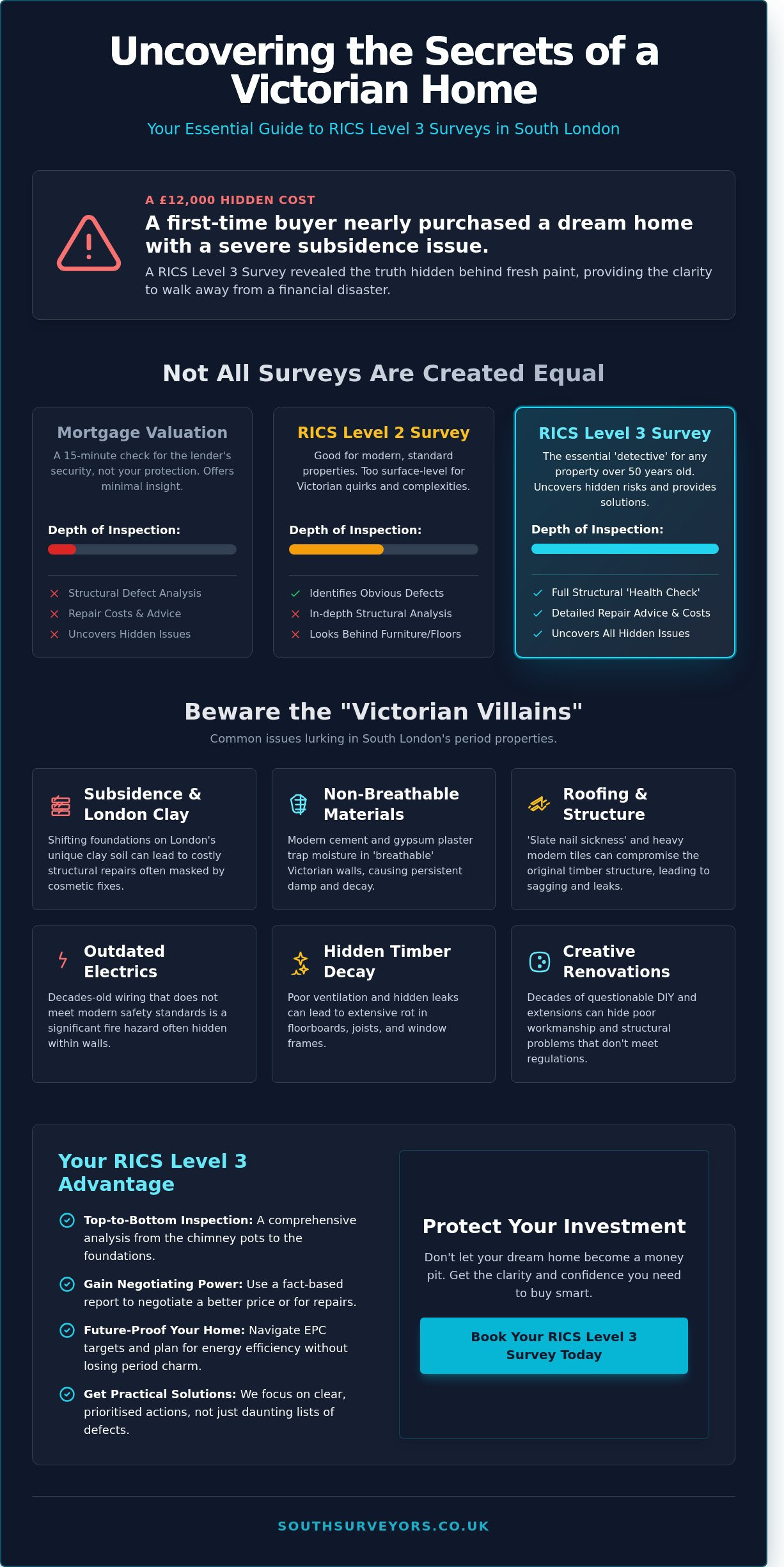
Last Tuesday, a first-time buyer in Lewisham stood in a sun-drenched SE13 kitchen, convinced they’d found ‘the one’, only for a RICS Level 3 inspection to reveal a £12,000 subsidence issue hidden behind fresh paint. You know that feeling of walking into a high-ceilinged hallway in Peckham or a bay-windowed beauty in Bromley and wanting to sign the papers immediately. It’s easy to be blinded by period charm, but you’re likely terrified that beneath those original floorboards lies a tangle of Victorian wiring or hidden damp.
We understand that anxiety. This is where a professional survey for victorian house becomes your essential ‘detective’. We’ll show you how a RICS Level 3 survey provides the clarity and confidence you need to negotiate a better price or walk away before your dream home becomes a money pit. We’re diving into the specific structural quirks of South London’s period gems and why a thorough, expert-led report is the only way to ensure your investment is sound.
Key Takeaways
- Learn why a standard check-up won’t cut it for period gems and how a RICS Level 3 survey for victorian house acts as your essential structural detective.
- Understand the science of ‘breathable’ materials and why traditional lime mortar is the unsung hero of a healthy, damp-free Victorian home.
- Identify the specific ‘Victorian villains’ lurking in South London, from shifting foundations in SE23 to the unique challenges posed by London Clay.
- Future-proof your investment by discovering how a detailed survey helps you navigate 2026 EPC targets and rising energy costs without losing period charm.
- Gain the clarity and confidence to negotiate like a pro with a report that focuses on practical solutions rather than just daunting lists of defects.
What is a Survey for a Victorian House and Why is it Different?
Buying a Victorian house is a bit like dating a charming eccentric; they are beautiful and full of character, but they definitely have their quirks. A survey for victorian house isn’t just a tick-box exercise. It’s a RICS Level 3 Building Survey specifically designed for properties built between 1837 and 1901. Unlike modern homes built with rigid concrete and cavity walls, these period gems were constructed using “breathable” materials like lime mortar and solid brickwork. If you treat a Victorian terrace in Bromley (BR1) like a 2024 new-build, you’re asking for damp issues and structural headaches.
Don’t fall into the trap of thinking a mortgage valuation is enough. The bank’s valuation is for their security, not your peace of mind. It’s often a 15-minute glance to ensure the house is worth the loan. To get real clarity and confidence in areas like Dulwich (SE21), you need a surveyor with a detective mindset. We look beyond the fresh coat of paint to understand how the building breathes and moves.
To better understand why these older properties require a specialist eye, watch this helpful video regarding common hidden issues:
The Victorian Legacy in South East London
The 19th-century building boom left an incredible mark on our local postcodes. You’ll find grand, leafy villas in Crystal Palace (SE19) and endless rows of iconic terraced housing in East Dulwich (SE22). Even the “railway” cottages in Croydon (CR0) have their own unique structural stories. We love them for their high ceilings and ornate cornicing, but their age means they’ve survived over 120 years of London weather and shifting clay soils. This “South London character” is exactly why a tailored survey for victorian house is essential to spot the eccentricities that could become expensive repairs.
Why a Standard Survey Won’t Cut the Mustard
A RICS Level 2 HomeBuyer Report is perfectly fine for a modern flat, but it’s too surface-level for a period property. Victorian homes are masters of disguise, often hiding decades of “creative” DIY and questionable extensions that don’t meet modern standards. We often find hidden rot or structural issues masked by 1970s renovations. A Level 3 Building Survey is the gold standard for any property over 50 years old because it provides the thorough, expert analysis needed to uncover hidden structural risks. Our goal is to provide you with a comprehensive report that lets you negotiate with facts, not guesswork.
The RICS Level 3 Survey: Your Deep Dive into Period Property
If you are eyeing up a three-storey terrace in East Dulwich (SE22) or a semi-detached gem in Bromley (BR1), a basic “homebuyer” report simply will not cut it. You need a survey for victorian house that goes beyond the surface. A RICS Level 3 Survey is our most comprehensive “top-to-bottom” inspection. We start at the chimney pots and do not stop until we have checked the foundations. It is about giving you real clarity and confidence before you sign on the dotted line. Our RICS-Certified team combines professional substance with a friendly, local flair. We know these streets because we live and work here, from the leafy avenues of Croydon (CR0) to the bustling hubs of Dartford (DA1).
While some reports just list problems, we focus on solutions. We understand that buying a home built between 1837 and 1901 comes with a unique set of quirks. Our surveyors provide a detailed report that acts as a manual for your future home. We explain the urgency of each find, helping you prioritise what needs fixing now and what can wait until next summer.
What Our Surveyors Actually Look For
Victorian architecture is stunning, but it was not built with modern living in mind. Our experts zoom in on the specific vulnerabilities of these period gems:
- Roofing: We check for “slate nail sickness,” where the original iron nails have corroded over the last 100 years. We also look for sagging ridge lines that suggest the timber structure is struggling under the weight of heavy concrete tiles added in the 1970s.
- Joinery: Those original sash windows are a major selling point, but rot is a common uninvited guest. We also assess the state of the floorboards, looking for signs of woodworm or damp that could compromise the 20mm thick timber.
- Structural integrity: We look through the wallpaper to find cracks that actually matter. We distinguish between minor settlement and serious subsidence, which is particularly relevant in South London areas with heavy clay soil like Sutton (SM1).
The ‘Detective Work’ Behind the Report
We do not just rely on what we can see. Our surveyors act as property detectives, using moisture meters and thermal imaging to find what the naked eye misses. This tech helps us identify hidden damp or insulation gaps that might negatively impact your Energy Performance Certificate rating. Since up to 35% of heat loss in Victorian homes occurs through uninsulated solid walls, this data is vital for your future energy bills.
We provide “Clarity and Confidence” by explaining exactly why a defect has occurred. If we find damp in a house in Bexley (DA5), we will tell you if it is caused by a blocked sub-floor vent or a leaking gutter. This level of detail is a core part of The Ultimate Guide to Building Surveys, ensuring you never feel left in the dark. If you are feeling a bit overwhelmed by a potential fixer-upper, you can always chat with our team for some expert, jargon-free advice on your next steps.
Common Victorian Villains: Damp, Subsidence, and Structural Surprises
Most buyers walk into a viewing in SE22 or SE15 with one word on their mind: damp. It is the ultimate Victorian villain. Here is the secret: these houses were designed to breathe. When we carry out a survey for victorian house, we often find that “damp” is actually just a building being suffocated by modern materials. These properties have stood for over 130 years; they are resilient, but they don’t like being wrapped in plastic.
Beyond the walls, you have to consider what is happening underground. South London sits heavily on “London Clay.” This soil is notorious for shrinking during hot summers and swelling in wet winters. In postcodes like SE23 (Forest Hill) or across the rolling hills of Crystal Palace, this movement can lead to structural shifts. While it sounds terrifying, a professional report gives you the clarity to distinguish between a house that is simply “settling” and one with active subsidence.
The Damp Dilemma: Rising vs. Penetrating
Victorian walls were built using porous bricks and lime mortar. This system acts like a sponge, absorbing moisture and then allowing it to evaporate naturally. Problems start when modern “quick fixes” are applied. If a previous owner used cement render or waterproof masonry paint, they have trapped that moisture inside the brickwork. You will see this as bubbling plaster or salt tidemarks. Check your air bricks too; if a South London gardener has raised the flower beds in your SE postcode garden, they might have blocked the vital ventilation. This often leads to condensation, a modern villain created by airtight uPVC windows and a lack of airflow.
Structural Strains and Bouncy Floors
Ever walked across a bedroom in East Dulwich and felt like you were on a trampoline? Bouncy floors usually indicate undersized joists or historic woodworm damage from decades ago. The bigger worry is the classic “knock-through.” Open-plan living is the South London dream, but if a previous owner removed a load-bearing wall without installing a calculated RSJ (Rolled Steel Joist), the floors above will eventually sag. A RICS surveyor provides the expertise to spot these “structural surprises” early. They can determine if a crack is a sign of active movement or just a century of the house finding its feet.
Don’t forget the hidden hardware. Lead piping and black rubber electrical cables from the 1950s are common finds in unrenovated gems. These aren’t reasons to walk away, but they are essential safety upgrades you should budget for. For deeper insights into maintaining period features correctly, you can consult this Historic England advice for owners. Investing in a survey for victorian house ensures you aren’t buying a money pit. Most issues in these period properties are fixable; you just need to know they exist before you sign the contract.
Planning for 2026: EPCs, Energy, and Modern Living in an Old House
You might be staring at a stunning bay window in Crystal Palace or a red-brick terrace in Bromley and wondering if you’re buying a thermal black hole. With energy prices remaining a top priority for 2026, the question isn’t just about the purchase price, it’s about the running costs. Buying a period gem doesn’t mean you’re committed to wearing three jumpers all winter. It just means you need a smarter strategy from day one.
A comprehensive survey for victorian house acts as your energy roadmap. While a standard valuation barely scratches the surface, a Level 3 survey identifies exactly where your heat is escaping. Whether it’s through the original suspended timber floors or the porous solid brick walls common in SE London, we provide the clarity you need to plan your upgrades. You can’t just slap modern insulation on a house built in 1890 and hope for the best. These buildings were designed to breathe, and getting it wrong leads to trapped moisture and rot.
The EPC Challenge for Period Homes
The government’s push for an EPC ‘C’ rating by 2030 puts Victorian owners in a unique position. Reaching that target without stripping away the character of a DA1 or BR3 property is a delicate balancing act. Installing solid wall insulation is effective, but if it’s done without considering the breathability of lime mortar, you’ll face damp issues within 24 months. Our reports help you understand these risks before you commit. You can learn more about how we break down these technical details in our guide to Understanding Your RICS Home Survey.
Budgeting for the ‘Big Three’
Think of your survey report as a professional shopping list for your future renovations. In the DA and BR postcode areas, finding tradespeople who specialise in heritage techniques is vital. Whether you are seeking local specialists or looking for the high-quality residential expertise offered by firms like Swiss Build Ltd, ensuring professional workmanship is paramount. We recommend focusing your 2026 budget on the ‘Big Three’ to ensure your home is future-proof:
- The Roof: We check for slipped slates and perished flashings that could compromise your loft insulation.
- Rewiring: Victorian homes weren’t built for heat pumps and EV chargers. We identify if your consumer unit is up to the task.
- Plumbing: We look for old lead pipes or inefficient systems that will drive up your water and heating bills.
To help you prioritise, here is a checklist of high-priority repairs that frequently appear in our South London surveys:
- Damp Proof Course (DPC) Integrity: Checking if high ground levels in your garden are bridging the original DPC.
- Sub-floor Ventilation: Ensuring air bricks aren’t blocked, which is the leading cause of joist rot in CR postcodes.
- Chimney Stack Stability: Inspecting the mortar and pots on those iconic Victorian stacks.
- Sash Window Condition: Identifying where draught-proofing or slimline double glazing is needed to boost EPC scores.
Don’t leave your 2026 energy planning to chance. Get the expert insights you need to buy with real confidence. Book your RICS-certified survey today.
Choosing Your South London Surveyor: Why Local Expertise Wins
Don’t be tempted by the rock-bottom prices of national online “panel” firms. When you are booking a survey for victorian house, you aren’t just buying a PDF; you’re buying local intelligence. A surveyor based 100 miles away won’t understand how South London’s heavy clay soil behaves during a dry summer in Crystal Palace (SE19) or why a terrace in Croydon (CR0) might be showing specific structural “character” that is actually a major red flag. You need someone who knows the specific architectural DNA of the streets from Dulwich to Dartford.
Postcode Precision: From SE to SM
A surveyor who knows Beckenham (BR3) inside out understands that the risks there differ wildly from those in Sutton (SM1). While we maintain an office in Islington, our deep roots are firmly planted in South London’s residential streets. We take a meticulous and dependable approach that our clients highlight in every testimonial. Whether it’s the damp-prone lower ground floors of Greenwich or the specific timber issues found in Dartford (DA1) cottages, we have the local data to back up our findings. We know which streets in the SE postcodes were built on old orchards and which ones are prone to specific drainage quirks.
From Survey to Sale: Using Your Report to Negotiate
A comprehensive Level 3 survey often pays for itself ten times over. If our report identifies £8,000 of urgent repointing or a failing chimney stack, that is hard evidence you can take back to the seller to negotiate a price reduction. Here is a pro tip for handling estate agents: stay cool. Instead of saying “the house is falling down,” try saying “the RICS report has highlighted some essential structural maintenance that wasn’t reflected in our initial offer.” It sounds professional rather than panicked and keeps the conversation moving toward a discount. If you are looking for a more concise option for a conventional property, read our RICS Level 2 Survey: The South London Buyer’s Guide.
At South Surveyors, we believe in Clarity and Confidence. We won’t just email a 50-page document and disappear into the night. We are the team that actually picks up the phone. We will walk you through the survey for victorian house findings personally, explaining what is a genuine “deal-breaker” and what is simply standard Victorian upkeep. This personal communication ensures you make your next move with your eyes wide open.
Your South London home should be your sanctuary, not a nightmare of hidden costs. Don’t leave your biggest investment to chance with a cut-price firm that doesn’t know the difference between a Bromley terrace and a Brixton villa. Get the experts in and buy with real confidence today.
Secure Your South London Slice of History
Investing in a period property across SE, BR, or DA postcodes is about more than just buying bricks; it’s about preserving a piece of London’s story. You’ve seen how damp, structural shifts, and the upcoming 2026 EPC requirements can turn a dream into a headache if you aren’t prepared. A standard check simply won’t cut it for these 19th-century builds. They require a specialist touch to uncover what’s really happening behind that ornate plasterwork.
That’s where we come in. Getting a thorough survey for victorian house ensures you aren’t blindsided by hidden repair bills. Our RICS-certified professionals live and breathe South London property, covering everything from the leafy streets of SM to the bustling hubs of CR. We provide in-depth, easy-to-understand reports and give you direct access to your surveyor for total clarity. Don’t leave your investment to chance when you can have expert eyes on every nook and cranny.
Get your tailored RICS Level 3 survey quote today for real peace of mind. Your future self, and your bank account, will thank you.
Frequently Asked Questions
Is a Level 3 survey really necessary for a Victorian house?
Yes, a RICS Level 3 survey is essential because Victorian properties are usually over 120 years old and often feature complex structural histories. While a basic Level 2 report might work for a modern flat in Greenwich, a period terrace in Crystal Palace needs a deep dive into its hidden bones. This comprehensive inspection provides the clarity and confidence you need to understand exactly what you’re buying before you sign the contract.
How much does a RICS Level 3 building survey cost in South London?
In the South London market, a RICS Level 3 building survey typically costs between £600 and £1,500. The final price depends on the property’s size, its estimated value, and its specific location, whether that’s a leafy street in Dulwich or a bustling corner of Bromley. While we don’t provide fixed quotes here, this investment represents a small fraction of the potential cost of fixing an undiagnosed structural issue later.
What are the most common problems found in Victorian house surveys?
The most frequent issues uncovered during a survey for victorian house include rising damp, timber decay in floor joists, and outdated electrical systems. Many homes in Croydon and Sutton also show signs of “blown” brickwork or historical movement that requires expert assessment. Identifying these 19th-century quirks early ensures you aren’t hit with a five-figure repair bill just months after moving into your new South East London home.
Can I use a survey report to negotiate the house price?
You can definitely use your survey report as a powerful tool to negotiate a lower purchase price or request that the seller completes specific repairs. If our RICS-Certified surveyors identify £5,000 worth of urgent roof work on a Blackheath villa, it’s standard practice to ask for a price reduction to cover those costs. This professional evidence shifts the conversation from guesswork to factual bargaining, often saving buyers thousands of pounds during the final sale stages.
How long does it take to get a Victorian house survey report back?
You’ll usually receive your comprehensive digital survey report within 3 to 5 working days after the physical inspection is finished. We understand the South East London property market moves at a frantic pace, so we aim to deliver your results quickly without sacrificing detail. Our surveyors often provide a brief verbal summary on the day of the visit too, so you aren’t left waiting in the dark while the full document is prepared.
What happens if the survey finds subsidence in the property?
If subsidence is detected, it doesn’t automatically mean you should walk away from the deal. We’ll recommend a structural engineer’s report to determine if the movement is historic or currently active. In clay-heavy neighbourhoods like Sydenham or Beckenham, some minor movement is quite common. Understanding the root cause gives you the peace of mind to decide whether to proceed, negotiate, or look for a different property entirely.
Will the surveyor check for asbestos in an old Victorian home?
A RICS-Certified surveyor will visually inspect the property for materials that might contain asbestos, such as old floor tiles, water tanks, or textured ceiling coatings. While a standard building survey isn’t a specialist laboratory test, we’ll flag any suspicious areas for you. If we find potential risks in a property in Streatham or Mitcham, we’ll advise you to commission a dedicated asbestos survey before you start any renovation or demolition work.
Is damp always a ‘deal-breaker’ in a period property purchase?
Damp is rarely a deal-breaker, but it’s a vital factor to understand during your survey for victorian house. Most period homes in areas like Lewisham or South Croydon suffer from some moisture because they were built using breathable materials rather than modern damp-proof membranes. Once you know if the issue is a simple ventilation fix or something more structural, you can budget for the repairs with real confidence and make an informed decision.