

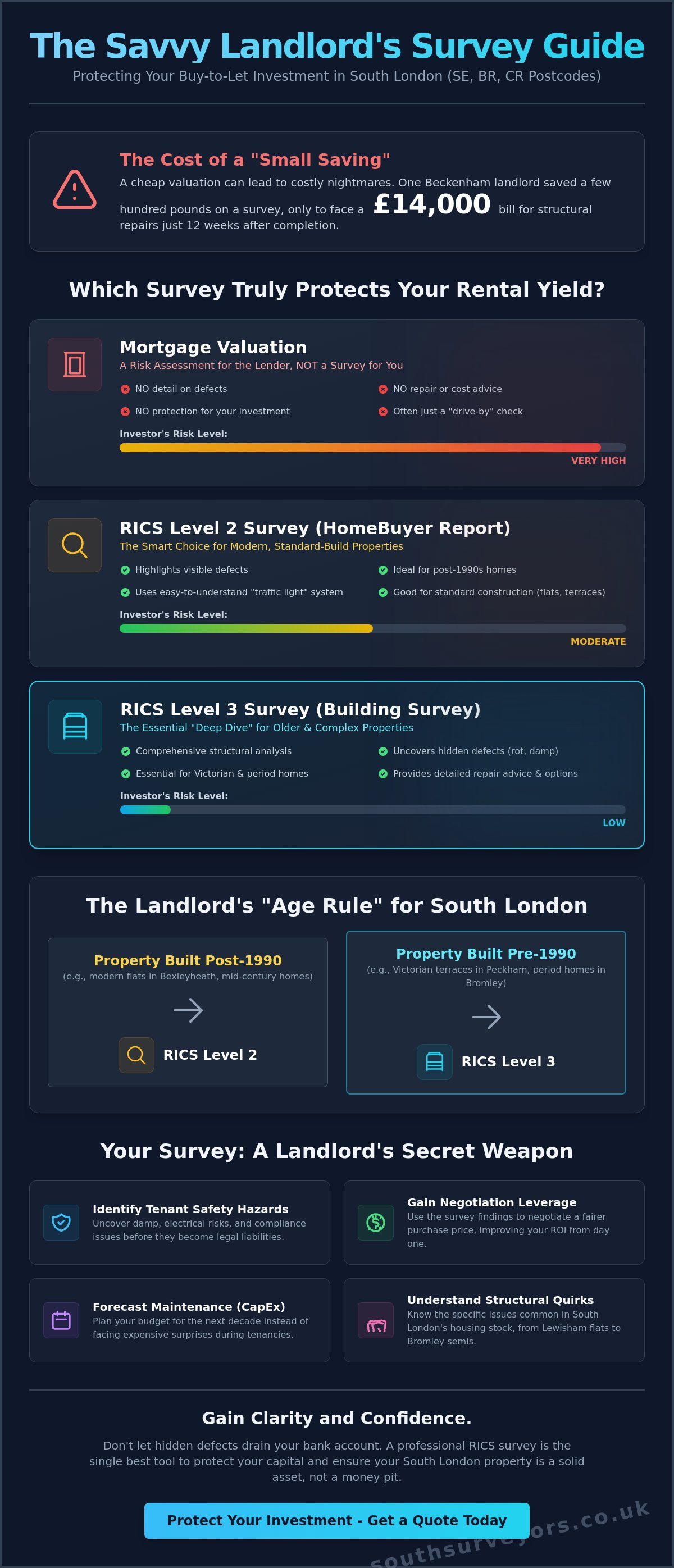
Last Tuesday, a landlord in Beckenham discovered that a small saving on a basic valuation led to a £14,000 bill for structural repairs just twelve weeks after the keys were handed over. It’s a story we hear too often across the SE and BR postcodes. You’ve likely spent months searching for the perfect investment, but the fear of hidden damp or legal compliance issues in a Victorian terrace can keep any savvy investor awake at night. You want a property that generates steady income, not one that drains your bank account before the first rent check arrives.
Finding the best survey for a buy-to-let property is the only way to gain the clarity and confidence needed to protect your yield. We’ll show you exactly which RICS-certified report will safeguard your investment and provide the leverage you need to negotiate a fairer purchase price. From checking the period brickwork in Croydon to ensuring tenant safety in Bromley, this guide outlines the essential steps to ensure your South London portfolio remains a solid asset rather than a money pit.
Key Takeaways
- Learn why a mortgage valuation is strictly for the lender’s peace of mind, while a professional survey is the only tool that truly protects your wallet and your yield.
- Discover how to choose the best survey for a buy-to-let property by applying the “Age Rule” to South London’s Victorian terraces and period conversions.
- Identify critical tenant safety hazards like damp and electrical risks early to avoid legal liabilities and ensure your SE or BR postcode rental is fully compliant.
- Master the art of maintenance forecasting so you can plan your CapEx for the next decade instead of facing “expensive surprises” during your first tenancy.
- Understand the unique structural quirks of South East London’s rental hotspots, from ex-local authority flats in Lewisham to 1930s semi-detached homes in Bromley.
Why a Mortgage Valuation is Never the Best Survey for a Buy-to-Let Property
Securing a buy-to-let property in South London is a massive financial milestone, but don’t let the excitement of a signed mortgage offer cloud your judgment. Many landlords fall into the trap of thinking the bank’s valuation is a thorough inspection. It isn’t. A valuation is a risk assessment for the lender’s benefit; a survey is a protection plan for your bank account. If you’re hunting for the best survey for a buy-to-let property, you need to understand that “cheap” upfront costs often translate to “expensive” surprises once your tenants move into that Victorian conversion in SE15.
To better understand the difference between these reports, watch this helpful video from a property expert:
The “Mortgage Valuation” Myth
Lenders only care about one thing: if you default on your loan, can they sell the property to recoup their cash? They don’t care if the flat in Bromley has a slow leak behind the shower or if the roof in Croydon is missing half its tiles. A mortgage valuation is frequently a “drive-by” or desktop exercise that might result in a single page of data with zero detail on defects. Chartered surveyors in the United Kingdom are trained to look much deeper than a basic valuation ever would. A RICS survey is a comprehensive health check for your investment assets, designed to reveal the hidden physical state of a building before you commit your capital.
Protecting Your ROI in the South London Jungle
The South London rental market is competitive, covering everything from sleek apartments in SE10 to period terraces in CR0. Unexpected repairs in these postcodes can be brutal for a landlord’s bottom line. Imagine a scenario where a £4,000 structural issue emerges three months after completion; that’s roughly two years of profit wiped out instantly. Our surveyors act as your secret weapon during the buying process. When we identify issues in a Dartford terrace or a Sutton maisonette, you gain the clarity and confidence to negotiate the price downwards. By identifying the best survey for a buy-to-let property early on, you turn potential liabilities into negotiation leverage. For a deeper dive into the different levels of reporting available, take a look at our guide to a home survey to find the right fit for your investment goals.
RICS Level 2 vs. Level 3: Which One is the Smart Choice for Landlords?
Choosing the best survey for a buy-to-let property isn’t just a box-ticking exercise for your mortgage lender. It’s a strategic move to protect your rental yield. In South East London and the surrounding postcodes like SE, BR, and CR, the housing stock is a wild mix of sleek new-builds and crumbly Victorian gems. Picking the wrong RICS level could mean missing a structural flaw that eats your profit for the next five years.
RICS Level 2 (HomeBuyer Report): The Mid-Range Option
If you’re eyeing a relatively modern flat in Bexleyheath (DA) or a mid-century terrace in Morden (SM), a level 2 survey is usually your go-to. This report focuses on visible defects and uses a simple “traffic light” system. Green means you’re good; amber needs attention; red means you should call a builder before you sign. It’s ideal for post-1990 builds where the risks are generally lower and the construction methods are standard.
RICS Level 3 Building Survey: The Deep Dive
For those investing in Victorian conversions in Peckham or sprawling period homes in Bromley (BR), a level 3 building survey is the only logical choice. This is a comprehensive analysis of the property’s structure and fabric. It’s designed to uncover hidden nasties like timber rot, rising damp, or subsidence that a surface-level check might miss. If the property was built before 1900, which is common in historic pockets of Greenwich or Dulwich, the RICS “Age Rule” strongly recommends this level of detail.
Landlords often worry about the price gap between these two options. While a Level 3 costs more, the difference is negligible when you consider the potential cost of a structural failure. Saving a few hundred pounds on a survey feels like a win until you’re hit with a bill for major roof repairs shortly after the tenants move in. Deciding on the best survey for a buy-to-let property depends entirely on the building’s history. A modern flat in Croydon (CR) or Sidcup (DA) might be fine with a Level 2, but anything older, heavily renovated, or unusually constructed demands the “Deep Dive” to give you real peace of mind.
If you’re still weighing up which report fits your potential investment, chatting with a local expert can help clarify the best path forward for your specific postcode.
The Landlord’s Checklist: What Your Survey Must Uncover
Think of a survey as more than just a hurdle to clear for your mortgage lender. For a savvy investor, the best survey for a buy-to-let property acts as a financial stress test. You’re looking for clarity on four critical fronts: tenant safety, future capital expenditure (CapEx), legal compliance, and those hidden “money pits” that thrive in South London’s unique housing stock. You don’t want to discover a £15,000 roof replacement is due just months after your first tenant moves into your new SE15 terrace.
In postcodes like SE22, BR3, and DA1, our RICS-certified team frequently flags these five common defects that can decimate your yield:
- Victorian Damp: Rising and penetrating damp in solid brick walls that lack modern damp-proof courses.
- Structural Movement: Subsidence caused by the infamous London Clay reacting to seasonal weather shifts.
- Roof Fatigue: Perished flashings and slipped slates on aged properties that lead to internal rot.
- Hazardous Electrics: Outdated fuse boards and “DIY” wiring that fail modern safety certifications.
- Thermal Inefficiency: Poorly insulated lofts and solid walls that make achieving a “C” EPC rating nearly impossible without major spend.
Damp, Mould, and the HHSRS
The Housing Health and Safety Rating System (HHSRS) isn’t just jargon; it’s the framework local councils use to decide if your rental is fit for human habitation. Since the 2023 updates to enforcement guidance, damp and mould are top of the hit list for inspectors. If you’re eyeing a charming but damp Victorian basement in Herne Hill, a surveyor’s moisture meter is your best friend. It provides the cold, hard data you need to fix issues before they become legal liabilities. South Surveyors identifies these risks early, ensuring you stay on the right side of the law and keep your tenants healthy.
Structural Integrity and Subsidence
The “London Clay” problem is a constant reality for landlords in BR and SE postcodes. This soil shrinks and swells with the British weather, which often leads to scary-looking cracks in masonry. A Level 3 survey is essential here because it differentiates between historic “settlement” and “active movement.” If the movement is active, you might need to walk away from the deal entirely. If it’s historic, you’ve got a powerful tool to negotiate a discount. We provide the confidence to know which is which. Choosing the best survey for a buy-to-let property ensures your yield isn’t swallowed by a surprise £20,000 underpinning bill.
Local Nuances: Surveying South London’s Rental Hotspots
South London’s rental market isn’t a single entity; it’s a patchwork of architectural eras and geological quirks. Choosing the best survey for a buy-to-let property means finding a professional who understands why a flat in Southwark faces different risks than a semi-detached house in Bromley. In high-density areas like Lewisham, ex-local authority blocks offer tempting yields, but they often come with complex service charge structures and “major works” liabilities that a standard valuation will miss completely.
Local knowledge of DA and SM postcode geology is just as vital. Many parts of Sutton and Sidcup sit on London Clay, which is notorious for seasonal movement. If you’re buying a property near a large oak tree in Carshalton, you need a surveyor who can distinguish between minor settlement and active subsidence. Navigating this “Property Jungle” requires more than a checklist. It needs a RICS-certified expert who knows which streets in Croydon were built on former marshland or which Victorian blocks in Peckham are prone to damp due to their original construction methods.
Period Properties in SE Postcodes
Victorian and Edwardian terraces in Dulwich or Greenwich are landlord favourites, but they’re rarely straightforward. Converted flats often suffer from poor soundproofing and outdated fire separation between floors. We always recommend checking the “whole building” even if you’re only buying the ground-floor unit. If the roof is failing three storeys up, you’ll likely be liable for a share of the repair costs. For a deeper dive into these specific architectural challenges, check out our building survey guide to see how we uncover hidden defects in SE postcodes.
The Suburban Shift: BR, DA, and CR
Investors are increasingly looking toward the BR, DA, and CR postcodes for better value. Areas like Sidcup, Croydon, and Bromley are dominated by 1930s to 1950s builds. While sturdy, these homes often hide aging electrics, lead piping, or uninsulated cavity walls that can kill your EPC rating. Since 2023, energy efficiency has become a make-or-break factor for rental profitability. Identifying these issues early allows you to negotiate the purchase price or plan your renovation budget with real confidence. These suburban hubs are current BTL hotspots, but only if you go in with your eyes wide open to the potential maintenance backlog.
Investing in the best survey for a buy-to-let property ensures you aren’t just buying a floorplan, but a viable financial asset. Our team provides the clarity you need to move forward without the stress of “hidden” surprises. We’ve spent years walking these streets, from the busy high streets of Brixton to the quiet cul-de-sacs of Orpington, ensuring our clients buy with total peace of mind.
Ready to protect your investment? Get a professional RICS survey quote today and secure your South London yield.
Clarity and Confidence: How South Surveyors Protect Your Investment
Investing in a South East London property is a significant financial commitment. Whether you’re targeting a Victorian conversion in SE22 or a modern apartment near the SM1 postcode, the success of your investment hinges on the quality of your due diligence. We provide the best survey for a buy-to-let property by going far beyond a simple checklist. Our RICS-certified surveyors provide meticulous reporting that identifies current defects and anticipates future maintenance issues that could erode your rental yield. We understand that as a landlord, you need to know if a property is a “money pit” or a “gold mine.” Our reports are designed to give you the leverage you need to negotiate prices or plan your renovation budget with precision. By choosing a team that knows the specific building stock of the SE, BR, DA, CR, and SM postcodes, you’re ensuring that no local quirk goes unnoticed.
Why We Aren’t Corporate Robots
We pride ourselves on having a bit of hipster flair mixed with serious professional substance. We aren’t interested in being another faceless corporate firm that treats you like a case number. You’ll likely deal with experts like Jazz Ettienne, who bring a personal, approachable touch to the surveying process. Our slogan, “Clarity and Confidence,” is a promise that you’ll understand the “so what?” behind every defect. After the inspection, we spend time on the phone with you to explain how a specific issue in a DA1 terrace or a CR0 flat might impact your investment. It’s about being a knowledgeable friend, not a corporate robot.
Your Next Move: Booking Your Survey
The path to a stress-free investment starts with a clear picture of your potential asset. We’ve made the process of getting a tailored quote for your specific property type incredibly simple. Whether you’re buying in Bromley (BR) or Sutton (SM), don’t let your BTL dream become a financial nightmare. You can get a RICS-certified survey quote from South Surveyors today to secure your yield. Our team is ready to help you find the best survey for a buy-to-let property to suit your needs and give you the peace of mind you deserve.
Protect Your Investment and Your Peace of Mind
Buying a rental property in South London is a massive commitment. You’ve seen why a basic mortgage valuation won’t cut it; it’s a tick-box for the lender, not a safety net for your wallet. Choosing the best survey for a buy-to-let property means looking deeper. Whether it’s a RICS Level 2 for a newer flat in Bromley (BR) or a Level 3 for a Victorian conversion in Croydon (CR), the right report stops your yield from being swallowed by hidden damp or structural surprises. Our RICS-regulated team understands the specific quirks of SE, DA, and SM postcodes, ensuring you make an informed decision based on local reality.
We don’t believe in sending a dry report and disappearing. You’ll get direct phone access to your surveyor to discuss the findings, providing the clarity and confidence you need to negotiate or walk away. Your future tenants deserve a safe home, and your bank balance deserves protection. Secure your investment with a RICS-certified survey from South Surveyors. It’s the smartest move you’ll make before the keys change hands. You’ve got this.
Frequently Asked Questions
Do I really need a survey for a buy-to-let flat if the building is managed?
You absolutely need a survey because management companies are only responsible for communal parts, not the specific risks inside your four walls. While the service charge covers the roof in an SE10 block, it won’t help if your internal joists are rotting or the wiring is a fire hazard. A professional survey provides the clarity and confidence you need to ensure your yield isn’t wiped out by internal repairs the freeholder won’t touch.
How much does a RICS Level 3 survey cost for a rental property in South London?
While we can’t give a fixed quote here, RICS data shows that a Level 3 survey in London typically starts around £600 and can exceed £1,500 for larger Victorian conversions in areas like Dulwich or Bromley. The final cost depends on the property’s purchase price and complexity. Investing in this level of detail is often the best survey for a buy-to-let property when dealing with older, high-value assets in the BR or SE postcodes.
Can I use a survey to negotiate the price of a BTL property?
You can certainly use the findings of a RICS-Certified report to negotiate a lower purchase price or ask the seller to fix issues before completion. If our surveyors find £5,000 worth of damp issues in a Croydon terrace, that’s a direct hit to your ROI. Presenting a professional report to the estate agent shows you’re a serious investor who makes informed decisions based on hard facts rather than guesswork.
How long does it take to get the survey report back?
You’ll typically receive your comprehensive digital report within 3 to 5 working days after the physical inspection is finished. We know that speed is vital when you’re trying to secure a deal in a fast-moving market like Streatham or Sutton. Our surveyors often call you immediately after the visit to give a verbal summary, providing peace of mind while the full document is being meticulously prepared.
Will the surveyor check for EPC compliance during the inspection?
A surveyor won’t issue a new certificate, but they will highlight defects that impact your Minimum Energy Efficiency Standards (MEES) compliance. Since April 2020, landlords need a minimum rating of E to legally rent out a property. We look for issues like poor insulation or outdated glazing in SM postcode flats that could prevent you from hitting these targets, helping you avoid potential fines of up to £5,000.
Is a Level 2 survey enough for a 1970s purpose-built flat in Croydon?
A RICS Level 2 survey is usually the right choice for a 1970s purpose-built flat in CR0, provided it’s built from conventional materials and hasn’t been heavily altered. It offers a thorough check of the property’s condition without the exhaustive structural analysis of a Level 3. It’s often considered the best survey for a buy-to-let property of this age because it balances cost-effectiveness with the professional substance required for a smart investment.
What happens if the survey finds subsidence in my potential investment?
If subsidence is flagged in a property in the DA or BR postcodes, your first step is to determine if the movement is historic or active. You might need a specialist structural engineer to investigate further. While it sounds scary, finding this early allows you to walk away or negotiate a significant price drop to cover the underpinning costs, ensuring your long-term yield remains protected from unforeseen disasters.