

What if that textured Artex ceiling in your new Peckham pad isn’t just a questionable design relic from the 70s, but a hidden variable in your renovation budget? For many buyers eyeing a Victorian terrace in SE22 or a 1930s semi in Bromley, the fear of finding asbestos in older properties building survey South London results can quickly suck the joy out of housewarming plans. We know the anxiety that comes with high-stakes transactions, from worrying about hidden health risks to dreading those unexpected removal bills that appear just as you’re ready to start decorating.
This guide is here to replace that panic with professional substance, showing you how to identify and manage asbestos in South London’s period homes without the usual corporate jargon. You’ll gain a clear understanding of the risks in SE, BR, and CR postcodes, learn exactly what a RICS Level 3 survey covers, and leave with a practical, safe plan for your future renovations. Let’s demystify the process so you can focus on the excitement of moving in rather than the stress of the unknown.
Key Takeaways
- Understand why asbestos was the “wonder material” for builders in SE21 and SE22 until 1999 and why its presence is a standard feature of the South London property landscape.
- Learn how to spot common hiding spots like Artex ceilings and bitumen floor adhesives in Victorian terraces and 1930s semis before you commit to a purchase.
- Discover how a RICS Level 3 asbestos in older properties building survey South London provides a comprehensive health check, identifying suspect materials to empower your decision-making.
- Get a practical plan for managing asbestos safely during renovations in postcodes like BR and CR, including why leaving materials in good condition is often the smartest move.
- Find out how to use professional survey findings as a powerful tool for price negotiations, ensuring you aren’t overpaying for a property with hidden management costs.
The ‘A-Word’ in South London: Why Our Period Homes Have a Hidden History
South London is a vibrant patchwork of architectural history. From the grand Victorian villas of Dulwich (SE21) to the leafy, artisan-filled streets of East Dulwich (SE22), our homes have fascinating stories to tell. Unfortunately, some of those stories include a guest that overstayed its welcome: asbestos. Between 1930 and 1999, builders across the capital viewed it as a “wonder material” because it was incredibly durable, cheap, and fire-resistant. It was the secret ingredient in everything from the roof over your head to the tiles under your feet.
What is asbestos? Essentially, it’s a group of naturally occurring minerals that were woven into thousands of building products. It only becomes a “monster” when it’s disturbed during your weekend DIY dreams, releasing microscopic fibres into the air. This is why commissioning a professional asbestos in older properties building survey South London is your first line of defense in the capital’s property jungle. It’s about empowerment, not fear; knowing what you’re buying allows you to manage the risk safely.
To better understand how this affects your home buying journey, watch this helpful guide:
The South London Property Timeline
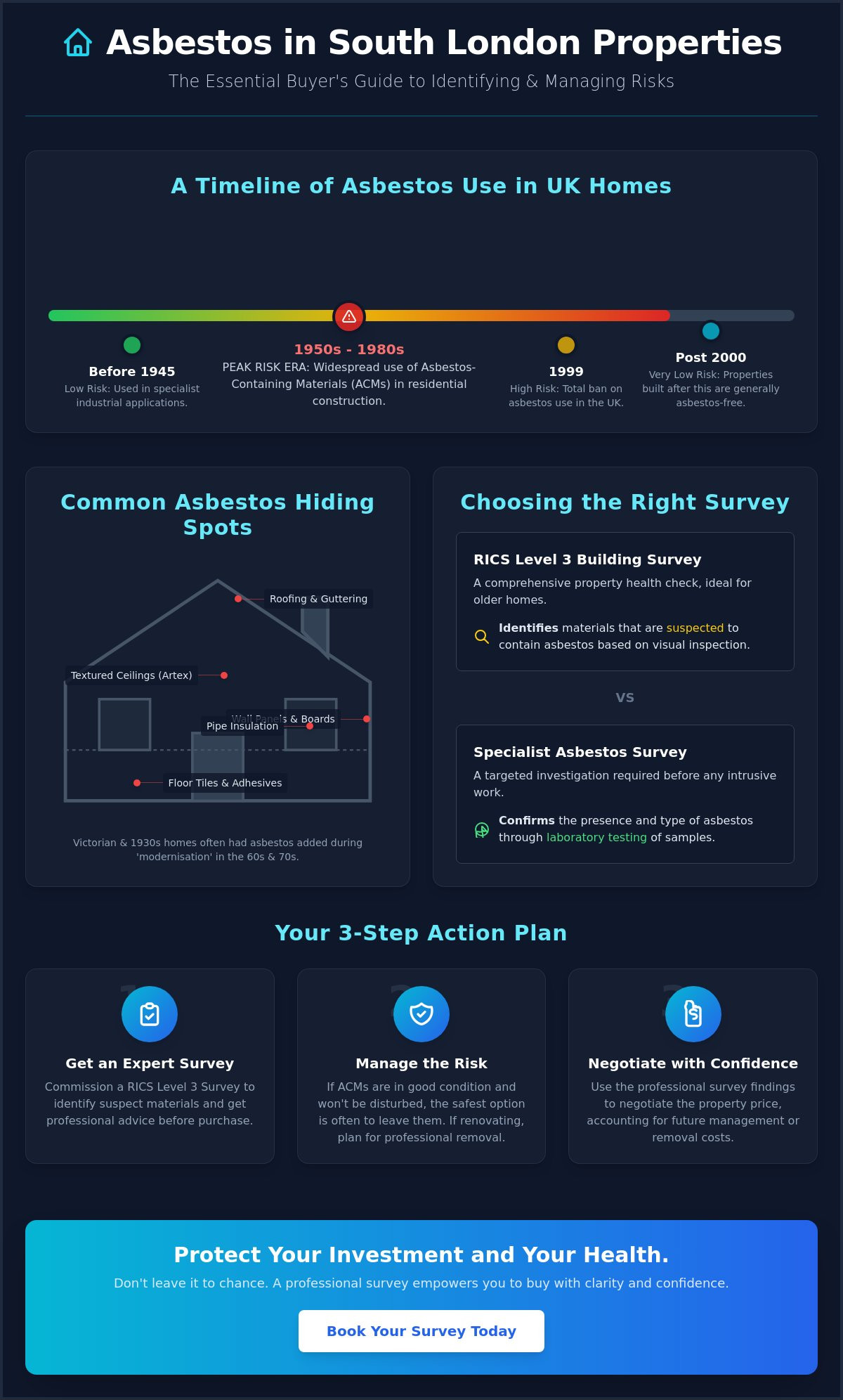
The risk level of a property often depends on when it was built or renovated. Before 1945, asbestos was primarily used in specialist fireproofing and large-scale industrial insulation. However, the 1950s through the 1980s marked the peak era for asbestos-containing materials (ACMs). If you’re looking at post-war builds or mid-century developments in Croydon or Bromley, these materials were used in almost every nook and cranny. It wasn’t until 1999 that the UK finally banned its use entirely. If your property was built after the turn of the millennium, you’re generally in the clear.
Why ‘Character’ Homes Often Hide Secrets
You might think a Victorian terrace in Peckham is too old for the “A-word.” However, many of these homes underwent “modernization” in the 1960s and 70s. This is when Artex ceilings and vinyl floor tiles were trendy additions, effectively introducing asbestos into homes built long before the material was common. Whether you are eyeing a 1930s semi in Bexleyheath or a converted flat in Sutton (SM1), the history of previous renovations is just as important as the original build date.
Local knowledge of postcodes like CR0 is vital because specific housing estates often used identical construction methods during post-war building booms. A meticulous surveyor knows exactly which “character” features are likely to be hiding 20th-century secrets. Understanding this hidden history doesn’t mean you should walk away from a beautiful period home; it simply means you need to be armed with the right facts to plan your renovation safely and negotiate with total confidence.
The Usual Suspects: Where Asbestos Hides in Victorian and 1930s Properties
Spotting asbestos isn’t about having X-ray vision; it’s about knowing where builders in the mid-1900s liked to cut corners or add “modern” flair. If you’re viewing a charming 1930s semi in Bromley or a Victorian conversion in Camberwell, the “usual suspects” are often hiding in plain sight. Identifying these materials during an asbestos in older properties building survey South London is a standard part of our process, helping you avoid nasty surprises after you’ve already handed over the keys.
Interior Hiding Spots You Might Miss
Artex ceilings are the most famous culprit. That decorative “popcorn” or “swirl” texture was incredibly popular for hiding uneven plaster. While it looks harmless, many versions contained white asbestos until the mid-1980s. Never sand these down yourself. Doing so releases fibres into your living space, which is a major breach of safety logic and UK asbestos regulations. It’s always better to skim over them or seek professional advice from an expert who knows the housing stock in SE21 and SE22.
Look down, too. Those small, brittle vinyl floor tiles often found in kitchens or hallways are frequently backed with a thick, black “bitumen” adhesive. This glue is a classic hiding spot for asbestos-containing materials. You might also find asbestos in older fuse boxes, behind fireplaces, or even as cold water tank insulation in the loft. These industrial touches were common in domestic settings across the SE and CR postcodes, providing fireproofing that we now know comes with a catch.
External and Structural Risks
The exterior of your property isn’t exempt. If you’re looking at a house with a detached garage in Sidcup (DA14) or a garden shed in Beckenham, check the roof. Corrugated asbestos cement sheets were the go-to material for outbuildings for decades. They’re usually fine if left alone, but they become brittle and dangerous if they start to crack or moss begins to eat away at the surface.
- Soffits and Fascias: The boards tucked under your roofline in areas like Croydon often used asbestos insulating board (AIB).
- Rainwater Goods: Old downpipes and gutters can sometimes be made of asbestos cement; they’re heavy, grey, and very durable.
- Flue Pipes: If the property has an older boiler system, the flue pipe venting through the roof or wall might be an asbestos composite.
When we conduct an asbestos in older properties building survey South London, we don’t just look at the walls; we look at the whole structural ecosystem. If you’re worried about what might be lurking in a potential purchase, a comprehensive building survey can provide the clarity you need to move forward without the stress.
RICS Level 3 Building Surveys vs. Specialist Asbestos Surveys: What’s the Difference?
When you’re knee-deep in property jargon, it’s easy to confuse a general “health check” with a specialist forensic investigation. Think of a RICS Level 3 survey as a full-body scan from a GP. It’s a deep-dive into the structural integrity of a property, covering everything from damp and subsidence to roof defects. While our surveyors are experts at spotting “suspect” materials, they aren’t lab technicians. A specialist asbestos survey, on the other hand, is like a biopsy. It involves taking physical samples, wearing protective gear, and sending materials off to a lab for confirmation.
Starting your journey with a building survey is almost always the smartest first move for buyers in South East London. It provides a holistic view of the property’s condition without the high upfront cost of specialist testing for every single room. During a level 3 building survey, we use our local experience to flag potential risks, allowing you to decide if further, more intrusive testing is actually necessary before you exchange contracts.
The Surveyor’s Role: Spotting the ‘Red Flags’
A RICS surveyor has a keen eye for the common locations for asbestos in homes, but their report is based on visual inspection. We can’t legally or safely start hacking into walls or ripping up floorboards to see what’s underneath. If we’re surveying a property in the SE or DA postcodes and we see 1970s ceiling panels or old boiler lagging, we’ll flag it as a “red flag.”
It’s also vital to understand the difference between a “Management Survey” and a “Refurbishment Survey.” A management survey ensures the building is safe for normal daily occupation. However, if you’re planning to knock down walls in a Croydon fixer-upper, you’ll eventually need a refurbishment survey. This is a much more aggressive inspection required by law before any building work begins.
When to Call in the Lab Techs
The transition from a visual check to physical sampling usually happens after the initial survey results are in. You don’t always need a specialist survey for every purchase; if the asbestos in older properties building survey South London finds that the materials are in good condition and won’t be disturbed, you might choose to simply monitor them. However, if the report identifies high-risk areas like damaged pipe lagging, that’s your cue to call in the experts with the white suits.
Having a Level 3 survey in hand gives you a significant advantage during the negotiation phase. If we identify suspect materials, you can use that professional evidence to ask the seller to pay for the specialist testing or to lower the asking price to cover future removal costs. It turns a vague fear into a quantifiable, manageable part of your property investment.
Buying or Renovating a ‘Post-War’ South London Home? Your Action Plan
If you’re eyeing a post-war gem in Sutton (SM1) or a spacious 1950s build in Croydon, you’re looking at prime real estate for asbestos-containing materials. But here’s the golden rule: don’t panic. Finding asbestos isn’t an automatic dealbreaker. If the material is in good condition and tucked away where it won’t be disturbed, it’s often safer to leave it exactly where it is rather than trying to rip it out. The risk only escalates when fibres are released into the air; a well-maintained Artex ceiling isn’t the ticking time bomb people often fear.
Your best tool in the negotiation phase is a comprehensive home survey. When your surveyor identifies suspect materials during an asbestos in older properties building survey South London, you’ve got concrete evidence to take back to the seller. You can use these findings to discuss a price reduction or ask the seller to cover the cost of professional removal before you move in. It’s about making an empowered decision based on facts, not anxiety.
Step-by-Step: From Survey to Sale
Start by carefully reviewing the ‘suspect materials’ section of your RICS report. If we’ve flagged something concerning, your next step is getting quotes for removal or encapsulation. Encapsulation is often a cost-effective alternative where the material is sealed with a specialist coating rather than removed. Finally, keep your solicitor in the loop. They can advise on asbestos indemnity policies or specific clauses in your contract to protect your investment from future liabilities.
Renovating Safely in SE and BR Postcodes
Planning a kitchen knock-through in Bromley or a loft conversion in SE19? Stop. DIY and asbestos are a dangerous pairing. Before you swing a sledgehammer, you need to know exactly what’s behind that plasterboard. According to industry data from May 2026, the average cost for a typical domestic asbestos removal project is around £1,750. If you’re dealing with an Artex ceiling of about 20m², removal costs can range from £2,750 to £6,000. These figures are significant, so budgeting early is essential for your renovation safety.
- Find Licensed Pros: Always use HSE-licensed contractors who specialize in the South London area. They’ll provide the necessary waste consignment notes to prove the material was disposed of legally.
- Keep a Register: Once you move in, start an asbestos register. This is just a simple folder containing your survey and any removal certificates.
- Inform Tradespeople: This register is a goldmine of information for future plumbers or electricians, ensuring they don’t accidentally drill into something hazardous.
Ready to get the facts on your potential new home? Book your RICS Building Survey with us today and move forward with total peace of mind.
South Surveyors: Navigating the Asbestos Maze with Professional Substance
Buying a home in South London is a significant milestone, but it shouldn’t feel like a gamble. When you’re standing in a sun-drenched kitchen in Herne Hill or eyeing a spacious flat in Croydon, you need more than just a “tick-box” report. You need the clarity that comes from a knowledgeable friend who also happens to be a RICS-regulated expert. Our approach is built on transparency and professional substance, ensuring that your asbestos in older properties building survey South London provides the emotional security you need to sign those contracts with total confidence.
We don’t believe in corporate jargon or automated call centers. Every report we produce is written in plain English, translating complex structural data into actionable advice. If we find suspect materials, we won’t just list them; we’ll explain exactly what they mean for your renovation plans and your budget. This meticulous attention to detail is why homeowners across the SE, BR, and CR postcodes trust us to demystify the property buying process.
Why Trust a South London Specialist?
Our commitment to the highest industry standards is at the core of everything we do. Because we’re regulated by the Royal Institution of Chartered Surveyors (RICS), you’re guaranteed a level of accountability that “cheap” alternatives simply can’t match. We know the specific housing stock of South East London like the back of our hand. We’ve stood in the lofts of Bromley semis and the basements of Dulwich villas, identifying the subtle red flags that corporate robots often overlook.
One of the biggest benefits of working with us is direct access. After you receive your report, you can pick up the phone and speak directly to your surveyor. We’ve saved countless buyers from expensive surprises by providing one-on-one consultations that clarify risks before they become problems. Whether it’s discussing the condition of a garage roof in Sidcup or the safety of Artex in a Peckham terrace, we’re here to provide the personal touch that makes a high-stakes transaction feel manageable.
Ready to Secure Your South London Gem?
A bespoke, thorough assessment is an investment in your future peace of mind. Don’t settle for a generic overview when you could have a deep-dive “health check” tailored to the unique history of your potential home. By identifying risks early, you empower yourself to negotiate effectively and plan your move without the dread of hidden hazards. It’s about taking control of the process so you can focus on the exciting parts of homeownership.
If you’re ready to move forward with a partner who values thoroughness and honesty, booking your RICS Level 3 Building Survey is the logical next step. Let us handle the technical complexities while you plan your housewarming party. Get a transparent, no-nonsense quote from South Surveyors today and discover why we’re the trusted choice for buyers across the DA, SM, and SE postcodes.
Secure Your South London Gem with Total Confidence
Navigating the property market in SE or BR postcodes doesn’t have to be a high-stakes guessing game. By now, you know that the “A-word” isn’t a signal to run away, but an invitation to be meticulous. Understanding that most materials are safe if left undisturbed, and knowing exactly how to use a surveyor’s findings to negotiate, transforms a potential headache into a manageable part of your home-buying journey.
Choosing an asbestos in older properties building survey South London is about more than just finding risks; it’s about gaining a partner who understands the specific architectural quirks of housing in DA, CR, and SM areas. Our RICS Regulated experts provide jargon-free, comprehensive Level 3 reports that prioritize your safety and your wallet. We swap corporate fluff for genuine local insight, giving you the tools to make an empowered decision about your future home.
Ready to take the next step? Book your RICS Level 3 Survey with the South London experts at South Surveyors and get the professional substance you deserve. Your dream period home is within reach, and we’re here to help you cross the threshold with complete peace of mind.
Frequently Asked Questions
Is asbestos common in South London properties built before 1999?
Yes, it is extremely common in homes built or renovated between the 1930s and the late 1990s. Since the UK didn’t fully ban all forms of asbestos until 1999, many Victorian terraces in Dulwich or 1930s semis in Bromley still contain it. It was a standard material for floor tiles, textured ceilings, and insulation across the SE and BR postcodes for decades.
Will a RICS Level 3 Building Survey tell me if there is asbestos?
A RICS Level 3 survey identifies materials that are suspected of containing asbestos through a professional visual inspection. While your surveyor won’t take physical samples for lab testing, they’ll flag high-risk areas like old pipe lagging or textured coatings. This asbestos in older properties building survey South London is the essential first step in deciding if you need more intrusive testing.
Should I pull out of a house sale if asbestos is found?
Not necessarily, as finding asbestos is rarely a reason to abandon a purchase if the material is in good condition. Most asbestos-containing materials are perfectly safe if left undisturbed. Instead of panicking, use the survey findings to negotiate the purchase price or ask the seller to arrange for safe removal. It’s just another variable to manage in the London property market.
How much does it cost to remove asbestos in a South London home?
Costs depend on the scope of the work, but a typical domestic removal project in South London averages around £1,750 as of May 2026. For specific structures, removing an asbestos garage roof can cost between £950 and £3,750. If you’re tackling a 20m² Artex ceiling, expect to pay anywhere from £2,750 to £6,000 for professional removal and safe disposal.
Can I test for asbestos myself with a DIY kit?
You can buy DIY kits, but we don’t recommend using them for complex property transactions. Sampling asbestos safely requires specific training and protective gear to avoid releasing dangerous fibres. For your own safety and for the legal peace of mind required during a house sale in Croydon or Sutton, it’s always better to hire a qualified professional who follows the latest HSE guidelines.
What happens if I disturb asbestos during a renovation?
Disturbing asbestos releases microscopic fibres that can cause serious long-term health issues if inhaled. If you accidentally hit a suspect material while renovating in Dartford or Peckham, stop work immediately and clear the area. There is no “safe” level of exposure above the legal control limit of 0.1 fibres per cubic centimetre of air, so professional decontamination is essential.
Is Artex always dangerous in older homes?
No, Artex is only dangerous when it’s damaged, sanded, or drilled into by an over-eager DIYer. If the textured coating on your ceiling is in good condition and left alone, the fibres are safely bound within the material. Many homeowners in SE22 choose to plaster over it, which is a safe and cost-effective way to modernize a room without the expense of full removal.
Do I need a specialist asbestos survey if I’m not planning renovations?
Probably not, as a standard asbestos in older properties building survey South London is usually sufficient for normal occupation. If the RICS report shows that the materials are in good condition, you can simply monitor them over time. You only strictly need a more intrusive “refurbishment and demolition survey” if you plan to knock down walls or do major structural work in your new home.