

Meta Title: Why Use a RICS Regulated Surveyor? | South London Property Guide
Meta Description: Navigating the property jungle in Croydon, Bromley, or Dulwich? Discover why the RICS badge is your ultimate safety net against hidden defects and financial risks.
What if that charming bay-fronted semi in Croydon is actually a beautifully staged financial trap? You’ve spent months scrolling through portals and dodging pushy agents to find “the one” in Bromley or Dulwich. It’s exhilarating, but let’s be honest, it’s also slightly terrifying. You’re likely worried about hidden subsidence or a roof that’s seen better days, and the last thing you want is a money pit that drains your savings before you’ve even unpacked. If you’ve ever wondered why use a RICS regulated surveyor, the answer lies in the robust legal and financial protection it offers your future home.
We completely get it. Buying a home in the SE, BR, or CR postcodes is a high-stakes game where the risks are real and the jargon is thick. This article will show you how the RICS badge acts as your legal safety net, standing between your perfect property and a potential nightmare. We’ll explore how strict professional standards and mandatory indemnity insurance protect your purchase, while providing the clear, jargon-free advice you need to make an empowered decision. From the latest 2026 AI transparency rules to the deep-dive details of a Level 3 Building Survey, you’ll discover how to navigate this property jungle with total confidence.
Key Takeaways
- Learn how the “Red Book” standards transform a simple inspection into a gold-standard document that protects your investment in areas like Dulwich or Bromley.
- Discover exactly why use a RICS regulated surveyor to secure a mandatory financial safety net, ensuring you aren’t left footing the bill for missed structural defects.
- Identify the red flags of unregulated surveyors who lack the strict ethical oversight and professional insurance necessary for high-stakes London property deals.
- Master the quick verification steps to confirm your surveyor is the real deal using the official RICS “Find a Member” portal before you sign any contracts.
- Gain the confidence to navigate the South London property market and push back against aggressive sales tactics with clear, jargon-free insights.
More Than Just Letters: What Does “RICS Regulated” Actually Mean?
The South London property market is fast, loud, and occasionally a bit chaotic. Whether you’re eyeing a Victorian terrace in Greenwich or a modern apartment in Croydon, you’ll see those four letters everywhere: RICS. The Royal Institution of Chartered Surveyors (RICS) is the global body that sets the bar for everything in the built environment. When you’re trying to figure out why use a RICS regulated surveyor, think of it as hiring a professional referee for the biggest financial game of your life. Regulation means a firm doesn’t just promise to be good; they’re legally and ethically bound to follow the “Red Book,” which is the gold standard for professional property conduct.
To get a better sense of the expertise and equipment a regulated professional brings to your doorstep, watch this helpful video:
Regulation ensures your surveyor is qualified, experienced, and, most importantly, held accountable by an external body. In our local postcodes like SE and BR, this status is what separates the true experts from the “cowboys” who might miss a major structural flaw while distracted by a fresh coat of paint. It’s about having an expert who is obligated to put your interests first, providing a level of transparency that’s often missing in the heat of a property deal.
The Gold Standard of Property Professionalism
Becoming a RICS member isn’t a quick weekend course. It involves years of rigorous training and tough assessments. “Chartered” is a protected title; anyone can call themselves a “property consultant,” but only those who’ve proven their mettle can use the RICS badge. These experts must also complete Continuous Professional Development (CPD). This means they stay sharp on the latest building regulations and construction trends. It’s vital knowledge when you’re dealing with the unique architectural quirks and soil types found across South East London.
Why Your Mortgage Lender Insists on RICS
Banks are notoriously risk-averse. They aren’t going to lend you hundreds of thousands of pounds based on a casual look at a house in Bexley or Sidcup. Lenders demand the valuation accuracy that only a RICS report provides before they’ll release funds. This requirement actually protects you, too. It helps prevent “down-valuation” shocks, where a lender decides a property is worth less than your agreed price. Understanding why use a RICS regulated surveyor helps you see that this isn’t just a hurdle; it’s a safeguard ensuring you don’t overpay for a home that isn’t a sound investment.
The Invisible Safety Net: Professional Indemnity and Protection
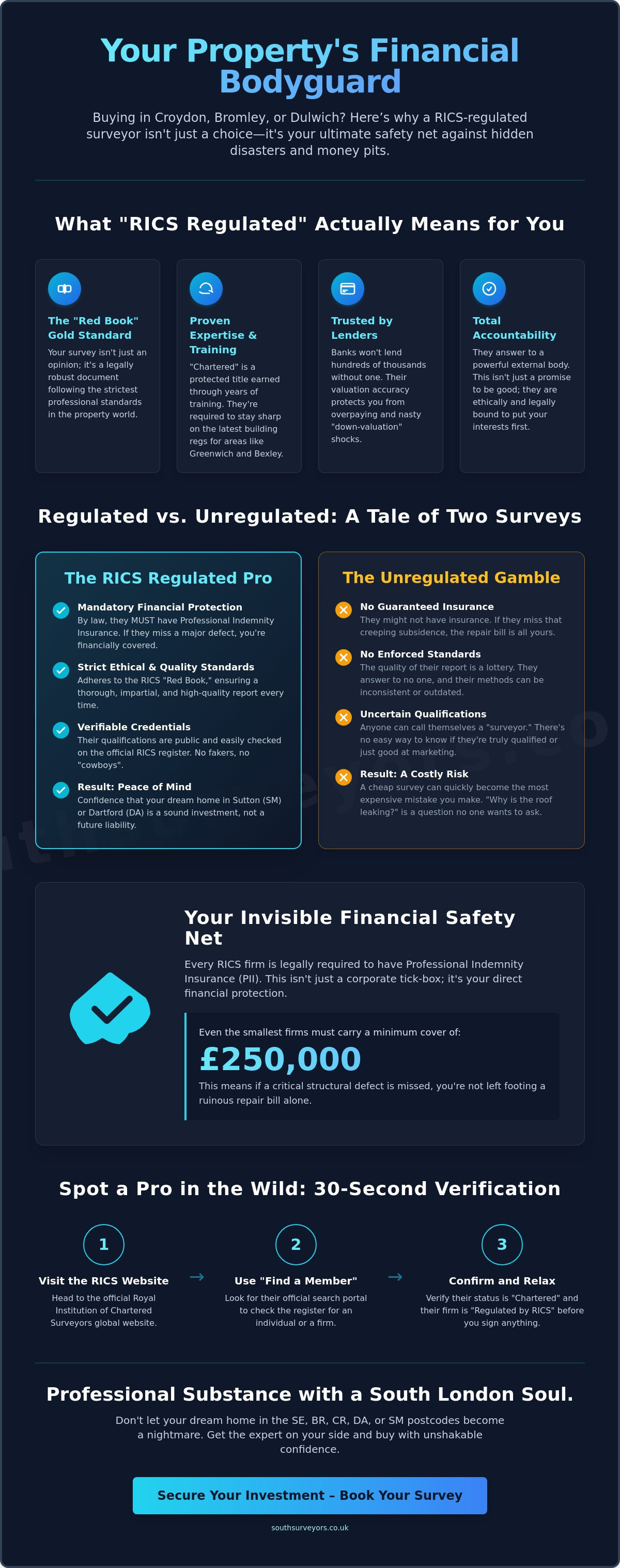
When you’re dropping a significant sum on a house in Bromley or Sutton, you aren’t just buying bricks; you’re buying a future. But what if that future has a structural crack that your surveyor missed? This is exactly why use a RICS regulated surveyor. By law, every RICS-regulated firm must carry Professional Indemnity Insurance (PII). It isn’t just a corporate formality. It is your financial fallback. If a major defect is overlooked, the insurance company steps in to cover the financial loss. It turns your survey from a one-off cost into a long-term protection policy for your deposit.
The numbers behind this safety net are substantial and strictly enforced. As of July 1, 2025, RICS updated its PII requirements to ensure firms remain resilient. For instance, even the smallest firms with a turnover under £100,000 must maintain at least £250,000 in indemnity cover. For larger practices with a turnover exceeding £200,001, this minimum rises to £1,000,000. This means that if you discover a massive issue post-completion, there is a verified pot of money available to make things right. If you hire an unregulated surveyor, you’re essentially on your own. If they make a mistake, you might have zero recourse if they simply close up shop or ignore your emails.
Professional Indemnity Insurance: Your Financial Shield
PII is the buyer’s guarantee against professional negligence, acting as a buffer between your bank account and unexpected disasters. South London period homes, like the stunning Victorians in Dulwich or the sprawling Edwardian properties in Chislehurst, often hide expensive secrets. We’re talking about things like historic subsidence or hidden dry rot that can cost tens of thousands to fix. If a surveyor fails to spot these during a thorough inspection, PII covers the repair costs. It is worth checking our range of professional services to see how we build this protection into every report we produce.
The RICS Complaints Handling Procedure (CHP)
Accountability is what keeps the industry honest. Every RICS-regulated firm must have a clear, two-stage complaints handling procedure. If something goes wrong, you don’t have to shout into the void. You follow a documented process designed to find a resolution. If the firm can’t fix the issue to your satisfaction, you have access to an independent Alternative Dispute Resolution (ADR) service. This is a free, RICS-approved pathway to justice. Contrast this with an unregulated firm where your only option might be an expensive, stressful day in court. In the property jungle of the SE, BR, and CR postcodes, having a clear path to redress isn’t just a luxury; it’s essential for your peace of mind.
Regulated vs. Unregulated Surveyors: Why “Cheap” Can Get Expensive
It is incredibly tempting to cut corners when your moving budget is being squeezed by stamp duty and removal vans. You might find a “property consultant” online offering a bargain-bin price for a survey in Herne Hill or Bromley. However, this is exactly why use a RICS regulated surveyor; the price difference between a pro and an amateur is nothing compared to the cost of a missed structural disaster. Unregulated surveyors don’t have to follow the RICS ethical code or maintain the heavy-duty insurance we discussed earlier. They aren’t accountable to anyone but themselves. When you’re making the biggest purchase of your life, “cheap” is a very dangerous word.
The Risks of Using an Unaccredited “Expert”
If an unaccredited surveyor misses a crumbling chimney stack or a serious damp issue, you have very little recourse. There’s no official watchdog to step in, and an unregulated individual can easily disappear if things get legally messy. Most high-street lenders and solicitors will flat-out reject a report if it doesn’t carry the RICS seal of approval. You could end up paying for a second survey just to satisfy your mortgage provider, proving that the “cheap” option is often the most expensive path you can take. It’s a classic case of buying cheap and paying twice in the unforgiving London property jungle. Saving a few hundred pounds on a fee today is a poor trade-off for a £20,000 roof repair that wasn’t flagged before you exchanged contracts.
Rigorous Training: Keeping Up with South London’s Postcodes
Local expertise isn’t just about knowing where the best brunch spots are in SE24. RICS surveyors undergo continuous training to understand specific local risks, like the shrinkable clay soils that frequently cause subsidence in the BR and CR postcodes. They are trained to spot “creative” DIY solutions often found in Victorian terraces, where a previous owner might have removed a load-bearing wall without the proper structural support. Regulation also mandates that surveyors stay current with the latest legislation. For instance, as of July 1, 2024, mandatory fire safety coverage is required for buildings of five storeys or more. An unregulated surveyor might not even be aware of these shifting legal requirements, leaving you legally exposed. A RICS pro ensures your RICS (level 2) Condition Report or Level 3 survey meets the highest modern standards, protecting both your safety and your bank balance.
Spotting a Pro in the Wild: How to Verify Your Surveyor
Don’t just take a fancy website or a charismatic voice at face value. In the high-stakes world of London property, verifying credentials is your best defense against a bad investment. If you’ve been wondering why use a RICS regulated surveyor, it’s because their status is independently verifiable. You don’t have to guess if they’re following the rules; you can see it for yourself. Look for the “Regulated by RICS” logo on their letterheads and digital platforms. This isn’t just a design choice. It’s a statement of accountability that protects your deposit and your future home.
Using the “Find a Member” Tool
The RICS “Find a Member” portal is your go-to resource for peace of mind. It’s simple to use and incredibly effective. Just pop in the firm’s name or your target postcode, like DA for Dartford or SM for Sutton. The tool will confirm if the firm is currently regulated and if the individual surveyors hold the right qualifications. You’ll see designations like AssocRICS (Associate), MRICS (Member), or FRICS (Fellow). While all three indicate professional competence, MRICS and FRICS denote higher levels of experience and assessment. We also recommend checking for any disciplinary history on the RICS website. A clean record is a clear indicator that the surveyor takes their ethical obligations seriously and prioritizes client safety.
Questions to Grill Your Surveyor Before Booking
Before you commit, treat the first phone call like an interview. You’re the client, and you deserve total transparency. Ask directly if the individual surveyor visiting the property is personally a member of RICS. Sometimes firms are regulated, but the legwork is done by unaccredited trainees. You should also confirm they have Professional Indemnity Insurance in place for your specific survey. Local knowledge is another huge factor. A surveyor who understands the shifting soils of Bromley or the unique drainage issues in Dartford will provide much better value. Ask how many level 3 building surveys they’ve completed in your specific neighborhood this month. Finally, ask for a sample report. If the language is buried in technical jargon rather than clear, actionable advice, keep looking. If you’re ready to move forward with a team that values clarity and professional substance, view our transparent survey options to get started today.
South Surveyors: Professional Substance with a South London Soul
We believe that property advice should feel like a chat with a knowledgeable friend, not a lecture from a corporate robot. At South Surveyors, we don’t just tick boxes or fill out forms to satisfy a checklist. We provide the genuine clarity you need to make a life-changing decision with total peace of mind. This personal approach is exactly why use a RICS regulated surveyor like us; you get the highest professional standards delivered with a local perspective that makes sense. We are proudly regulated by the Royal Institution of Chartered Surveyors, ensuring every home survey we produce is a gold-standard document you can trust.
Our team lives and breathes the unique geography of South London. We’ve spent years exploring every corner of our patch, from the leafy hills of Crystal Palace to the suburban flats of Sutton. We bridge the gap between technical expertise and real-world accessibility. When you work with us, you aren’t just getting a report. You’re getting a partner who has your back in a competitive and often stressful market. We understand the emotional weight of buying a home in the SE, BR, or CR postcodes, and we’re here to make sure your investment is sound.
Hyperlocal Expertise from Croydon to Greenwich
Our deep understanding of local property archetypes is what sets us apart. Whether it’s a Victorian terrace in Greenwich or a 1930s semi in the DA postcode, we know what to look for. Our local roots help us spot area-specific issues that outsiders might miss, such as “London Stock” brick fatigue or common drainage patterns in the SM area. We’re committed to being accessible to our clients. You won’t be passed around a call center. You can actually talk to the surveyor who inspected your property to discuss any concerns in detail. This direct communication ensures you feel empowered and informed throughout the process.
Clear Reports for Confident Decisions
We’ve designed our Level 2 surveys to be “plain English” guides rather than confusing technical manuals. We want you to understand exactly what’s happening with your potential home without needing a degree in building pathology. By providing factual, regulated data, we empower you to negotiate prices or request repairs with confidence. You’ll have the evidence you need to push back against pushy sales tactics and make a decision based on reality. Ready to take the next step in your property journey? Get a RICS-regulated quote for your South London move today and let’s get you moving with confidence.
Secure Your South London Investment with Confidence
Regulation isn’t just a corporate badge; it’s a promise of accountability and high-level insurance that protects your bank balance from hidden structural secrets. By choosing a professional who understands the specific clay soils of Bromley and the Victorian architecture of Greenwich, you turn a stressful transaction into a secure investment. You’ve learned how to verify credentials and exactly why use a RICS regulated surveyor to avoid the “buy cheap, pay twice” trap that many London buyers fall into.
Ready to get a gold-standard report for your move? Book your RICS regulated survey with the South London experts at South Surveyors. We are a proud RICS Regulated Firm providing bespoke Level 2 and Level 3 Building Surveys across the SE, BR, DA, CR, and SM postcodes. Your dream home in South London is waiting, and with the right expert by your side, you can sign that contract with total peace of mind. Happy house hunting!
Frequently Asked Questions
Is it illegal to call yourself a surveyor if you aren’t RICS regulated?
It isn’t actually illegal for someone to call themselves a generic “surveyor” because the term isn’t legally protected in the UK. However, the title “Chartered Surveyor” and the professional designations MRICS or FRICS are strictly protected by law. If you hire someone without these credentials, you are missing out on the rigorous oversight and ethical standards that define the profession. This is a major reason why use a RICS regulated surveyor for your own protection.
Can I use an unregulated surveyor for a Help to Buy valuation?
You cannot use an unregulated surveyor for a Help to Buy valuation. The administrators of the scheme have very strict criteria that mandate the use of a RICS member for any valuation report. The document must be independent and meet specific RICS Red Book standards to be accepted. Choosing an unaccredited individual will simply result in your application being rejected, wasting both your time and money during a busy move.
What happens if a RICS surveyor misses a major problem like subsidence?
If a major structural issue like subsidence is missed, you have a clear and documented path to financial recourse. You first trigger the firm’s mandatory Complaints Handling Procedure to seek a resolution. If the issue isn’t resolved, you can escalate to an independent redress scheme or make a claim against the firm’s Professional Indemnity Insurance. This safety net ensures you aren’t left paying for expensive repairs in areas like Bromley or Croydon alone.
How much more does a RICS regulated surveyor cost compared to a non-regulated one?
While an unregulated “property consultant” might offer a lower upfront fee, the price of a RICS surveyor reflects their mandatory insurance and continuous professional training. In the South London market, the price difference is usually minimal compared to the massive financial protection you receive. Investing in a regulated professional is a smart move for your deposit, ensuring you don’t get stuck with a “money pit” in the SE or DA postcodes.
Do all mortgage lenders require a RICS regulated survey?
Yes, virtually every high-street mortgage lender requires a valuation from a RICS regulated professional before they will release any funds. Banks need to know that their security is worth the loan amount, and they only trust the standardized accuracy of the RICS Red Book. Without this regulated report, your mortgage application won’t get past the first hurdle, regardless of how much you love that Victorian terrace in Greenwich.
What is the difference between a RICS surveyor and a structural engineer?
A RICS surveyor assesses the overall condition and visible defects of a property, while a structural engineer focuses specifically on the physics of the building’s integrity. If your surveyor spots a suspicious crack in a Sutton semi, they might recommend an engineer to calculate the exact structural fix. Think of the surveyor as your property GP who checks everything, and the engineer as the specialist consultant for complex structural issues.
How can I check if a firm is actually regulated by RICS?
You can easily verify a firm’s status by using the official “Find a Surveyor” tool on the RICS website. Simply enter the firm name or the postcode of your target property in the BR or CR area to see their registration. A genuine firm will also proudly display the “Regulated by RICS” logo on their website and letterheads. If you can’t find them on the official register, it is a major red flag.
Will a RICS survey help me negotiate the house price in South London?
A RICS survey provides a factual, evidence-based document that you can use as a powerful negotiation tool. If your report highlights significant damp proofing or roof repairs needed in a Herne Hill home, you have the professional data to justify a lower offer. Most sellers in the competitive South London market will listen to a regulated professional’s findings, helping you secure a price that reflects the property’s true condition.