

What if the few hundred pounds you’re trying to save on a survey ends up costing you fifty grand in Victorian damp repairs three months after you move into that charming SE22 terrace? It is the question every savvy buyer eventually asks: is a homebuyer report detailed enough to catch the ghosts of renovations past, or are you just paying for a professional “vibes” check? We know the feeling of standing in a beautiful Dartford semi or a Sutton flat, feeling the intense pressure from estate agents to sign on the dotted line before someone else swoops in.
You want to move fast, but you also want to sleep at night without dreaming of crumbling foundations and hidden dry rot. We completely understand that tension. This article is here to give you total certainty by explaining exactly where a RICS Level 2 survey shines and where it might leave you vulnerable to a “money pit” disaster. We will take a deep dive into what our surveyors actually investigate on-site, from the lofts of Bromley to the basements of Croydon, ensuring you have the peace of mind you deserve before you commit your hard-earned cash to a South London postcode.
Key Takeaways
- Learn why the RICS Level 2 Condition Report is the go-to for modern homes but might not be the right fit for every South London property.
- Master the “Traffic Light” system to prioritize repairs and understand the urgency of defects before you commit to your purchase.
- Find out if a homebuyer report detailed enough for areas like Bromley and Croydon, where unique clay soil conditions make subsidence a common local concern.
- Recognize the specific “red flags,” such as significant extensions or structural alterations, that signal it’s time to upgrade to a Level 3 Building Survey.
- Gain the tools to choose your survey level with confidence, ensuring you get the professional depth needed to avoid a “money pit” disaster.
The RICS Level 2 Survey: What “Detailed Enough” Actually Means
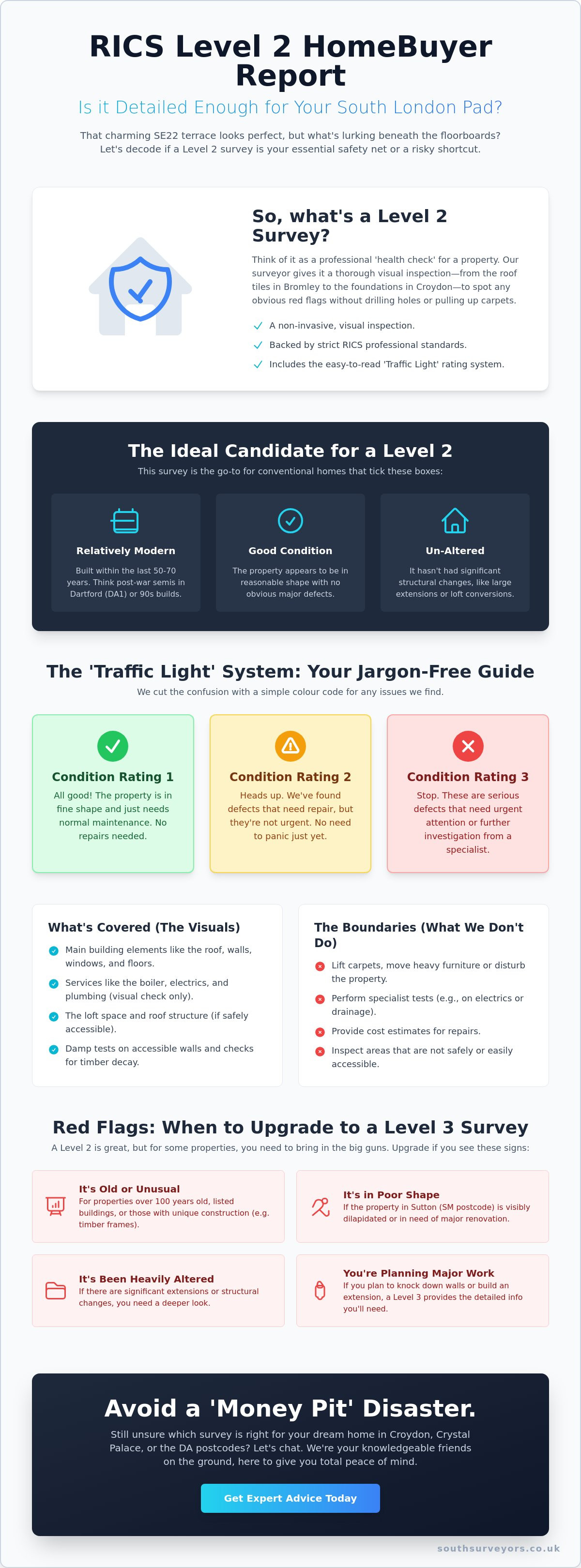
The RICS Level 2 survey is a visual, non-invasive health check designed to assess the general condition of a property without disturbing the fabric of the building. For many buyers eyeing up a relatively modern semi in Bromley or a purpose-built flat in Sutton, this report is the bread and butter of the industry. It’s perfectly suited for conventional properties built within the last 50 to 70 years that appear to be in reasonable condition. If you’re wondering is a homebuyer report detailed enough for that 1980s build in the SM postcode, the answer is often a reassuring “yes.” However, the “standard home” is a bit of a myth in London; what looks modern might have hidden history that requires a professional eye.
To ensure everything stays above board, these surveys follow the strict professional standards set out by the Royal Institution of Chartered Surveyors (RICS). This means you aren’t just getting a surveyor’s opinion; you’re getting a report backed by a globally recognized body. It’s about giving you the confidence to sign that contract without a knot in your stomach. We aim to be your knowledgeable friend on the ground, translating technical findings into actionable advice that helps you make an empowered decision.
To better understand this concept, watch this helpful video:
The Visual Inspection Boundary
The Level 2 survey has clear boundaries. Think of it like a doctor’s check-up where they don’t perform surgery. We look at everything visible, from the roof tiles to the floorboards, but we won’t be ripping up your potential new living room carpet or moving a heavy mahogany wardrobe in a Croydon bedroom. It covers the main structural elements, including walls, roof, floors, and windows. We also check the services like gas, water, and electrics. However, we won’t be running full pressure tests on the pipes. It’s a visual assessment to spot obvious red flags. This level of detail is usually plenty for a well-maintained terrace in SE22 or a newer build in DA1. If you’re asking is a homebuyer report detailed enough for a house that hasn’t been touched since the 1970s, this visual boundary is exactly where you need to be careful.
The “Traffic Light” Condition Ratings
One of the best things about this report is the “Traffic Light” system. It cuts through the jargon and tells you exactly what needs your attention without the fluff. This structured approach helps you prioritize your budget before you even get the keys.
- Green (1): No repair currently needed. The area is performing as it should and just needs normal maintenance.
- Amber (2): Defects that need repairing but aren’t urgent. You’ll want to fix these eventually, but they aren’t deal-breakers today.
- Red (3): Serious defects that need immediate attention or further investigation. This might include structural movement or severe damp that could impact the property’s value.
This system is designed to provide you with emotional security. If you see a Red rating on a property in CR0, you know you need to pause. It might be time to negotiate the price or get a specialist in. It turns a complex document into a clear roadmap for your South London purchase, giving you the peace of mind to move forward or the evidence you need to walk away.
The Anatomy of a HomeBuyer Report: Seeing Beyond the Surface
Peeking into the attic of an Edwardian house in Crystal Palace or checking the guttering of a 1930s semi in Sutton requires a certain level of professional sleuthing. While we aren’t going to start dismantling the property, a Level 2 survey is surprisingly thorough within its visual limits. We will climb into the roof space, provided there’s a safe hatch and it isn’t blocked by decades of stored boxes, to look for signs of leaking or structural rot. We also carry moisture meters to test accessible wall surfaces. If there’s a damp patch lurking behind a sofa in your potential new CR0 home, we want to find it before you do.
The exterior gets a proper look too. We check the chimney stacks, the state of the gutters, and even the boundary walls. It’s not just about the bricks and mortar; it’s about the “legal trail” too. If we spot a shiny new extension on a house in Orpington but don’t see evidence of building regulations, we’ll flag it so your solicitor can dig deeper. It’s this level of detail that helps you decide: is a homebuyer report detailed enough for your specific purchase, or does the property have too many question marks?
What is Under the Microscope?
We’re looking for the big hitters that keep buyers awake at night: subsidence, woodworm, and dry rot. If there’s a suspicious crack in a wall in Dulwich or signs of “flight holes” in the timber of a loft in Lewisham, it goes in the report. We also keep an eye out for hazardous materials like asbestos, which is common in many South London homes built before the year 2000. Beyond just spotting problems, we provide advice on future maintenance. Preventing a small leak from becoming a “money pit” disaster is the core goal of our RICS Level 2 Condition Report.
The “No-Go” Zones
Honesty is key here. A Level 2 survey is strictly non-invasive. We won’t be drilling holes in the walls or lifting up the floorboards to see what’s happening underneath. If a roof is particularly high, we’re limited by our 3-meter ladders; we won’t be scaling the heights of a four-story townhouse in Greenwich without specialist equipment. You also won’t find detailed repair cost estimates here. If the house feels like it needs a total overhaul, you might find yourself asking again: is a homebuyer report detailed enough, or do I need the “Gold Standard” Level 3 instead?
- Non-invasive: We use eyes and equipment, not hammers and drills.
- Height limits: We only inspect what is safely reachable with a standard ladder.
- No costings: We identify the problem, but we don’t price the fix.
The South London Property Test: When Postcodes Change the Rules
If you’re house-hunting across the SE, BR, DA, CR, and SM postcodes, you’ll quickly realize that South London isn’t just a collection of cool cafes and parks. It’s a complex patchwork of geological quirks and historical layers. When you’re staring at a beautiful Victorian terrace in Peckham or Dulwich, you’re looking at a building that has survived over a century of “creative” DIY and shifting foundations. This is where the question of whether is a homebuyer report detailed enough becomes critical. For a pre-1900 home, a Level 2 survey might miss the deeper, structural nuances that only a more invasive inspection can uncover, simply because it wasn’t designed to poke behind the heavy curtains of history.
Period Properties vs. Modern Flats
A modern, purpose-built flat in a Sutton development is often the perfect candidate for a Level 2 report. It is conventional, built with modern materials, and generally follows a predictable pattern of wear and tear. Switch that for a converted Victorian maisonette in Herne Hill, and the risk profile shifts significantly. Older South East London stock often hides “unseen” timber decay or joist issues that a purely visual check might overlook. Because a Level 2 is non-invasive, it won’t uncover what’s happening beneath those original floorboards, making it a risky choice for buildings that have seen a hundred years of London life.
Local Postcode Nemeses: Subsidence and Clay
Postcodes like CR and BR are notorious hotspots for structural movement. This isn’t just bad luck; it’s down to the heavy London clay soil. This soil acts like a sponge, shrinking during dry summers and swelling in wet winters. This “shrink-swell” cycle can lead to subsidence, a red flag that can tank a property’s value and make insurance a nightmare. When we walk down a street in Bromley, we aren’t just looking at the bricks. We’re looking for the specific crack patterns that suggest the ground is moving. We also keep a sharp eye out for Japanese Knotweed in neglected gardens across the SE and DA postcodes. This invasive plant can be a deal-breaker for lenders, and spotting it early is essential. This hyperlocal expertise is exactly why you need to ask if is a homebuyer report detailed enough for the specific street you’re buying into. Our goal is to provide the peace of mind that comes from knowing your surveyor understands the literal ground you’re standing on.
Level 2 vs. Level 3: Identifying the “Detail Gap”
While a RICS Level 2 survey is a brilliant tool for modern homes in places like Dartford or Sidcup, there are times when it feels like bringing a map to a maze. The RICS (level 3) Building Survey is what we call the “Gold Standard” for property peace of mind. It goes significantly deeper than the visual check we’ve discussed so far. If you are eyeing a property that has been heavily extended or altered, you really need to ask: is a homebuyer report detailed enough to catch the structural ghosts of past renovations? Usually, the answer is a firm no. A Level 3 survey includes “desk-based” research into the history of the building, checking historical maps and records to see if your potential new home in SE18 was once sitting on something it shouldn’t be.
For those still weighing up the basics of the intermediate option, our RICS Level 2 Survey: The South London Buyer’s Guide to Peace of Mind provides a great starting point for standard properties. However, when the architecture gets complex, the “detail gap” between a Level 2 and a Level 3 can become a financial chasm.
The Cost of Missing a Defect
Choosing the wrong survey level isn’t just a paperwork error; it’s a massive financial risk. Some industry reports suggest that average repair costs for buyers who skip a detailed survey can top £8,000 once they move in. According to the RICS, one in three homebuyers who only opt for a basic condition report later discover significant defects that a more thorough inspection would have flagged. A Level 3 survey is an investment that often pays for itself. If we find a structural issue in a Croydon semi, you can use that professional report to negotiate thousands off the asking price. It turns a potential disaster into a powerful bargaining chip at the closing table.
The “Building Survey” Upgrade Triggers
So, how do you know when to ditch the Level 2? There are a few clear triggers that should make you reach for the upgrade button. If the house is over 50 years old, it has likely seen enough “DIY experts” to warrant a closer look. If you are planning major renovations, like a loft conversion in Bromley or a basement dig-out in Dulwich, the Level 3 provides the structural baseline you need. Finally, keep an eye out for unusual construction. Whether it’s a timber-framed cottage or a non-traditional concrete build in the CR postcode, these properties have unique failure points that a standard visual check might miss. If your gut feeling says the house is “wonky,” don’t settle for a surface-level glance. You can book a RICS (level 3) Building Survey to get the full, unvarnished truth about your future home.
Making the Call: How to Choose Your Survey Without the Stress
Deciding on a survey level often feels like the final boss of the house buying process. You’ve navigated the mortgage offers and the estate agent banter; now you just need to know if the building is actually sound. When you’re standing in a hallway in East Dulwich or a kitchen in Sidcup, the question of whether is a homebuyer report detailed enough usually boils down to the “vibe” of the property. If your gut feeling says the house is a bit wonky, or if those floorboards have a suspicious bounce, don’t ignore it. A RICS (level 3) Building Survey is the right call when your intuition tells you there’s more to the story than meets the eye.
We always suggest speaking to your surveyor directly before and after the inspection. A PDF report is a vital document, but a five minute chat with a knowledgeable friend who has actually crawled into the loft is worth its weight in gold. For a deeper dive into the different types of inspections available across the capital, check out The Ultimate Guide to Building Surveys: Navigating South London’s Property Jungle.
The South Surveyors Difference
We don’t just work in these areas; we live and breathe postcodes like SE22, CR0, and BR1. This local connection means we understand the specific nuances of South London’s housing stock, from the shifting clay soils of Bromley to the unique architectural quirks of Croydon’s Victorian terraces. Our approach is built on bespoke advice that goes far beyond a standard RICS template. While we are strictly RICS regulated for your total financial security and peace of mind, we pride ourselves on being approachable experts who explain things clearly without the heavy corporate jargon.
Your Decision Checklist
Still torn? Ask yourself these three quick questions to settle the debate once and for all:
- Is the property over 50 years old? If yes, the hidden history of older builds usually warrants a Level 3.
- Are you planning to knock down walls or extend? You’ll need the structural detail of a Building Survey to plan safely.
- Has it been significantly renovated recently? A Level 3 helps verify that the “pretty” finishes aren’t hiding structural shortcuts.
If you answered “no” to all three and you’re looking at a conventional, modern home, then a Level 2 is likely your perfect match. Booking your inspection shouldn’t be another chore on your to-do list; it’s the final step toward total certainty. You can get a transparent, expert-led quote for your South London survey in under five minutes. Let’s make sure your new home is the dream you’ve been promised, not a hidden money pit.
Secure Your South London Investment with Confidence
You’ve done the hard work of finding your perfect corner of South London. Now, you just need to ensure the building is as solid as your future plans. We’ve explored how a Level 2 survey works for modern homes, but also identified those “upgrade triggers” where the visual check simply isn’t enough. For a 1930s semi in Sutton or a Victorian terrace in Lewisham, the question of whether is a homebuyer report detailed enough depends entirely on the property’s history and the literal ground it sits on. London clay doesn’t play fair. You need a professional who knows how to spot the signs of movement before they become your problem.
Choosing South Surveyors means you’re partnering with a RICS Regulated Firm that understands the specific challenges of the SE, BR, and CR postcodes. We offer expert local knowledge and, most importantly, direct access to your surveyor for any post-report questions. Don’t leave your biggest financial decision to a generic PDF. Ready to move forward with total peace of mind? Book your RICS survey with a South London expert today and get the clarity you deserve. Your future home is waiting, and we’re here to help you sign that contract with a smile.
Frequently Asked Questions
Is a HomeBuyer Report enough for a 1930s semi-detached house?
It usually is, provided the property hasn’t been heavily extended or suffered years of neglect. These houses are the backbone of areas like Bexley and Bromley, and they generally follow a predictable, conventional construction pattern. However, if you spot large cracks or the roof looks original and weary, you might want to consider if is a homebuyer report detailed enough or if a Level 3 is a safer bet for your peace of mind.
What is the main difference between a Level 2 and Level 3 survey?
Think of Level 2 as a comprehensive health check and Level 3 as a full diagnostic scan. Level 2 is perfect for conventional properties in reasonable nick, focusing on visible issues. Level 3 goes much deeper, looking under floorboards and into the nooks of older or unusual buildings. It also provides specific advice on how to fix the problems we find, which is a major help for renovation projects.
Can I change my mind and upgrade from a Level 2 to a Level 3 after booking?
You absolutely can, as long as the inspection hasn’t taken place yet. If you book a Level 2 for a house in Orpington and then discover it has a complicated history or structural quirks, just give us a shout. We’ll adjust the booking and ensure the right expert is on the case. We want you to feel empowered and certain before you sign that contract.
Does a HomeBuyer Report include a valuation of the property?
A RICS Property Valuation isn’t a standard part of every Level 2 report, but it can be added as a bespoke service. While the survey tells you if the house is structurally sound, the valuation tells you if you’re paying a fair price. It’s a great tool for negotiating with sellers in competitive spots like Crystal Palace, ensuring you don’t overpay in a shifting market.
How long does it take to receive the report after the surveyor visits?
You’ll typically receive your digital report within three to five working days after the site visit. We know the pressure from estate agents in Croydon and Sutton can be intense, so we work quickly to get the facts to you. Our goal is to provide a swift turnaround without compromising on the meticulous detail and professional standards you expect from a RICS regulated firm.
Will the surveyor check for damp and subsidence in a Level 2 report?
Yes, we keep a keen eye out for both using visual checks and professional equipment. We use a moisture meter to check for damp on accessible walls and look for the tell-tale crack patterns that suggest subsidence. In areas like Bromley with heavy clay soil, this is a vital part of checking if is a homebuyer report detailed enough for your specific street and postcode.
Is a HomeBuyer Report enough for a flat in South London?
For a modern, purpose-built flat in a development, a Level 2 is almost always the perfect choice. It covers all the essentials you need to know about your individual unit and the immediate common areas. If you’re buying a converted flat in a 150-year-old house in Greenwich, however, the risks are often higher. In those cases, a more detailed look might be necessary to catch hidden period property issues.
What happens if the surveyor finds a “Red” condition rating?
Don’t panic, but do take it seriously. A “Red” rating means there’s a significant defect that needs immediate repair or a specialist investigation, such as a drainage check. It gives you the evidence you need to ask the seller to fix the issue or knock the cost off the purchase price. It’s all about risk mitigation and making sure you aren’t buying a “money pit” disaster.