

You’ve finally had an offer accepted on that dream Victorian terrace in Crystal Palace or a sleek apartment in Croydon, but now the clock is ticking. Your seller is getting twitchy, your solicitor is chasing for dates, and you’re left wondering: how long does a building survey take before you can actually call this place home? It’s the “black hole” of the home-buying process where silence usually leads to stress. Whether you’re navigating the London Clay of SE postcodes or checking for damp in a DA period property, the wait shouldn’t feel like a mystery.
We completely understand that every day without a report feels like a day closer to the seller pulling out. That’s why we’ve put together this 2026 guide to give you a realistic, no-nonsense schedule for your RICS survey. We’ll break down the difference between a quick Level 2 check and the intensive Level 3 Building Survey, explaining exactly what happens from the moment you book to the second the PDF hits your inbox. You’ll get a clear timeline to hand over to your legal team, ensuring your move through SM or BR postcodes stays efficient, thorough, and entirely on track.
Key Takeaways
- Understand the on-site difference between a RICS Level 2 Condition Report and a comprehensive Level 3 Building Survey, which can range from one to eight hours.
- Discover why South London’s unique period architecture and “London Clay” geology in SE and CR postcodes require a more meticulous, time-intensive inspection.
- Get a realistic end-to-end timeline for how long does a building survey take, covering everything from the initial booking to the final report arriving in your inbox.
- Identify common “time-sinks” like shared access issues in Peckham converted flats or hidden cellars that can add hours to a surveyor’s visit.
- Learn actionable ways to shave days off your wait time by instructing your surveyor early and coordinating access with estate agents in advance.
How Long Does a Building Survey Take? The Quick Breakdown
So, you’ve finally had an offer accepted on that dream home, but now you’re stuck in the waiting limbo. It’s the most common question we hear from anxious buyers: how long does a building survey take? The answer isn’t just a single number, because every house in South London has its own personality, and sometimes its own hidden secrets. While the modern art of property assessment is highly specialized, the broader field of Surveying has always been about precision and technical mastery, ensuring that every square inch of a structure is properly accounted for before you sign on the dotted line.
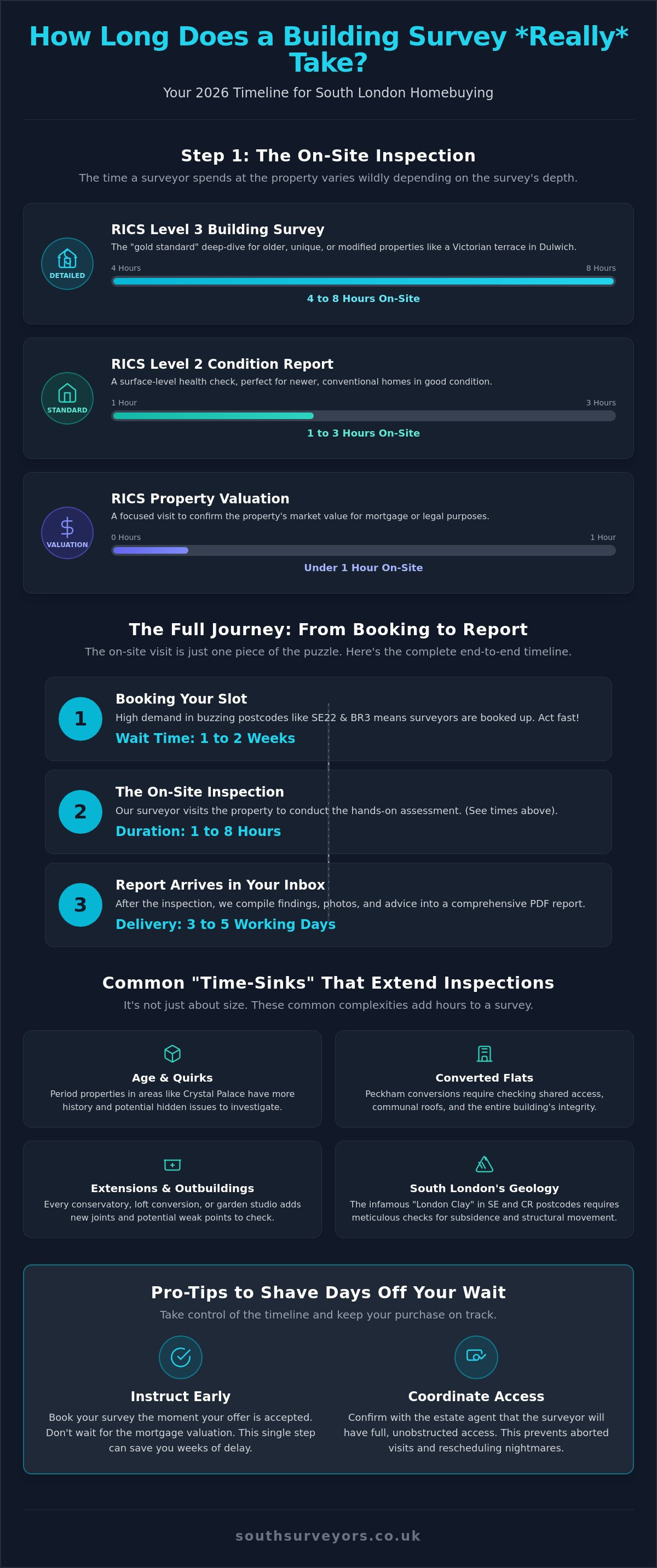
To help you visualize what happens during those vital hours on-site, check out this quick guide:
Typically, a RICS Level 2 Condition Report takes between 1 and 3 hours on-site. This is a focused assessment, usually suited for newer builds where the construction is straightforward. If you’ve opted for the more comprehensive RICS Level 3 Building Survey, expect us to be there for 4 to 8 hours. This is the “gold standard” for older or unique properties where we need to be much more intrusive to get the full picture. For those who only need a RICS Property Valuation, the visit is much shorter, often taking less than an hour to confirm the essential details of the property.
Level 2 vs. Level 3: Why the time gap?
The difference comes down to depth. A Level 2 report is a surface-level health check. It’s great for spotting obvious red flags in modern homes, but it doesn’t go behind the scenes. However, if you’re buying a period property in Dulwich, you really need the Level 3. This involves checking those awkward attic nooks, looking under manhole covers, and lifting floorboards where possible. The extra time spent on-site translates to a much more detailed report, giving you the confidence to proceed or the evidence to negotiate. More detail simply requires more time at the property and more hours at the desk afterward.
The 2026 South London Market Reality
The property market in 2026 is moving fast, and surveyors are in high demand. In the current climate, understanding how long does a building survey take is vital for managing your solicitor’s expectations and keeping your seller calm. High demand in buzzing postcodes like SE22 and BR3 means that you might face a 1 to 2 week wait just to get a slot in the diary. At South Surveyors, we focus on local efficiency because we know how fragile property chains can be. Instructing us as soon as your offer is accepted is the best way to avoid delays. Once the inspection is finished, you’ll usually receive your full, professional report within 3 to 5 working days.
Size, Age, and Quirks: What Influences the Clock?
While square footage is the most obvious factor in the timeline, it isn’t always the biggest hurdle. When people ask how long does a building survey take, they’re often surprised to learn that a compact, quirky property can take longer than a modern five-bedroom house. Complexity is the secret time-sink. For instance, those trendy converted flats in Peckham (SE15) often present unique challenges. We aren’t just looking at your four walls; we’re often investigating shared access points, communal roof spaces, and the structural integrity of the entire building. These logistical puzzles require a bit more detective work than a standard semi-detached home.
The presence of outbuildings, garden studios, or multiple extensions also adds significant weight to the inspection. Every time a previous owner added a conservatory or converted a loft, they created a new set of joints, roof valleys, and potential structural weak points that we need to examine. We treat every extension as a separate chapter in the property’s story, ensuring that the “new” parts are as sound as the original build. If your future home has been heavily modified, we’ll naturally spend more time on-site to ensure everything is up to scratch.
Occupied properties present their own set of hurdles. Navigating around a seller’s heavy Victorian furniture, mountain of storage boxes, or even a nervous pet can slow a surveyor down. In an empty property, we can move through rooms with surgical precision. In a lived-in home, we have to be respectful while still ensuring we get a clear view of the “bones” of the house. If you’re looking for a quick turnaround, you might want to check our availability for empty properties which often allow for a slightly swifter flow.
The “Period Property” Tax on Time
Those iconic Victorian terraces in Bromley are packed with character, but they also hide age-related secrets. Older homes require a meticulous eye for historic movement and the specific subsidence risks associated with South London’s geology. We look for the subtle signs of damp or timber decay that newer builds simply don’t have. This is why RICS Level 3 surveys are essential here. They give us the license to dive deep into these structural quirks, ensuring your “characterful” home isn’t actually a money pit.
Modern Homes and New Builds
If you’re eyeing a sleek apartment in Croydon (CR0), the clock moves a bit faster. A RICS Level 2 Condition Report might only take 90 minutes because the materials and construction methods are standardized. However, don’t let the speed fool you into skipping a survey. Even in SM postcodes, new builds can suffer from snagging issues or poor finishing that only a professional will spot. Understanding how long does a building survey take for a modern build helps you coordinate with estate agents and keep your purchase moving toward that all-important exchange of contracts.
From Inspection to Inbox: The Full Survey Timeline
Most buyers think the clock only starts when the surveyor turns the key in the lock. In reality, the journey begins much earlier. When you ask how long does a building survey take, you have to account for the administrative “lead-in” time. In a bustling 2026 market, finding a slot in a diary for a property in Greenwich (SE10) or Bexleyheath (DA6) typically takes 1 to 3 working days. This is the stage where we coordinate with estate agents and confirm access, a logistical dance that happens behind the scenes to keep your purchase moving.
Once the inspection is booked, the “Big Day” arrives. As we’ve discussed, this site visit can last anywhere from 1 to 8 hours. But the work doesn’t stop when we pack up our ladders. The next 48 to 72 hours are dedicated to data analysis and drafting. This is where your surveyor sits down with hundreds of photos, site notes, and thermal imaging data to piece together the property’s story. We don’t just list defects; we analyze what they mean for your future bank balance. Finally, the report undergoes a rigorous quality check before the final PDF lands in your inbox, usually within 3 to 5 working days of the visit.
Why you don’t get the report instantly
It’s tempting to want a “same-day” result, but quality takes time. Surveyors must cross-reference their on-site findings with local geological data and strict RICS standards. Writing a comprehensive Level 2 survey or Level 3 report requires careful wording to ensure you are legally protected and fully informed. Our reports are bespoke, not copy-paste jobs. We take the time to ensure every observation is specific to your potential home, providing a document that actually carries weight during price negotiations.
Urgent Findings and Immediate Feedback
If we find something truly concerning during an inspection in a DA or SE postcode, we won’t leave you biting your nails until the report is finished. While the final document is the legally binding one, we believe in the personal touch. If there’s a significant structural issue or a safety red flag, we’ll often give you a “heads up” call shortly after the visit. This immediate feedback allows you to update your solicitor or start thinking about your next move while we finalize the technical details. It’s about empowering you with information as quickly as professional standards allow.
Why South London Homes Need Extra “TLC” (and Time)
South London isn’t just a collection of vibrant neighborhoods and excellent brunch spots; it’s a complex geological puzzle that keeps surveyors on their toes. When you’re trying to figure out how long does a building survey take, you have to look at the ground beneath the property. Areas like Croydon (CR) are famous for heavy London Clay, which shrinks and swells with the seasons, while parts of Greenwich (SE10) sit on much sandier soil. This geological “mixed bag” means we spend extra time investigating subsidence, a frequent concern in SE postcodes where Victorian terraces have stood for over a century on relatively shallow foundations.
It’s not just the soil that adds minutes to the clock. Unique architectural features like the London “butterfly” roof or deep Victorian basements are hidden time-consumers. A butterfly roof might look charming from the street, but its central valley gutter is a notorious weak point for leaks. We take the time to inspect these properly because a missed defect here could lead to thousands in repair costs later. If you want to understand the full scope of these local quirks, our guide to Building Surveys in South London covers the “property jungle” in much more detail.
Postcode-Specific Challenges
Every postcode in our patch brings something different to the table. In Bromley (BR), we often navigate a mix of sprawling 1930s semis and leafy estates that require a broad range of technical checks. Dartford (DA) and Sidcup present a different challenge, where we often have to account for newer developments built near industrial heritage sites. Meanwhile, in Sutton (SM), we frequently encounter post-war “pre-fab” or non-standard constructions. These homes don’t follow the usual rules of brick and mortar, so they absolutely require the meticulous eye of a Level 3 expert to ensure they’re a safe investment.
The Local Expertise Advantage
There’s a massive benefit to using someone who knows the SE London “vibe.” A surveyor who understands the common defects in Herne Hill (SE24) will work much faster and more accurately than an outsider who’s never seen a specific type of local brickwork before. We know exactly where the typical issues in Bexleyheath (DA6) tend to hide. While our main administrative hub is based in Islington, our hearts and our expertise are firmly rooted in South London. This hyperlocal knowledge allows us to spot red flags quickly, keeping your timeline as tight as possible. If you’re ready to get started, you can book your South London survey here with a team that truly knows the area.
Pro-Tips to Speed Up Your Survey
You’ve done the hard work of finding the perfect home; now it’s time to grease the wheels of the survey process. If you are worried about how long does a building survey take, the best thing you can do is seize the initiative. A significant portion of property delays are administrative, not technical. You can shave valuable days off your timeline by instructing your surveyor the moment your offer is accepted. Many buyers make the mistake of waiting for their mortgage lender’s valuation first. However, that valuation is for the bank’s benefit, not yours. By booking your RICS survey early, you jump the queue in high-demand areas like Bromley or Dulwich.
Access is the most common hurdle we face on the ground. We have seen surveys delayed because an estate agent forgot the key to a Victorian cellar or because a loft hatch in a Bexleyheath semi was painted shut. Explicitly tell the agent that the surveyor requires full access to the loft, cellar, and any outbuildings. Similarly, having the right paperwork ready is a total game-changer. If the property has had recent upgrades, like new windows in Sidcup or damp-proofing in a Crystal Palace terrace, provide those FENSA or damp-proofing guarantees upfront. It prevents us from having to flag “missing documentation” in your report, which only creates more back-and-forth with your solicitor later.
Choosing a local firm like South Surveyors is a strategic move for your schedule. We don’t have to factor in massive travel times across the Thames or get lost looking for a hidden mews in SE postcodes. We are already in your neighborhood, which means we can often slot you in faster than a national firm with a generic call center.
Communication is Key
Keeping your solicitor in the loop is vital to avoid “document tag.” Ensure we have the correct, direct contact details for the vendor or the specific branch handling the sale in Croydon or Sutton from day one. A quick phone call between all parties can often resolve access issues before they even start. When everyone is on the same page, the transition from the physical inspection to the final PDF in your inbox happens much more smoothly.
Next Steps: Getting Your Quote
Understanding how long does a building survey take is all about managing expectations and being prepared. Getting a bespoke quote for your SE, BR, or CR property is the final piece of the puzzle. You deserve the peace of mind that comes with a RICS-regulated firm that knows the South London landscape inside out. We provide the tools for sound decision-making without the corporate jargon or the unnecessary wait times. If you are ready to move forward with confidence, contact South Surveyors for a professional, friendly quote today.
Secure Your Move With Confidence
Navigating the South London property market often feels like a high-stakes sprint, but your survey shouldn’t be a hurdle that slows you down. We’ve explored how the answer to how long does a building survey take depends on whether you’re eyeing a sleek Croydon flat or a characterful Victorian terrace in Bromley. By understanding the realistic timeline, from the initial site visit to the final quality-checked report landing in your inbox, you’re empowered to manage your property chain and keep your solicitor happy.
As a RICS Regulated Firm with deep roots in SE and DA postcodes, we combine technical mastery with the personal touch you need during a stressful move. Our hyperlocal expertise means we know exactly where the “London Clay” issues hide, ensuring your report is thorough yet delivered with impressive efficiency. We pride ourselves on friendly, personal communication that cuts through the jargon and puts your mind at ease.
Don’t let administrative delays put your purchase at risk. Book your South London RICS survey today and get the clarity you need to exchange with total peace of mind. Your future home is waiting, and we’re here to help you get the keys with confidence.
Frequently Asked Questions
Can I attend the survey to make it go faster?
You usually cannot attend the survey to speed it up; in fact, it often has the opposite effect. Our surveyors need total concentration to spot subtle defects in Victorian terraces or modern Croydon builds. While we love a chat, having a buyer present can distract from the methodical checklist we follow. It is much better to let us work in peace and then schedule a follow-up call to discuss the findings.
How soon after the survey will I get the keys to my new house?
Getting your survey report does not mean you get the keys immediately. The survey is a vital part of your due diligence, but you still need to complete the legal conveyancing process. Depending on the complexity of the chain in areas like Bromley or Sutton, it could still take several weeks or months after the survey before you finally reach completion and get those keys in your hand.
Will the surveyor check the drainage and the roof?
We certainly check the roof and drainage as part of our standard RICS inspections. For the roof, we use binoculars or high-level photography to assess the tiles and valleys from the ground. Regarding drainage, we lift accessible manhole covers to check for blockages or flow issues. If you are worried about how long does a building survey take, rest assured these checks are integrated into our efficient on-site workflow.
What happens if the surveyor finds a major problem?
If a major structural issue or safety red flag appears, we will highlight it clearly in your report using the RICS “traffic light” system. This gives you the evidence needed to renegotiate the purchase price or ask the seller to carry out repairs before you exchange. We provide the technical facts so you can make an empowered decision about whether to proceed with the investment or walk away from the deal.
Does a house survey take longer for a leasehold flat in Peckham?
A survey for a leasehold flat in Peckham often takes longer because we have to consider the communal parts of the building. We aren’t just looking at your flat; we are assessing the roof, hallways, and external walls that you might be financially responsible for through service charges. When people ask how long does a building survey take for a flat, they often forget that we must also check for blockages in shared drainage systems.
How much does a RICS Level 3 building survey cost in South London?
The cost of a RICS Level 3 Building Survey depends entirely on the property’s size, age, and estimated value. While we don’t offer a “one size fits all” price, older Victorian homes in SE postcodes generally require more intensive work than a modern semi in Sidcup. It is always best to request a bespoke quote tailored to your specific South London property to ensure you are getting the right level of expertise for your investment.
Is a mortgage valuation the same as a building survey?
A mortgage valuation is definitely not the same as a building survey. The valuation is a brief check carried out for your lender to ensure the property is worth the loan amount. It won’t tell you about damp, structural movement, or roof leaks. A RICS survey is a deep dive into the property’s condition designed specifically to protect your interests and your bank balance from hidden repair costs in the future.
Can a survey be done in the rain or bad weather?
We can usually carry out a survey in the rain or typical UK weather. In fact, wet weather can be helpful for spotting active leaks or failing gutters in Dartford or Greenwich properties. Unless the weather is so severe that it presents a safety risk, like high winds preventing a safe ladder check, we will proceed as planned. We are used to the South London drizzle and won’t let it slow us down.