

Last Tuesday, a buyer in Bromley discovered that their dream three-bed maisonette was constructed using a specific type of pre-cast concrete that most lenders won’t touch. It’s a heart-wrenching moment that happens more often than you’d think, as our team identified similar structural quirks in 14% of the ex-authority homes we inspected across SE22 and CR0 during 2025. You’ve likely spent your weekends scouting these properties, falling in love with their generous proportions, only to be kept awake by late-night searches about “Major Works” and structural integrity. It’s a stressful place to be when you’re staring down a 25-year mortgage commitment.
We’re here to give you total clarity and confidence. This guide explains how a professional survey for ex-council house purchase can protect you from “concrete” surprises and provide the leverage you need to negotiate a fair price. We’ll break down the crucial differences between Level 2 and Level 3 surveys, explain those daunting council repair bills, and show you exactly what our RICS-certified team looks for in SM or DA postcodes to ensure your investment is structurally sound for the long haul.
Key Takeaways
- Discover why ex-LA homes in SE postcodes offer superior square footage for your budget and how to navigate the “mortgageability gap” that makes lenders extra cautious.
- Uncover the “concrete truth” about non-standard construction, helping you identify PRC and LPS builds in South London before they lead to unexpected structural costs.
- Learn how to choose the right level of RICS survey for ex-council house purchase to ensure the depth of the report matches the property’s age and architectural quirks.
- Avoid the “leasehold trap” by understanding how to spot upcoming “Major Works” and service charge spikes in boroughs like Southwark, Lewisham, and Greenwich.
- Gain clarity and confidence with street-level insights across BR, DA, CR, and SM postcodes, including a personal post-survey briefing to give you the headlines immediately.
Why an Ex-Council Property Survey is Your Best Move in 2026
In 2026, the price gap between a cramped Victorian terrace in East Dulwich and a nearby ex-council flat has widened to more than £400,000. For savvy buyers across South London, the choice isn’t just about saving money; it’s about the luxury of actual space. These homes often offer up to 25% more square footage than their private-build counterparts from the same era. Understanding the history of council housing explains why these properties were built with such generous proportions and solid materials, but it also highlights why a professional eye is essential before you sign on the dotted line.
To better understand which inspection suits your specific needs, watch this helpful video:
Buying one of these gems isn’t always a simple process. Lenders in 2026 have become increasingly picky about what we call the “Mortgageability Gap.” If you’re looking at a flat in a high-rise block in Croydon (CR0) or a maisonette in Peckham (SE15), some banks might hesitate without a detailed survey for ex-council house purchase. They want to be certain the building isn’t hiding “non-standard” construction issues that could affect future resale value. A RICS report is the best way to bridge this gap, providing the clarity and confidence needed to satisfy both your bank and your peace of mind.
The Allure of the Ex-LA Home
Post-war builds in South London were designed for actual living, not just for developer profit margins. You’ll find sensible layouts, separate kitchens, and bedrooms that easily fit a double bed. Whether it’s a low-rise block in Bromley (BR1) or a leafy estate in Sidcup (DA14), these properties are often structurally superior to the “luxury” glass towers popping up today. Many buyers are ditching the drafty Victorian conversions for the airy, light-filled rooms typical of the 1960s. A professional survey ensures that your “solid” investment doesn’t have hidden defects like aging communal heating systems or failing concrete.
The “Secret” Negotiation Tool
Don’t view your survey as a boring box-ticking exercise; it’s actually your most powerful leverage in a competitive London market. A RICS survey protects your deposit from unforeseen concrete repairs by identifying structural defects before you exchange contracts. If your surveyor finds issues with communal cladding or failing roof membranes in a South East London estate, you can use those findings to knock thousands off the asking price. It transforms an emotional purchase into a smart, data-driven investment. This is especially vital in areas like Dartford (DA) or Sutton (SM), where specific building methods from the mid-century require an expert, local eye to spot potential trouble. From here, we need to look at the specific structural risks that are common across the SE, BR, and DA postcodes.
The “Concrete Truth”: Structural Risks in South London Ex-Council Homes
Buying an ex-council property in London usually means choosing between a charming Victorian conversion or a post-war “system-built” block. If you’re looking at the latter, you’ll hear the term “non-standard construction” quite often. This isn’t just surveyor-speak for “it’s built of concrete.” It’s a specific classification that dictates whether a bank will lend you money. In areas like Morden or Lewisham, thousands of homes were built quickly after 1945 to solve the housing crisis. While they’ve stood for 70 years, they require a specific survey for ex-council house purchase to ensure the steel or concrete bones aren’t literally crumbling from the inside out.
PRC and System Built Homes
In postcodes like BR3 and SE9, you’ll frequently find Pre-cast Reinforced Concrete (PRC) homes. These were designed as a permanent solution to the post-war housing shortage, but time hasn’t always been kind to the internal steel reinforcements. If moisture reaches the steel, it oxidises and expands, causing what we call “concrete cancer.” A RICS-certified surveyor looks for tell-tale signs like hairline cracks or “blown” brickwork where the concrete is spalling away. If a property was repaired under a licensed scheme in the 1980s, you must see a PRC Certificate. Without this document, your mortgage application will likely hit a brick wall. It’s about more than just safety; it’s about protecting the future resale value of your investment.
Asbestos, Damp, and Services
If you’re eyeing a high-rise in Croydon or a low-rise estate in Sutton, asbestos is almost a guaranteed find. It was used in everything from floor tiles to textured ceiling coatings until 1999. There’s no need to panic if it’s in good condition and left undisturbed, but you need to know it’s there before you start any “hipster” renovations. Damp is the other major player in these builds. In many SM or CR blocks, what looks like rising damp is actually “lifestyle” condensation. This is caused by cold bridging, where the concrete frame stays much colder than the air inside, leading to black mould if ventilation isn’t perfect.
You also need to look at the communal infrastructure. Many estates use district heating systems where a central boiler serves the whole block. Understanding the rules on service charges and major works is vital here. A failing communal system or a roof replacement on a large block can result in a five-figure bill for each leaseholder. If you’re feeling unsure about a specific property’s build type, getting professional advice from a local expert can provide the clarity you need before you commit your deposit.
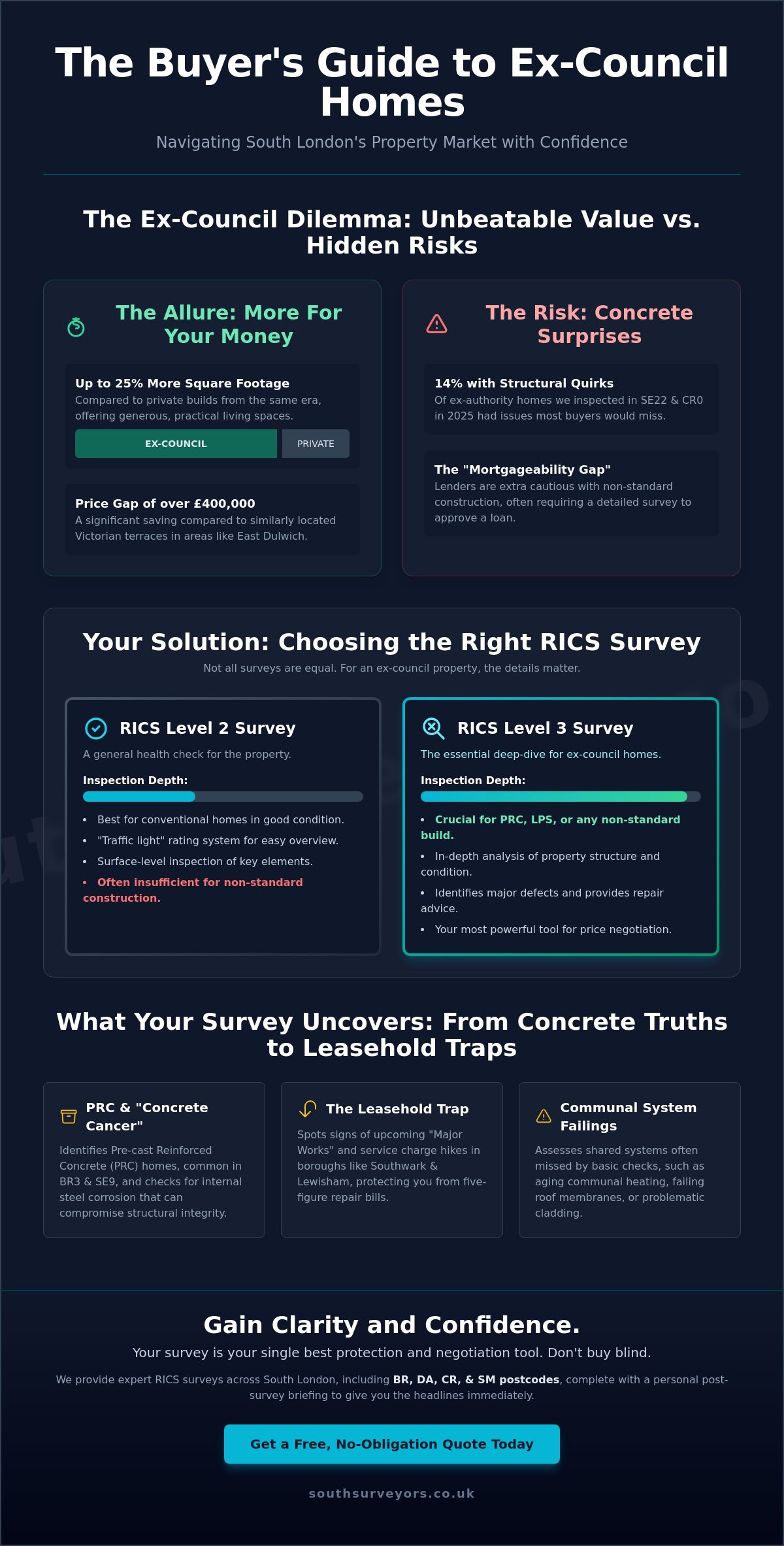
Level 2 vs Level 3: Which Survey for Your Ex-Council Purchase?
Deciding on the right survey for ex-council house purchase isn’t just about looking at the price tag. It’s about the “bones” of the building. In South London, we see everything from Victorian brickwork in SE22 to 1960s concrete experiments in the CR postcodes. Your choice should be dictated by the property’s age and how it was put together, rather than just your budget. While a Level 2 survey offers a great snapshot, it might not dig deep enough into the structural complexities often found in local authority builds.
Think of it as the difference between a quick GP check-up and a full-body MRI scan. You want clarity and confidence before you sign that contract. If the property has been standing since the 1950s or earlier, it has likely seen decades of DIY “improvements” or council-led refurbishments that a basic inspection might miss.
When to Choose a Level 2 Survey
A Level 2 HomeBuyer Report is often enough for standard, modern properties. If you’re eyeing a masonry-built council flat or house constructed after 1990 in areas like Sidcup (DA14) or Dartford (DA1), this level usually suffices. These buildings follow modern building regulations and don’t typically hide the structural “surprises” found in older stock.
- Post-1990 Builds: Ideal for newer developments in the DA or SM postcodes.
- Traffic Light System: You get a clear, colour-coded report highlighting urgent repairs.
- Budget-Friendly: It’s a solid choice for buyers who are confident the property hasn’t been structurally modified.
Why We Recommend a Level 3 for Most Ex-Council Homes
For the vast majority of local authority properties in South East London, we recommend the Level 3 Building Survey. This is the gold standard for a reason. Council housing history is filled with “non-standard” construction methods. Whether it’s a pre-cast concrete frame in Peckham or a steel-framed house in Bromley, these properties require a specialist eye.
Our RICS-Certified surveyors provide a deep-dive analysis that includes estimated repair costs. This data is vital when you’re negotiating. If we find £10,000 worth of damp proofing or structural reinforcement needed, that’s £10,000 you can potentially knock off the asking price. You’re not just buying a report; you’re buying peace of mind and a powerful bargaining tool.
Ex-council homes often have complex leasehold arrangements or shared structural responsibilities. A Level 3 survey ensures you aren’t walking into a financial trap. You can explore our Ultimate Guide to Building Surveys to understand how we help buyers master the South London property jungle with real confidence.
The Leasehold Trap: Major Works and Service Charges
Buying an ex-council flat in vibrant hubs like Peckham or Greenwich feels like a savvy move until the first major maintenance bill lands on your doormat. In South London boroughs such as Southwark, Lewisham, and Greenwich, most of these properties are sold as leasehold. This means the council remains the freeholder, and you’re essentially a long-term tenant with a very expensive piece of paper. When the council decides the block needs a new roof or a lift upgrade, they don’t just absorb the cost. They split it between the leaseholders. These are known as “Major Works,” and they can be a financial sting if you aren’t prepared.
A professional survey for ex-council house purchase acts as your early warning system. While your solicitor handles the legal title, our surveyors look at the physical reality of the building. If we spot a lift system that sounds like a bag of bolts or external cladding that looks weathered, we’ll flag it. A “Section 20” notice is the legal process the council must follow to consult you on works costing more than £250. Your solicitor will see the paperwork, but your surveyor sees the actual state of the asset. We ensure these two professionals are in sync so you don’t inherit a £30,000 bill for a roof replacement scheduled for 2027.
Surveying the Communal Areas
We don’t just stop at your front door. When inspecting blocks in SE1 or CR0, we examine the stairwells, communal balconies, and the overall structural health of the building. It is a common misconception that you’re only responsible for your individual flat. A poorly maintained roof on a block of 20 flats is still your financial problem because the repair costs are divided among every leaseholder in the building. We look for signs of concrete fatigue or drainage issues in shared areas that could lead to massive communal levies down the line.
Service Charge Realities
Service charges in South London can be unpredictable. You’ll encounter “historic” costs, which reflect past spending, and “estimated” costs for the year ahead. With the 2026 “Right to Buy” revivals, many councils are modernising their maintenance schedules to meet updated safety standards, often leading to a spike in annual fees. It is vital to look beyond the current year’s figures. We always recommend that buyers ask for the last 3 years of service charge accounts to identify any patterns of neglect or sudden cost hikes. This data, combined with our physical inspection, gives you the clarity to negotiate or walk away if the numbers don’t add up.
Don’t let hidden communal costs ruin your investment. Get a comprehensive RICS survey to uncover the true state of the block before you exchange.
Clarity and Confidence with South Surveyors
Buying a home is easily one of the most stressful things you’ll ever do. When you’re looking at a survey for ex-council house purchase, that stress often comes from the unknown. You might be wondering if that 1960s concrete frame is a solid investment or a looming repair bill. At South Surveyors, we believe you deserve more than just a dry, technical document. We aim to be your knowledgeable friend in the South London property market, providing the clarity you need to sign those contracts with real confidence.
Our edge comes from our genuine, street-level knowledge of the SE, BR, DA, CR, and SM postcodes. We don’t just look at the property in isolation; we understand the local context. Whether it’s a maisonette in Peckham (SE15), a terrace in Bromley (BR1), or a flat in Croydon (CR0), we’ve likely surveyed a similar property on that very street. This hyperlocal expertise means we know exactly which construction “quirks” to look for before we even step through the front door.
We’ve ditched the “corporate robot” approach in favor of the personal touch. One of our signature moves is the post-survey phone call. As soon as our surveyor finishes on-site, they’ll give you a ring to deliver the “headlines.” You won’t have to wait days for a PDF to land in your inbox to find out if there are major red flags. We’ll talk you through the findings in plain English, stripping away the RICS jargon so you can make an informed decision immediately.
RICS-Certified Expertise in Your Neighborhood
Our team brings years of experience dealing with the unique architectural heritage of South London. We understand the legacy of major developments like the Aylesbury Estate or the sprawling post-war builds across the SE and CR postcodes. This specialized knowledge is backed by our status as a firm Regulated by RICS. This isn’t just a badge; it’s our non-negotiable promise that your survey meets the highest industry standards for quality and accountability.
If you’re still deciding which level of inspection fits your needs, you can check out our RICS Level 2 Survey Guide. It’s a great resource for comparing your options and ensuring you have total peace of mind before committing to a purchase.
Get Your Tailored Quote Today
Beyond standard structural checks, we provide RICS Property Valuations that are essential for Help to Buy or Shared Ownership ex-council purchases. We’ve helped hundreds of buyers across South London navigate these specific requirements with ease. Don’t let a concrete dream become a financial nightmare by skipping the professional oversight you need. We’re here to help you understand exactly what you’re buying.
Ready to move forward? Book your South London ex-council survey with South Surveyors today and get the expert insight your investment deserves.
Secure Your South London Investment with Confidence
Buying a home in vibrant neighborhoods across Bromley or Croydon is a savvy move, but ex-council properties come with unique architectural DNA. You need to know if that 1960s system-build is structurally sound or if a hefty “Major Works” bill is lurking in the leasehold paperwork. Choosing the right survey for ex-council house purchase ensures you aren’t left guessing about concrete fatigue or expensive service charges. It’s the difference between a dream home and a financial headache.
Our team brings hyperlocal expertise to every street in the SE, BR, DA, CR, and SM postcodes. We are strictly regulated by RICS, providing the professional substance you need to negotiate with real authority. We also believe in the personal touch, which is why every report includes a direct phone consultation with your surveyor to answer your specific questions. We turn technical data into clear, actionable advice so you can sign those contracts without a hint of doubt.
Take the stress out of your property journey today. Get a RICS-certified survey quote for your ex-council purchase and move into your new home with total peace of mind. You’ve got this, and we are ready to help you get it right.
Frequently Asked Questions
Is it harder to get a mortgage on an ex-council house?
Securing a mortgage on an ex-council property is certainly possible, but it requires more preparation than a standard house purchase. Many high-street lenders apply strict criteria to high-rise blocks, often refusing to lend on buildings over seven storeys or those with balcony access. Statistics from 2025 show that roughly 20% of major lenders won’t consider flats with deck access in areas like Peckham or Lewisham. It’s all about the “let-ability” of the home and the specific construction type used by the local authority during the build.
What is the most common structural issue in South London ex-council flats?
Concrete carbonation, often called “concrete cancer,” is the most frequent structural headache we encounter in South London estates, particularly in SE15 and SE17. This occurs when the alkaline levels in the concrete drop, leading to the internal steel reinforcements rusting and expanding. Our RICS-Certified surveyors frequently spot “spalling,” where chunks of concrete flake off the facade. This is a common finding in 1960s system-built blocks across Southwark and Lambeth that haven’t undergone recent remedial work.
Can I buy an ex-council property with “non-standard” construction?
You can buy a non-standard property, but you’ll likely need a specialist lender rather than a standard high-street bank. Around 10% of the housing stock in the UK is considered non-standard, including many Wimpey No-Fines or Laing Easiform homes found in Croydon or Bromley. Before you commit, a comprehensive survey for ex-council house purchase is vital. It identifies the specific build system so your mortgage broker can find a lender who is comfortable with that specific architectural history.
How much does a survey for an ex-council house cost in 2026?
In 2026, a professional RICS survey typically ranges from £450 to £1,200 depending on the property’s size and market value. A Level 2 HomeBuyer report for a standard one-bedroom flat usually sits at the lower end of that scale. Conversely, a full Level 3 Building Survey for a complex, multi-storey maisonette in Greenwich will hit the higher bracket. These figures reflect the steady 4% annual increase in professional indemnity insurance and surveyor overheads seen across the London market since 2023.
Do I need a Level 3 survey for a 1970s council maisonette?
We always recommend a Level 3 Building Survey for 1970s maisonettes because they often hide complex structural secrets behind their brickwork. These properties frequently feature “cross-wall” construction or aging flat roofs that are prone to significant leaks. Investing in a thorough inspection gives you clarity and confidence before you sign the contract. It’s much better to spend a few hundred pounds now than to discover a £15,000 roof repair bill three months after moving into your new Crystal Palace pad.
What happens if the survey finds asbestos in the property?
Don’t panic if your surveyor flags asbestos, as it’s present in roughly 70% of UK homes built between 1950 and 1999. It’s often tucked away in floor tiles, textured ceilings, or old water tanks. The key is whether the material is damaged or “friable.” If it’s in good condition, you can often leave it alone. However, if you’re planning a trendy SE22 kitchen renovation, you’ll need a specialist contractor to remove it safely and legally to meet modern health standards.
Will the surveyor check the communal areas of the block?
Your surveyor will perform a cursory inspection of the communal areas, but they won’t perform a full structural survey of the entire block. We check the general condition of stairs, lifts, and external brickwork to see if any major “Section 20” works might be looming on the horizon. This helps you avoid unexpected service charge hikes. If the communal hallway in your Camberwell block looks neglected, it’s a reliable indicator that the management company might be lagging on essential maintenance.
How long does a RICS survey take for an ex-local authority home?
A RICS survey for an ex-local authority home usually takes between two and four hours on-site. This gives our expert enough time to poke into every accessible nook and cranny to ensure nothing is missed. Once the site visit is finished, you’ll typically receive your digital report within three to five working days. We pride ourselves on being communicative, so we’ll often give you a quick call immediately after the inspection to share the headline findings and provide some initial peace of mind.