

What if that “stunning” open-plan kitchen extension in Peckham Rye is actually held up by little more than hope and a bit of dodgy plasterboard? When you’re dropping an average of £557,000 on a home in SE15 or East Dulwich, you deserve more than a “looks fine to me” assessment. Booking a building survey for house with extension South London is the only way to ensure that the shiny new addition to your property isn’t hiding a structural disaster or a breach of the 2026 building regulations.
We know the feeling. You’ve finally found a place in Bromley or Croydon, but the fear of inheriting someone else’s DIY shortcuts is enough to keep you awake. This guide explains why a standard Level 2 check often misses the critical details of modified properties and how a Level 3 survey protects your investment. You’ll discover how to verify structural integrity and gain the evidence needed to negotiate the price if those bifold doors come with hidden structural headaches.
Key Takeaways
- Discover why a standard check usually fails for structural additions and how a Level 3 survey spots the hidden “jigsaw” issues where old and new walls meet.
- Learn how spending a little more now can save you £20,000 in repair bills by catching “thermal bridging” and damp before you exchange contracts.
- Understand why a RICS-certified building survey for house with extension South London is the only way to handle the unique structural quirks of period properties in SE22 or SE10.
- Get the lowdown on the “Extension Audit” to ensure your dream home in Bromley or Croydon actually has the right planning paperwork to avoid future legal headaches.
- See how a direct chat with your surveyor after the inspection gives you the real-world clarity and confidence needed to negotiate like a pro.
Why a “Standard” Check Fails an Extended South London Home
Let’s be honest; your mortgage valuation isn’t a survey. It’s a glorified tick-box exercise for the lender to make sure the house actually exists and isn’t made of cardboard. If you’re eyeing a Victorian terrace in SE10 with a sleek, glass-box extension, that basic valuation won’t tell you if the two structures are speaking to each other or plotting a messy divorce. This is where a RICS Level 3 building survey for house with extension South London becomes your best friend. It is the “gold standard” for any property that has been sliced, diced, or added to over the years, providing the depth of detail a simple valuation ignores.
To better understand the legalities and structural boundaries involved in these types of property changes, watch this helpful video:
South London is a beautiful, chaotic architectural jigsaw. You might find a 1930s semi in SE22 that has been treated to a “Grand Designs” style rear pod, or a DA postcode cottage with a DIY loft conversion from the nineties. These hybrids create massive structural stresses. Modern materials like steel and glass expand and contract at different rates than old London stock brick. Without a deep dive into the principles of building surveying, you are essentially buying a mystery box. A Level 3 survey ensures those modern additions aren’t compromising the original bones of the building.
The Problem with “Surface-Level” Inspections
A Level 2 survey is “look but don’t touch.” It is fine for a standard flat, but for an extended home, it is like trying to diagnose an engine fault by looking at the car’s paintwork. Level 3 is the “under the hood” inspection. It is designed to sniff out issues hidden behind fresh plasterboard. We’ve seen plenty of “cowboy” extensions where a load-bearing wall was swapped for a “hope-it-stays-up” timber frame. A thorough surveyor knows the difference and ensures you aren’t left holding the bill when the cracks start to show.
South London Postcodes and the Extension Boom
In areas like Bromley (BR) and Croydon (CR), the extension boom has been relentless. But here is the catch: much of the SE, SM, and CR postcode regions sit on “London Clay.” This soil is notoriously temperamental; it shrinks when dry and swells when wet. When you bolt a heavy new extension onto an old house, the two parts often settle at different speeds. Local expertise is vital here. You need someone who knows how the foundations in Sutton should behave compared to the slopes of Crystal Palace or the river-adjacent plots in Greenwich.
The Structural Jigsaw: What We Look for in Your Extension
Think of an extended home in South London as a structural hybrid. You’ve got the original “old guard” brickwork, likely built on shallow foundations in the Victorian era, shaking hands with a modern addition. When we perform a building survey for house with extension South London, the most critical area we inspect is “The Junction.” This is the seam where the two structures meet. In postcodes like SE15 or SE22, we often find that builders haven’t accounted for how these two very different materials will interact over time. If the join isn’t flexible, the house will let you know through cracks, leaks, and unwanted draughts.
Junction Defects and Movement
We often look for “differential movement.” This is just a fancy way of saying the two parts of your house are moving at different speeds. Your 1930s semi in SM1 has had nearly a century to settle into the London clay, while that new rear extension is still finding its feet. If they aren’t tied together with proper movement joints, you’ll see cracks appearing exactly where the old wall meets the new one. Sticking bifold doors or a slight slope in the kitchen floor are often the first red flags. Our surveyors use high-level equipment to check if the roofing transitions and guttering are actually watertight or just “resting” against the original building.
Damp, Insulation, and the “Cold Bridge”
It’s a common South London tragedy: a beautiful new kitchen in East Dulwich that feels like a walk-in fridge by November. This is usually caused by “thermal bridging.” It happens when a structural element, like a steel beam, creates a direct path for heat to escape. This doesn’t just make your heating bill spike; it leads to condensation and black mould behind your expensive new cabinets. We inspect for breached damp proof membranes (DPM) and check those insulation values with expert eyes. Even if the walls look freshly painted, we’re making sure the “new” part of your home is actually habitable.
We also keep a close eye on the plumbing. Victorian pipework in BR1 or CR0 wasn’t designed for the extra load of a modern utility room and three bathrooms. Extensions often “bodge” into existing drainage, which can lead to slow sinks or nasty back-ups in the garden. If you want to be sure your pipes and foundations aren’t a ticking time bomb, you can view our tailored survey services to see how we dig deeper into these structural details. Our goal is to give you the clarity and confidence to move forward without any nasty surprises under the floorboards.
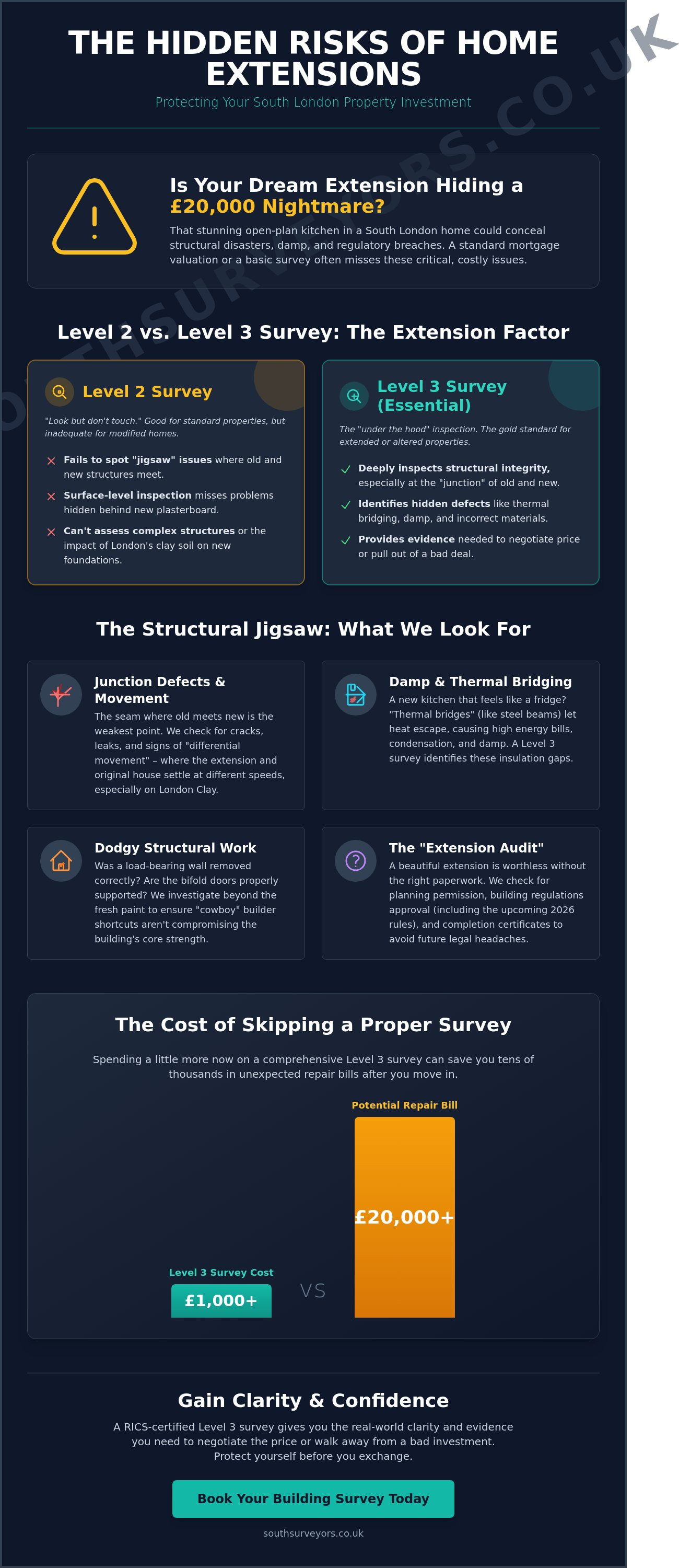
Level 3 Survey vs. Level 2: The Extension Factor
Selecting the right inspection level is where many buyers in South East London get stuck. You’ll often hear that a RICS Level 2 survey is fine for “modern” homes. But if that house in Beckenham or Sidcup has been extended, the “modern” label is a bit of a trap. A Level 2 survey is essentially a surface-level assessment; it’s a “look but don’t touch” approach. In contrast, a Level 3 Building Survey is an “under the hood” investigation. When you’re dealing with a building survey for house with extension South London, you need that extra depth to see what’s happening behind the shiny new kitchen units and fresh plaster.
The cost difference between the two is usually around £200 to £400, which feels like a significant jump when you’re already juggling stamp duty and solicitor fees. However, that small upfront investment can save you £20,000 or more in structural repairs later. If an extension is more than a decade old or uses non-traditional materials like timber frames or structural insulated panels (SIPs), a Level 3 isn’t just a recommendation; it’s a necessity. This is especially true if the seller can’t produce a completion certificate or a 10-year structural warranty. Without these documents, you’re essentially flying blind into a potential financial storm.
The “In-Depth” Advantage
A Level 3 survey allows us to be much more hands-on. We’ll lift loose floorboards where possible and enter loft spaces to check how the extension roof is actually tied into the original rafters. In subsidence-prone areas like Dulwich or Forest Hill, we pay special attention to the “piling” or foundation depth. If the extension hasn’t been anchored correctly into the London clay, the structural report will flag it before it becomes your problem. For a deeper dive into what we cover, check out our Level 3 Building Survey: A Complete Guide.
Negotiation Power in South East London
The property market in Greenwich and Blackheath is famously competitive. Having a detailed RICS-certified report gives you a massive tactical advantage. If we find that the “stunning” extension needs £5,000 of remedial damp proofing or structural ties, you have concrete evidence to knock that amount off the asking price. It turns a stressful “maybe” into a confident “yes, at a better price.” Beyond the price tag, it provides the peace of mind your solicitor and mortgage lender need to move the sale forward. It’s about buying with your head, not just your heart.
The Extension Audit: Paperwork and Planning
A building survey for house with extension South London isn’t just about looking at cracks; it’s about playing detective with the paperwork. While the physical structure might look solid, its legal status is what determines your future peace of mind. We often find that homeowners in Sidcup or Bexley have added a “simple” rear extension without realizing they’ve overstepped the limits of Permitted Development. As of 2026, those limits remain strict: 3 metres for terraced or semi-detached homes and 4 metres for detached properties. If that new sunroom in a DA postcode is a centimetre over without full planning permission, it’s a legal headache waiting to happen.
Our surveyors cross-reference the physical dimensions of the property with the local planning portal. We look for the “prior approval” documents required for larger extensions, which allow up to 6 or 8 metres depending on the house type. Beyond the size, we check if the seller played nice with the neighbours. If the extension was built within 3 metres of a neighbouring foundation, a Party Wall Agreement should have been in place. Without it, you could inherit a boundary dispute that costs thousands to resolve through legal channels.
Building Regulations: The Safety Shield
Completion Certificates are arguably more important than the extension itself. This piece of paper proves that a building control officer from a council like Bromley or Greenwich actually visited the site and verified that the structural steels, insulation, and fire safety measures meet the 2026 standards. If we find structural work that hasn’t been signed off, it’s a massive red flag. It usually means the “bones” of the extension were never independently verified. For a deeper look at the legal side of building near boundaries, check out The Party Wall Act: A Friendly Guide.
Insurance and Future Risks
An illegal extension is more than just a paperwork glitch. It can actually void your home insurance policy. If a fire starts in an uncertified kitchen extension in Southwark or Lewisham, your insurer might refuse to pay out because the work didn’t meet building regulations. There is also the lingering risk of “Enforcement Action.” Councils have the power to demand that unapproved structures are altered or even demolished. Your surveyor is your first line of defence, ensuring you don’t buy a property that the council wants to tear down. If you want to ensure your prospective home is fully compliant, you can book a comprehensive RICS building survey to get the full picture before you sign.
Clarity and Confidence with South Surveyors
We know that buying a home in South London is a high-stakes game. You aren’t just buying a property; you’re buying into a lifestyle in places like Crystal Palace or Hither Green. Because we specialize exclusively in the SE, BR, DA, CR, and SM postcodes, we’ve seen every architectural quirk the city has to offer. Whether it’s a Victorian terrace with a modern “glass box” or a 1930s semi with a wraparound extension, we provide the professional substance you need with a no-nonsense, conversational approach. We don’t do corporate fluff; we do clarity.
When you book a building survey for house with extension South London with us, you aren’t just getting a PDF that sits in your inbox. We believe in the personal touch. Every report we produce is followed by a direct conversation with your surveyor. We’ll spend the time needed on the phone to explain exactly what those cracks mean or why that specific roofing join in your Croydon home needs attention. Within the first 24 hours of your enquiry, you’ll have a clear timeline and a dedicated expert ready to dive into the structural details of your potential new home.
Local Experts, Not Corporate Robots
Our team lives and breathes the local property market. We understand the “London Clay” issues in Dulwich and the drainage challenges in the DA postcodes. Being Regulated by RICS is our non-negotiable promise to you. It means we adhere to the highest industry standards while maintaining an approachable vibe. We take pride in being the experts you actually want to talk to. As one of our recent clients noted, “He spent 20 minutes explaining the damp in my Peckham extension, making sure I understood the repair costs before I committed.” That is the level of reassurance we bring to every inspection.
- RICS-Certified Professionals: Expert-led reports that lenders and solicitors trust.
- Hyperlocal Knowledge: We know the specific building trends and risks in South East London.
- Clear Communication: No jargon, just honest advice and follow-up calls as standard.
- Fast Turnaround: We get moving quickly so you don’t lose out on your dream home.
Ready to Get Moving in South London?
Buying a home with an extension is an exciting milestone, and it shouldn’t be overshadowed by structural anxiety. By choosing a Level 3 survey, you’re giving yourself the best possible protection against unforeseen repair costs. Let’s make sure your investment in Greenwich or Bromley is as solid as it looks on the surface. You can get a tailored quote for your South London building survey today and take the first step toward a confident purchase. If you’re still weighing up your options, feel free to browse our Ultimate Guide to Building Surveys for more expert insights into navigating the local property jungle.
Move Forward with Clarity and Confidence
Buying a home with a shiny new extension in Peckham or Bromley is a huge win, but only if the foundations and paperwork are as solid as that kitchen island looks. You’ve learned how differential movement can hide behind fresh plaster and why missing completion certificates are a major red flag for your future resale value. Investing in a professional building survey for house with extension South London ensures you aren’t inheriting a structural jigsaw that’s missing half its pieces.
As a firm Regulated by RICS, we specialize in the SE, BR, DA, CR, and SM postcodes. We know exactly how London clay behaves under a heavy new addition. We don’t just send a report and vanish; every survey includes a direct phone consultation with your surveyor to answer those nagging questions. We want you to sign that contract with real peace of mind, knowing your investment is structurally sound and legally compliant.
Book your expert RICS Level 3 survey with South Surveyors today to get the expert insights you need. You’ve found the right house; let’s make sure it’s the right home for your future.
Your Extension Questions Answered
Do I really need a Level 3 survey for a modern extension?
Yes, you definitely do. Modern doesn’t always mean “perfectly built,” and extensions are high-risk zones for structural “bodges” hidden behind fancy bifold doors. A building survey for house with extension South London is the only way to check how that new addition is actually holding up against the original Victorian brickwork in places like Forest Hill or East Dulwich. It ensures the structural junctions are sound and won’t start leaking the moment the London weather turns.
What happens if the surveyor finds the extension has no Building Regs?
It’s a significant red flag that requires immediate attention from your solicitor. If an extension in Bromley or Bexley lacks a completion certificate, it means the work was never independently verified for safety. This can lead to council enforcement action or void your home insurance. We’ll flag these gaps so you can negotiate for indemnity insurance or demand that the seller gets the work regularised before you exchange contracts.
How much does a building survey for an extended house in South London cost?
In 2026, a RICS Level 3 survey typically costs between £630 and £1,500 plus. For higher-value or particularly complex properties in postcodes like SE10 or SE21, prices can exceed £2,000. While it’s a bigger upfront cost than a Level 2 report, it’s a small price to pay to avoid inheriting a £20,000 structural repair bill. We provide clear, fixed quotes so you know exactly where you stand from the start.
Can a surveyor tell if a wall in an extension is load-bearing?
Yes, we can usually determine this by examining the structural layout and the direction of floor joists. In many South London open-plan renovations, walls are removed to create that “Grand Designs” feel. We check that the correct steel beams were installed to take the weight. If things look suspicious, we’ll recommend further investigation to ensure your ceiling isn’t being held up by little more than hope and luck.
Will the survey cover the loft conversion as well as the rear extension?
Absolutely, a Level 3 survey is a “top to bottom” inspection of the entire property. We’ll climb into the loft space in your SM or CR postcode home to check that the conversion hasn’t compromised the roof’s integrity. We look at everything from the floor strength to the fire safety of the stairs. It’s about giving you a total overview of every modification made to the original building.
How long does a Level 3 survey take for a house with an extension?
Expect the on-site inspection to take between four and six hours. We take our time because we’re doing a deep dive into the junctions, roofing, and drainage of your South London extension. Once the site visit is finished, we’ll give you a quick verbal update. The full, comprehensive PDF report, packed with professional substance and clear advice, usually follows within three to five working days.