

What if the most expensive mistake you make on your South East London property journey isn’t the mortgage rate, but a hidden mineral tucked away in the artex ceiling of your new SE22 flat? If you’re eyeing up a mid-century home in Croydon or a classic terrace in Bromley, you’ve likely asked yourself: does a RICS survey check for asbestos? It’s a common worry for anyone buying a property built or refurbished before 2000, as the fear of hidden health risks and eye-watering removal costs can quickly dampen the excitement of getting your keys.
We completely understand that anxiety. When you’re investing your life savings into a home in the DA or SM postcodes, you want total transparency, not a report full of vague caveats. Discover exactly how RICS surveyors identify asbestos risks in London properties and when you need a specialist report. This guide will walk you through the difference between survey levels, explain the visual-only rule, and show you how to use these findings to negotiate a fairer price, ensuring your new start is as safe as it is stylish.
Key Takeaways
- Learn that RICS surveyors use a visual-only approach to flag potential risks, ensuring the property remains undisturbed during your inspection.
- Identify why South London hotspots in the SE and CR postcodes are particularly prone to containing these materials due to mid-century building trends.
- Clarify exactly how much detail you’ll get when asking does a RICS survey check for asbestos and when you might need a more intrusive specialist report.
- Discover a practical action plan for handling asbestos findings, from assessing renovation risks to negotiating the final purchase price.
- Understand how a plain-English report helps you bypass corporate jargon, giving you the clarity needed for a stress-free move.
The Invisible Guest: Why Asbestos is a South London Property Staple
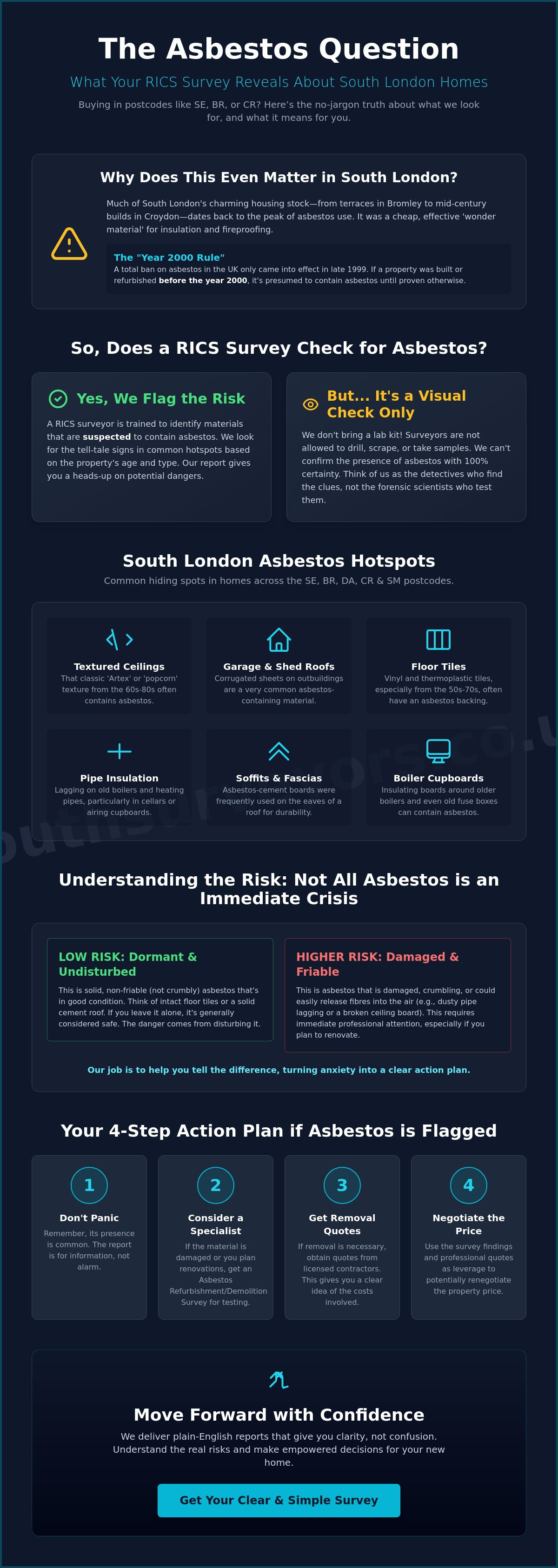
Before we dive into the nitty-gritty of your report, let’s look at the guest that nobody invited to the housewarming party. To understand the risks, you first need to know what asbestos is: a naturally occurring mineral that was once the gold standard for fireproofing and insulation. It’s tough, heat-resistant, and, unfortunately, incredibly common in South London homes built during the post-war reconstruction era. Because it was cheap and effective, it found its way into everything from floor tiles to roof sheets.
If you’re house-hunting in the SE or CR postcodes, you’re likely seeing a lot of 1950s to 1980s architecture. This was the peak of asbestos use in the UK. Many buyers ask, does a RICS survey check for asbestos, because they realize that these vintage builds often hide materials that were perfectly legal at the time. It wasn’t until the “Year 2000 Rule” came into effect that a total ban was implemented. This means if you’re looking at a modern development in Sidcup or a newer build in Bexley (DA), you can usually breathe a sigh of relief. However, for the rest of our local housing stock, a little detective work is required.
To better understand this concept, watch this helpful video:
In older pockets of the city, asbestos is the ultimate hide-and-seek champion. You might find it in the corrugated garage roofs of a Bromley semi-detached, the insulation of a Sutton (SM) terrace, or lurking in the thermoplastic floor tiles of a charming Dulwich maisonette. Identifying these potential hotspots early is the key to avoiding a budget-breaking surprise later on.
The 1960s and 70s Legacy in the BR and CR Postcodes
Mid-century estates in areas like Croydon are famous for their functional design, but they often feature asbestos-containing soffits and fascia boards. Then there’s the 1970s suburban classic: the Artex ceiling. While that “popcorn” texture might just look like a dated design choice, it often contains a small percentage of white asbestos. We also keep a close eye on “hidden” spots like old fuse boxes and the lining of boiler cupboards, where heat resistance was a priority for builders at the time.
Why “Old” Does Not Always Mean “Dangerous”
Here is the good news: having asbestos in your home isn’t an immediate health crisis. There’s a massive difference between dormant, “non-friable” asbestos (like a solid floor tile) and damaged, “friable” materials that crumble to the touch. When you’re wondering does a RICS survey check for asbestos, remember that our role is to highlight these risks so you aren’t left with a surprise bill after completion. If the material is in good condition and left undisturbed, it’s generally safe. At South Surveyors, we aim to replace “asbestos anxiety” with empowered decision-making, helping you understand if a material is a minor detail or a renovation deal-breaker.
RICS Level 2 vs. Level 3: Who Is Looking for the “A-Word”?
So, you’ve narrowed down your choice of survey, but you’re still wondering: does a RICS survey check for asbestos in the same way for every property? While the visual inspection might look similar to the untrained eye, the depth of the investigation and the advice you receive changes significantly depending on whether you opt for a Level 2 or Level 3 report. Our surveyors aren’t just looking at the bricks and mortar; they’re looking at the history of the build to determine where risks might be hiding.
It’s vital to understand that regardless of the level, we operate under a “Visual Inspection” mandate. We are guests in the seller’s home. This means we won’t be ripping up retro floor tiles in a Crystal Palace flat or peeling back the wallpaper in a Forest Hill villa. Our expertise lies in identifying materials that are “likely” to contain asbestos based on the age and style of the property, always adhering to the safety standards set out by Health and Safety Executive (HSE) regulations.
RICS (level 2) Condition Report and Asbestos
For a relatively modern home in Bexleyheath or a 1990s build in Sutton (SM), a RICS (level 2) Condition Report is often the most sensible choice. At this level, your surveyor will flag obvious Asbestos Containing Materials (ACMs) that are clearly visible, such as cement flue pipes or garage roofing. However, it’s a surface-level scan. If the asbestos is hidden behind a boxing-in or tucked under a carpet, a Level 2 survey might not catch it because the scope is intentionally limited to what is easily accessible, which is why many buyers ask does a RICS survey check for asbestos before committing to this entry-level report.
RICS (level 3) Building Survey: The Deep Dive
If you’re eyeing up a grand Victorian house in Dulwich or a quirky period property in Peckham, a RICS (level 3) Building Survey is the gold standard. Here, the surveyor follows a “trail of suspicion.” If we spot an old boiler cupboard with suspicious lining, we’ll look closer at the surrounding pipework and insulation. We provide much more detailed advice on the implications of any asbestos found, helping you understand the potential repair costs or management requirements before you sign on the dotted line. If you’re still debating which report is right for your South East London move, you can always reach out to us for a friendly chat about your specific property.
Every RICS report uses a traffic light system to keep things clear. Regarding asbestos, you’ll usually see one of three Condition Ratings:
- Condition Rating 1: No repair currently needed. The property is generally modern and likely asbestos-free.
- Condition Rating 2: Defects that need repairing but aren’t considered urgent. This might be used for well-maintained, encapsulated asbestos.
- Condition Rating 3: Serious defects that need urgent attention. Because of the health implications if the material is disturbed, suspected asbestos is almost always flagged as a Rating 3.
This isn’t designed to scare you. Instead, it gives you the professional evidence needed to request further specialist testing or to negotiate the purchase price based on the cost of professional removal.
The Limits of the Look: Why Your Surveyor Isn’t Bringing a Lab Kit
Imagine your surveyor turning up to a lovely semi-detached house in Bromley with a hammer and a specimen jar. It just doesn’t happen. While many buyers ask, does a RICS survey check for asbestos, it’s vital to remember that we are guests in the seller’s home. Our mandate is strictly non-invasive. We can’t go drilling into walls or chipping off pieces of the ceiling to see what’s inside because our job is to observe, not to dismantle.
A RICS surveyor’s assessment of asbestos is limited strictly to a visual, non-invasive inspection of accessible areas to identify materials that might reasonably be suspected of containing asbestos.
The reason we don’t take samples during a standard survey is simple: safety. Sampling involves intentionally breaking the material to get a piece for the lab. Doing this without proper containment can release the very fibres we’re trying to avoid. Following official government advice on asbestos, any material suspected of containing these fibres should be left alone unless handled by a professional with the right equipment. Our role is to spot the risk so you can decide if you want to pay for a specialist to take those samples later.
When “Potential” Becomes a “Recommendation”
When we walk through a property in the CR or SM postcodes, we look for clues. It’s about age, texture, and location. If we see floor tiles that look suspiciously like 1970s thermoplastic or an old cement tank in the loft of a home in DA14, we’ll flag it. We use standard phrasing like “suspected asbestos-containing material” (ACM). This isn’t us being vague; it’s the safest professional stance. If we can’t prove it isn’t asbestos with our eyes, we must presume it is to protect your health and your wallet.
Specialist Asbestos Surveys Explained
If our report highlights a risk, your next step might be a specialist survey. There are two main types. A Management Survey is standard for normal occupation. It checks if materials are safe to stay as they are. However, if you’re planning a big renovation in Greenwich or Lewisham, you’ll need a Refurbishment and Demolition (R&D) Survey. This is much more aggressive and involves checking behind walls and under floors. For these, you should always look for a UKAS-accredited lab in the London area to ensure the results are legally robust and accurate.
Found Asbestos? Don’t Panic—Here’s Your South London Action Plan
So, the report is back, and the “A-word” has made a guest appearance. Take a deep breath. If you’ve been asking does a RICS survey check for asbestos, you now have your answer: it has done exactly what it was supposed to do by flagging a potential risk before you exchanged contracts. Now, it’s time to move from anxiety to action with a solid South London plan. Finding suspected asbestos doesn’t mean your purchase is doomed; it just means you need to be strategic about your next steps.
Step one is a careful review of the report. Look at the specific location and the condition rating we’ve assigned. Is it a solid cement tank in a DA1 loft or a damaged ceiling in an SE15 flat? Step two requires looking at your own vision for the property. If you’re just planning a fresh coat of paint and the material is in good condition, encapsulated asbestos is often best left alone. However, if you’re planning to transform that space, your approach needs to change immediately.
Knocking Down Walls in Herne Hill or Morden?
Are you planning an open-plan masterpiece in Herne Hill or a kitchen extension in Morden? This is where your renovation plans change the risk level entirely. Disturbing asbestos is where the danger lies, and it’s a legal requirement to have it handled by licensed pros in domestic properties if the material is high-risk. If you opted for a RICS Level 3 Building Survey, you’ll already have a head start with our detailed advice on the implications for these types of repairs and structural changes.
The Art of the Re-Negotiation
Finding asbestos isn’t necessarily a reason to walk away from your dream home in the BR or CR postcodes. Instead, view it as a tool for empowerment. Step three is all about negotiation. Present the findings to the estate agent calmly. Use the “Condition 3” rating from our report to explain that you need to investigate further. Step four is getting a firm quote for removal or encapsulation from a local SE London specialist.
Once you have a concrete figure for the work, you can justify a reduction in your offer to cover these costs. This keeps your budget intact and ensures your peace of mind remains unshakeable during the final stretch of the purchase. If you’re ready to get the clarity you need for your next move, book your comprehensive RICS survey with us today and let our experts do the detective work for you.
Moving Forward with Confidence: How South Surveyors Demystifies the Report
Buying a home in South London is a high-stakes adventure. When you’re constantly asking yourself, does a RICS survey check for asbestos, you aren’t just looking for a technical tick-box. You’re looking for peace of mind. At South Surveyors, we’ve built our reputation on cutting through the corporate noise that often surrounds property transactions. Our reports are written in plain English, designed to give you the clarity you need to make a move without the jargon-induced headache. We don’t believe in dumping a massive, confusing PDF on your desk and disappearing into the night.
Instead, we position ourselves as your knowledgeable friend in the property jungle. We know the difference between a 1930s Bromley terrace and a 1970s Sutton apartment because we’ve been inside hundreds of them. Our goal is to empower you with information that is both factually accurate and easy to digest. By the time you finish reading one of our reports, you won’t just see a list of defects; you’ll see a clear path forward for your new home in the SE or SM postcodes.
Bespoke Advice for Your South London Purchase
One of the biggest frustrations with national surveying firms is the lack of a personal touch. You’re often treated like a number in a database. We do things differently. When you work with us, you get direct access to your surveyor for any post-report questions. If you’ve read your report and still feel a bit uneasy about that artex ceiling in your new SE20 pad, just pick up the phone. We’re here to chat through the details.
Our deep roots in the SE, BR, and DA postcode communities mean we don’t just see houses; we see neighbourhoods we’ve lived and worked in for years. This local expertise allows us to provide a bespoke service that considers the specific architectural quirks of South East London. The South Surveyors promise is simple: we provide professional substance wrapped in total transparency, ensuring you feel confident at every stage of your purchase.
Ready to Survey Your Future Home?
Whether you’re looking at a sleek modern flat in Greenwich and need a RICS Level 2 Survey, or a sprawling period house in Beckenham that requires a Level 3 deep dive, we’ve got you covered. Our Level 3 reports are widely considered the gold standard for older homes because we follow every trail of suspicion to keep you safe from hidden costs. Don’t let the “invisible guest” of asbestos ruin your property plans. Book your South London survey with our friendly experts today and take the first step toward a stress-free move.
Secure Your Move with Expert Local Insight
By now, you should have a clear answer to the vital question: does a RICS survey check for asbestos? While it isn’t a destructive lab test, your RICS report is the ultimate risk management tool. It flags suspicious materials in those mid-century Croydon estates or Bromley semis before they become your financial burden. Whether you’re opting for a detailed Level 3 inspection or a standard Level 2 report, you’re buying more than just a document; you’re buying the clarity needed to negotiate fairly and renovate safely.
As a RICS Regulated Firm with deep roots across the SE, BR, DA, CR, and SM postcodes, we pride ourselves on our 5-star rated, jargon-free communication. We don’t just list defects. We provide the professional substance and “knowledgeable friend” perspective you need to move forward with total confidence. We’ve helped countless buyers across South East London navigate the property jungle without the corporate robot talk.
Get a bespoke quote for your South London property survey here.
Your new start in South London should be about choosing the right furniture and finding the best local coffee, not worrying about hidden minerals. Let’s get your survey sorted so you can focus on the move with a smile.
Frequently Asked Questions
Is it illegal to sell a house with asbestos in the UK?
It is perfectly legal to sell a house containing asbestos in the UK. There isn’t a legal requirement for a seller to remove it before a sale, but they’re obligated to be honest. They must disclose its presence on the Property Information Form (TA6) if they’re aware of it. If you’re buying a 1960s semi in Shirley, the presence of asbestos is often the rule rather than the exception.
Will asbestos in a property affect my mortgage offer?
Generally, the presence of asbestos won’t kill your mortgage offer. Lenders are very used to seeing it in South London’s older housing stock. However, if a surveyor flags that the material is damaged or “friable,” meaning it’s easily crumbled, the lender might request a specialist report. In some cases, they may even retain some funds until the material is professionally made safe or removed.
Can I remove asbestos Artex myself if it is in good condition?
While you aren’t legally barred from DIY removal in your own home, we strongly advise against it. Artex often contains white asbestos, and scraping it off dry creates a cloud of dangerous fibres. Even if it’s currently in good condition, professional removal or “boarding over” is the safer, smarter choice for your health and future resale value in areas like Forest Hill or Dulwich.
How much does a specialist asbestos survey cost in London?
For a standard three-bedroom house in South London, an industry-standard Management Survey usually costs around £250, though you should expect to pay 10-20% more in the capital. If you’re planning a major renovation in Peckham, an intrusive Refurbishment and Demolition (R&D) survey typically ranges from £300 to £500. These specialist reports provide the laboratory confirmation that a standard visual inspection cannot provide.
Does a RICS Level 3 survey include testing for asbestos in the soil?
No, a Level 3 survey focuses strictly on the building’s structure and fabric. If you’re concerned about buried waste in a part of Deptford or Greenwich with an industrial past, you’ll need a specialist environmental search or a soil contamination report. When asking does a RICS survey check for asbestos, it’s important to understand the scope is limited to the accessible parts of the dwelling itself.
What happens if a surveyor misses asbestos during the inspection?
RICS surveys are visual and non-invasive, so if asbestos is hidden behind a false wall or under floorboards, the surveyor isn’t usually liable for missing it. However, if obvious ACMs were overlooked in plain sight, you may have a claim through their professional indemnity insurance. This is why we always recommend a Level 3 survey for older properties to ensure the most thorough visual check possible.
Should I walk away from a house if the survey flags asbestos?
Not necessarily. Asbestos is manageable and often perfectly safe if left undisturbed and in good condition. Instead of walking away from that dream flat in Crystal Palace, use the findings as a tool for empowerment. Get a quote for removal and ask the seller to adjust the price accordingly. Most sellers in the SE postcodes understand that asbestos is part and parcel of London living.
Is asbestos common in 1930s houses in South London?
Yes, it is very common, though often found in later additions rather than the original 1930s build. You’ll frequently find it in garage roofs, boiler flues, or Artex added during 1970s renovations. Whether you’re in Bexley or Bromley, a property of this age almost certainly has a few “invisible guests” hiding in plain sight. Our job is to make sure you know exactly where they are.