

What if that “red alert” survey report for your Victorian terrace in Crystal Palace isn’t actually a deal-breaker, but a secret discount code in disguise? It’s completely natural to feel a bit sick when words like “structural movement” or “significant damp” pop up in black and white. You’ve spent months scouting SE19 or BR1, finally found a place that feels like home, and now a technical document is threatening to bring the whole thing crashing down. We get it; the pressure from estate agents to just “get it over the line” can be intense, especially when you’re already worried about hidden repair costs.
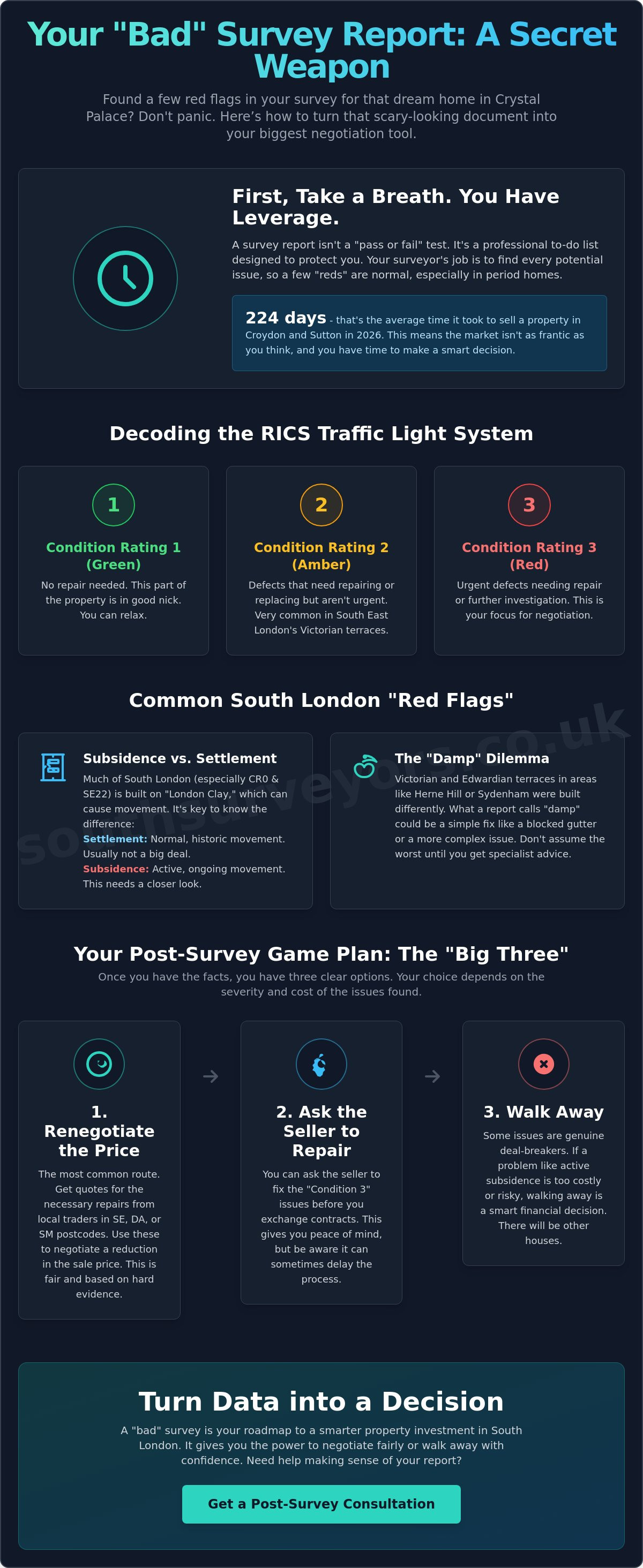
This guide will show you exactly what to do after a bad survey report to regain control and ensure you aren’t overpaying for a South London money pit. With properties across Croydon and Sutton taking an average of 224 days to find a buyer in 2026, you have far more leverage than you might think. We’ll help you decode the RICS jargon, identify which defects are genuine deal-breakers, and provide a clear plan to negotiate the price down with total confidence. By the time you’ve finished reading, you’ll see that report for what it really is: a powerful tool for a much smarter investment.
Key Takeaways
- Learn why “Condition Rating 3” doesn’t mean you should cancel your move; it simply means your surveyor is being thorough about highlighting urgent repairs.
- Discover exactly what to do after a bad survey report to transform technical jargon into a powerful negotiation tool for a fairer purchase price.
- Identify hyperlocal red flags like “London Clay” subsidence in CR0 or the damp issues common in Herne Hill’s iconic period terraces.
- Master the “Big Three” strategy to help you decide whether to renegotiate, request repairs, or walk away using specialist quotes from local contractors in DA and SM postcodes.
- Gain the confidence to handle estate agent pressure by using a post-survey consultation to clarify which defects are genuine deal-breakers.
Take a Breath: Why a “Bad” Survey Report Isn’t the End of the World
You’ve finally found the one. Maybe it’s a charming Victorian conversion near Beckenham Junction or a 1930s semi in Crystal Palace with views for miles. You open the PDF from your surveyor, and suddenly, it feels like the walls are closing in. There are red boxes everywhere. It’s easy to panic, but seeing a few “Condition Rating 3” marks doesn’t mean your dream home is a disaster. It just means your surveyor is doing exactly what you paid them for.
To understand the basics of this process, you might want to look into what is a home inspection? and how it differs from a simple mortgage valuation. When people ask what to do after a bad survey report, the first step is always to take a beat. A survey isn’t a pass or fail exam. It’s a professional roadmap that highlights exactly what needs your attention over the next few years. Think of it as a pre-flight safety check rather than a reason to cancel the trip.
To better understand how to handle these findings, watch this helpful video:
The Surveyor’s Job: Professional Pessimism?
Surveyors have a legal duty of care to you. They are trained to look for every potential risk, from a tiny patch of damp to a hairline crack that might hint at something deeper. This “professional pessimism” is actually your best friend. It’s their job to find the flaws so you don’t discover them three months after moving into your new place in Bromley. You need to distinguish between “structural deal-breakers,” like active subsidence, and “maintenance to-dos,” like an old boiler that’s reaching the end of its life. A “bad” report is simply a tool for total transparency; it provides the clarity you need to make an empowered decision about your investment.
The “Traffic Light” System Simplified
Most RICS reports use a simple traffic light system to help you prioritize. Condition Rating 1 (Green) means no repair is currently needed. Condition Rating 2 (Amber) is incredibly common for the period properties across South East London; it identifies defects that aren’t urgent but will need attention eventually. Finally, Condition Rating 3 (Red) marks urgent defects that need immediate repair or further investigation. If you’re buying a Victorian terrace in Herne Hill or Sydenham, expect plenty of Amber. The trick is identifying which Red issues are genuine safety risks or could lead to massive costs if they aren’t addressed before you exchange contracts.
Decoding the Red Flags: Common South London Property Issues
Every corner of South London has its own personality, from the leafy streets of Dulwich to the bustling hubs of Croydon. Unfortunately, our local architecture also comes with specific “personality traits” that often trigger red boxes in a report. Knowing what to do after a bad survey report starts with understanding whether you’re looking at a standard regional quirk or a genuine structural crisis. Most surveyors in SE and BR postcodes see the same handful of issues daily, so don’t assume your potential home is uniquely cursed just yet.
Subsidence vs. Settlement
If you’re looking at property in CR0 or SE22, you’re likely sitting on “London Clay.” This soil is notorious for expanding and contracting depending on the weather. When a report mentions movement, it’s vital to distinguish between historic settlement, which is basically the house getting comfortable over a century, and active subsidence. While a survey identifies these signs, it’s helpful to understand what a home inspection covers in terms of visual evidence versus a full geotechnical investigation. If the cracks are diagonal and wider than a 50p piece, you might need a structural engineer, but many Bromley and Croydon terraces have slight, stable tilts that have been there since the Blitz.
The “Damp” Dilemma in Period Homes
Victorian and Edwardian terraces in areas like Herne Hill or near the old path of the River Effra are famous for damp readings. However, “rising damp” is frequently a misdiagnosis. These older buildings were designed to breathe using lime mortar and suspended timber floors. When modern owners trap that moisture with plastic paints or cement render, the house rebels. Before you panic about a “red” damp rating in Dulwich, check if the issues are actually caused by blocked air bricks or leaky gutters. You can find more detail on these specific South London quirks in our guide to Spotting Property Defects in South London Homes.
Roofing and services also play a huge role in “bad” reports. Many flat conversions in SE postcodes feature “DIY” electrical work from the 80s or 90s that won’t meet 2026 safety standards. Similarly, shared chimney stacks in DA and SM postcodes are often neglected, leading to loose masonry or perished flashings. These aren’t necessarily reasons to walk away, but they are vital points for your “to-do” list. If you’re feeling overwhelmed by the technical details, you can always book a consultation with our team to translate that jargon into plain English.
The Big Three: Negotiate, Repair, or Walk Away?
Once you’ve finished decoding those red flags in your Sidcup semi or Dartford terrace, you’re at a major crossroads. Deciding what to do after a bad survey report usually boils down to three distinct paths. You can ask for a discount, request that the seller handles the mess, or simply hand back the keys and keep looking. This is the moment where you transition from an emotional buyer to a savvy investor. You aren’t being “difficult”; you’re being diligent.
Your most powerful weapon in this phase is a comprehensive RICS Level 3 Building Survey. Unlike a basic mortgage valuation, this report provides a granular, factual evidence base that estate agents in Sutton or Croydon can’t simply hand-wave away. It shifts the narrative from “I feel the house is too expensive” to “The professional evidence shows £15,000 of urgent structural work is required.” This factual foundation is what gives you the confidence to stand your ground during the following weeks.
Mastering the Renegotiation
When you present your findings to the estate agent, don’t go in guns blazing. Position yourself as a “knowledgeable friend” who wants the deal to work but needs the numbers to make sense. A great strategy is to pair your surveyor’s estimate with a specific contractor’s quote for the work. If you’ve found significant damp in a Bromley cottage, showing a real-world quote for the repair makes the price drop feel logical rather than opportunistic. Generally, it’s better to negotiate a lower purchase price and manage the repairs yourself. That way, you control the quality of the materials and the contractors used, ensuring the job is done right the first time.
When to Walk Away (The Deal-Breakers)
Some issues are simply too big to swallow, regardless of the postcode. If a property in an SM or DA postcode is flagged for severe Japanese Knotweed or has been fitted with certain types of spray foam insulation, it might be completely unmortgageable in the 2026 market. You also need to calculate your “Emotional ROI.” If the survey reveals a six-month renovation that will break your spirit and your bank account before you’ve even unpacked, it’s okay to let go. Walking away is a sign of a smart, disciplined buyer, not a failed purchase. There is always another house, but there isn’t always another house deposit if you sink yours into a money pit.
The South London Strategy: Getting Specialist Quotes in SE, BR, and CR
A report on a 1930s semi in Shirley shouldn’t be read the same way as a Victorian terrace in Dulwich. Every era of London building stock has its own quirks, and understanding what to do after a bad survey report requires a hyperlocal lens. You need tradespeople who know why a house in DA1 or SM1 might be behaving the way it is. Avoid the “Estate Agent’s Recommended Contractor” at all costs. Their priority is often closing the sale to secure their commission, not protecting your long term investment. You need independent eyes that work for you, not the deal.
Sourcing Local Trades in South East London
Finding the right people in SE and BR postcodes is about specificity. When you call a damp specialist or a structural firm, don’t just say the survey was bad. Ask them for a quote that specifically addresses the points marked as “Condition Rating 3” in your report. This forces them to look at the exact issues your surveyor flagged rather than giving you a generic, inflated estimate.
- The Power of Three: Always get three independent quotes to validate your negotiation position. If three different roofers in Sidcup tell you the chimney stack just needs repointing rather than a full rebuild, you have a solid case.
- RICS-Approved Specialists: For structural or damp works, look for contractors who understand RICS standards. This ensures their quotes carry weight during price renegotiations.
- Local Expertise: A contractor in Dartford or Sutton who knows the local soil and common build styles will provide a much more accurate quote than someone traveling from across the city.
The Role of the Mortgage Lender
Sometimes, the bank gets a whiff of the survey and panics. They might issue a “retention,” where they hold back a portion of the loan until specific repairs are finished, or even a “down-valuation.” This is where your home survey becomes a lifeline. Share the relevant technical sections with your mortgage broker immediately. They can often use the professional detail in our report to talk to the lender’s underwriters, proving that the issues are manageable and the property remains a sound security for the loan.
If you’re stuck between a panicking lender and a stubborn seller, get a professional second opinion from our surveyors to help bridge the gap and keep your purchase on track.
Turning Data into Decisions: How South Surveyors Supports Your Next Move
A survey report can feel like a heavy read, especially when it’s filled with technical terms and urgent warnings. At South Surveyors, we believe that understanding what to do after a bad survey report shouldn’t require a degree in civil engineering. We focus on transparency and empowerment, taking that digital PDF and turning it into a conversation about your future. Our mission is to ensure you feel secure in your decision, whether that means pushing forward with a price reduction or knowing exactly when to walk away from a potential money pit.
We see ourselves as your technical allies in a fast paced market. While estate agents are focused on the “sold” sign, we are focused on your long term mental ease and financial security. By choosing a RICS regulated firm, you are opting for a level of professional accreditation that generic, “budget” providers simply cannot match. We don’t just find the flaws; we provide the context you need to handle them like a pro.
Expert Consultation, Not Just a PDF
The real value of our service isn’t just the inspection itself; it’s the accessibility of our experts afterward. We offer a dedicated “Post-Survey Call” where you can chat through the results directly with the surveyor who walked the property. This one-on-one consultation is where the technical jargon is stripped away. We can explain why a specific crack in a Croydon semi isn’t a disaster, or why the damp in a Bromley terrace needs a specialist’s eye. Our surveyors have deep roots in South London. We’ve likely surveyed dozens of homes in your exact postcode, from SE to SM, giving us a level of local insight that nationwide companies lack. This bespoke approach ensures you aren’t just another number in a corporate database.
Ready to Move Forward with Confidence?
If you’ve received a worrying report from a different firm and feel like you’re being left in the dark, don’t panic. We often provide second opinions for buyers who need a more personal, communicative approach to their documentation. Property transactions in South London are high stakes, but they don’t have to be high stress. Every defect has a solution, and almost every solution has a price tag that can be factored into your negotiation strategy. Transitioning from a worried buyer to an empowered homeowner starts with having the right experts in your corner. We are here to provide the clarity you need to make a sound investment in the neighborhoods you love.
Speak to a South London expert today and let’s turn that “bad” report into your biggest negotiation advantage.
Your Next Move: From Panic to Purchase
Panic is the enemy of a solid property deal. Now that you know what to do after a bad survey report, you can stop viewing those technical flaws as failures and start seeing them as leverage. Whether you are eyeing a fixer-upper in Sidcup or a period conversion in Sydenham, remember that the goal isn’t to find a perfect house; it’s to find a home where you understand every brick and joist before you sign on the dotted line.
By using your RICS report to negotiate a fairer price or request essential repairs, you are protecting both your bank account and your long term sanity. As a RICS Regulated Firm with deep roots across the SE, BR, DA, CR, and SM postcodes, we’ve seen it all. We don’t just hand you a technical PDF and disappear. We provide direct access to your surveyor for post-report advice, ensuring you have a knowledgeable friend in your corner through the entire process.
If you’re feeling overwhelmed by a worrying report from another firm, don’t let the stress stall your move. You can get a professional second opinion on your survey report from South Surveyors and regain your confidence. You’ve got this, and we’re here to help you cross the finish line with your eyes wide open.
Frequently Asked Questions
Do I have to show the bad survey report to the seller?
You are under no legal obligation to share your full survey report with the seller or their estate agent. Since you paid for the document, it is your private property. However, providing relevant excerpts of “Condition Rating 3” issues is often the best strategy for justifying a price reduction. It transforms a vague request into a fact-based negotiation that estate agents in Sidcup or Dartford will actually take seriously.
Can a bad survey stop me from getting a mortgage?
A negative report can lead a lender to issue a “down-valuation” or a “retention” where they withhold funds until repairs are completed. If the surveyor flags severe structural instability or invasive species like Japanese Knotweed, the property might be deemed unsuitable security for a loan. In these cases, you’ll need to work closely with your broker and the seller to find a technical solution or a specialist lender.
How much should I knock off the house price after a bad survey?
There is no fixed percentage for a price drop; it should be based on the actual cost of the identified repairs. When deciding what to do after a bad survey report, get quotes from local contractors in areas like Bromley or Croydon to provide a realistic figure. Buyers often ask for the repair cost plus a small “hassle factor” discount for managing the works themselves after moving in.
Is a Level 2 survey enough, or do I need a Level 3 if the report is “bad”?
If a Level 2 survey returns several “Red” ratings, upgrading to a Level 3 Building Survey is often a wise move. While a Level 2 provides a great overview for modern homes, a Level 3 offers the deep-dive analysis needed for older South London terraces. It provides more detailed advice on repairs and the consequences of inaction, which is vital for high-stakes decisions in SE or BR postcodes.
What are the most common “red flags” in South London houses?
South London properties frequently face issues with subsidence due to the heavy “London Clay” soil found in postcodes like CR0 and SE22. Dampness is another common culprit, often caused by modern renovations trapping moisture in breathable Victorian brickwork. You should also watch out for outdated electrical systems in older flat conversions and neglected chimney stacks, which are recurring themes in DA and SM postcode reports.
Should I pay for a second survey if the first one was negative?
Paying for a completely new survey is rarely necessary, but getting specialist secondary reports is highly recommended. If your initial report flags “structural movement,” you should hire a structural engineer rather than another general surveyor. This provides the technical depth needed to satisfy lenders and can often reveal that a scary-looking crack is actually a minor, historic settlement issue rather than active subsidence in Croydon.
How long do I have to negotiate after receiving the survey report?
You can negotiate right up until the exchange of contracts, which is the point where the deal becomes legally binding. However, it is best to act quickly once you receive your report to avoid frustrating the chain. In the 2026 South London market, where the average time to secure a buyer is 224 days, most sellers are willing to listen to reasonable, evidence-based requests to keep the sale on track.
Can I pull out of the house sale for free after a bad survey?
You can legally withdraw from the purchase at any time before the exchange of contracts without paying the seller a penalty. While you will lose the money already spent on your surveyor and initial legal fees, walking away might save you thousands in the long run. It is a calculated decision that ensures you don’t inherit a “money pit” that could derail your financial future in South East London.