

The infamous London Clay doesn’t care about your artisan sourdough or your weekend plans in Greenwich. If you have noticed a suspicious diagonal line creeping up your hallway or a door that suddenly refuses to close, you are likely already hunting for a signs of subsidence survey South London to stop the panic. It is a stressful realization, especially when your home is your biggest asset, but in the SE, BR, and CR postcodes, these “sinking suspicions” are a geological fact of life that can be managed with the right expertise.
We understand the anxiety that comes with spotting structural movement; it is the thin line between a quirky period feature and a massive repair bill. This guide is designed to help you discover how to spot movement early and why a South London-specific survey is your best defense against the unique challenges of our local soil. We will preview the “Big Six” warning signs, explain the geological hotspots from Dartford to Sutton, and provide a clear roadmap for your next steps. By the end, you will have the definitive answers you need to secure your property investment with total peace of mind before you exchange contracts.
Key Takeaways
- Discover why the reactive “London Clay” makes properties in postcodes like SE and BR more prone to foundation shifts during extreme weather cycles.
- Learn to identify the “Big Six” visual cues, from classic diagonal “staircase” cracks in brickwork to doors that suddenly refuse to close properly.
- Understand how a professional signs of subsidence survey South London correlates internal damage with external factors to provide a definitive answer on structural stability.
- Find out why a crack isn’t always a catastrophe and how simple interventions, such as fixing leaky drains in Sutton or Croydon, can often stop the sinking.
- Get a clear roadmap for navigating insurance complexities and protecting your property investment before you commit to a purchase or exchange.
Why South London Properties Love to Sink: The London Clay Conundrum
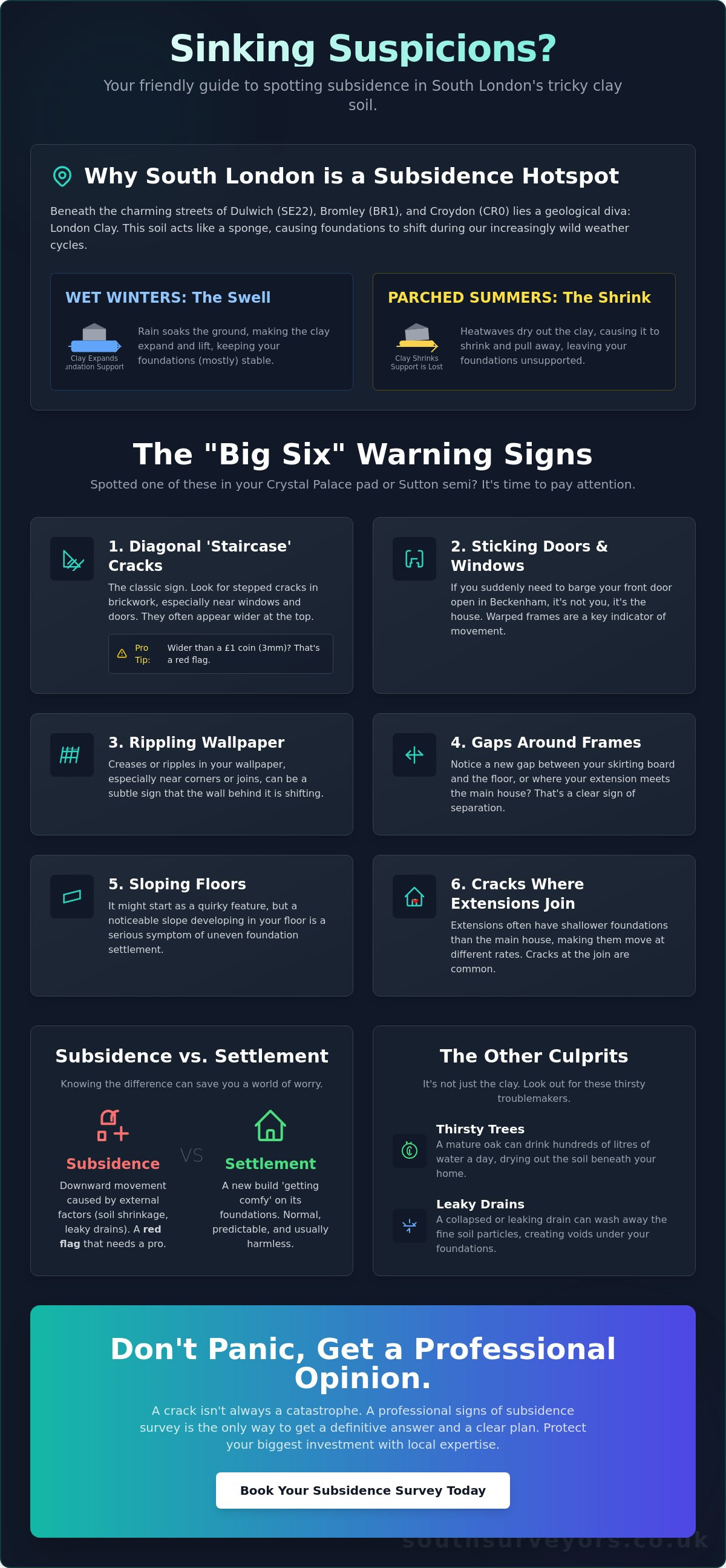
South London is famous for its vibrant markets and leafy streets, but beneath those charming facades lies a bit of a geological diva. Subsidence is the term we use when the ground under your foundations starts to sink downwards. This isn’t just a minor cosmetic issue; it’s a physical failure of the soil’s ability to support your home’s weight. In postcodes like SE22 or BR1, this is often tied to the notorious London Clay Conundrum. This specific type of soil is highly “shrink-swell” reactive. It acts like a giant sponge that expands when it’s soaked and contracts significantly when it dries out.
As we move through 2026, we’re seeing the “surge event” patterns from previous years become the new normal. The record-breaking heatwaves of 2022 kicked off a cycle of soil shrinkage that insurers are still paying for today, with domestic subsidence claims reaching a record £307 million in 2025. When we combine these increasingly parched summers with the intensely wet winters we’ve experienced recently, the clay soil is under constant stress. If you’re worried about new cracks in your Lewisham semi, booking a signs of subsidence survey South London is the most reliable way to determine if the ground is actually shifting beneath your feet.
To better understand why your property might be moving, watch this helpful expert guide:
Subsidence vs. Settlement: Know the Difference
It’s easy to get these two confused, but the distinction could save you a lot of sleepless nights. Settlement is what happens when a relatively new building “gets comfortable” on its foundations, usually within the first few years of being built. It’s the house equivalent of settling into a sofa. Subsidence, however, is almost always caused by external factors like soil shrinkage or a collapsed drain. While settlement is a predictable part of a building’s life, subsidence is a structural red flag that requires professional attention. Confusing the two can lead to unnecessary anxiety or, worse, ignoring a problem that’s getting deeper.
The Role of South London’s Famous Trees
We all love the green canopy in places like Dulwich or Beckenham, but those majestic oaks and willows are incredibly thirsty. A mature tree can drink hundreds of litres of water every day. During a dry spell, their roots will reach further and deeper to find moisture, sucking the water directly out of the clay soil. This process, known as root desiccation, causes the soil to shrink even faster, leaving a void that your foundations eventually drop into. Before you blame the walls, it’s always worth looking at the foliage nearby. A signs of subsidence survey South London will often look at the distance between your home and the nearest large tree as a primary risk factor.
The “Big Six” Signs of Subsidence: A Homeowner’s Checklist
Playing detective in your own home in Crystal Palace or Forest Hill can feel a bit stressful, especially when you are looking for signs of structural movement. While small hairline cracks are often just the house breathing, certain symptoms are more serious. If you are spotting these, it might be time to consider a signs of subsidence survey South London to get a professional’s eye on the situation. We recommend keeping an eye out for these specific red flags:
- Diagonal staircase cracks: These usually follow the mortar lines in a stepped pattern. If they are wider than 3mm, about the thickness of a pound coin, and appear near window frames or doors, they are a classic indicator.
- Sticking points: If your front door in Bromley suddenly needs a shoulder barge to open, or your windows are jamming for no apparent reason, the frame might be warping as the wall tilts.
- Wallpaper ripples: This happens when the wall behind the paper shifts, causing the decorative layer to buckle or crinkle. It’s often mistaken for damp, but the lack of a musty smell is a giveaway.
- The Great Divide: Extensions in areas like Sutton often sit on different foundation depths than the main house. If you see a widening gap where the two meet, it’s a sign they are moving at different rates.
Inside the House: What Your Skirting Boards Are Telling You
Check your skirting boards for sudden changes. If you notice a gap appearing between the wood and the floor, or if you can see daylight where there used to be a tight fit, the floor might be dropping. A simple way to check for a slope is the marble test. Place a marble on a hard floor in the middle of the room; if it consistently races toward one corner, you’ve likely got an unexplained slope. These issues often become more apparent after a parched South London summer, which leaves the clay soil bone-dry and brittle.
Outside the House: Pathway and Patio Warnings
Don’t forget to walk the perimeter of your property. Cracks in your driveway or patio that seem to point toward the house are worth checking. Even a leaning garden wall in Croydon can be a herald of deeper issues, as it suggests the soil in the entire plot is unstable. While we usually talk about sinking, there is also heave. This is the opposite of subsidence, where the ground swells upwards, often after a large tree is removed and the soil rehydrates too quickly. This upward pressure can be just as damaging, and it’s something official government guidance recommends monitoring closely. If your home’s exterior is looking a bit wonky, booking a RICS Level 3 Building Survey can help clarify if it’s a minor fix or a major project.
The Subsidence Survey: What Happens When a RICS Expert Steps In?
When you book a signs of subsidence survey South London, you aren’t just getting a professional with a clipboard and a worried expression. You’re hiring a structural detective. We start with a comprehensive visual sweep, mapping every crack like a cartographer. We aren’t just looking at the size of the gaps; we’re looking at their direction and history. By correlating internal damage with external brickwork, we can determine if the house is tilting, rotating, or simply settling into its old age. It is about connecting the dots between that crack in your hallway and the one on your garden wall.
Sometimes, the culprit isn’t the geology at all. In places like Sidcup or Bexley, we often find that a leaky Victorian drain is the real villain. If a pipe has cracked, it can wash away the fine particles in the soil, creating a void that foundations eventually drop into. This is why our inspection includes a careful look at your drainage layout. We want to rule out “washout” before we start talking about more complex soil issues. This level of detail is exactly why a RICS Level 3 Building Survey is considered the gold standard for structural peace of mind.
Why a RICS Level 3 Survey is Non-Negotiable
If you’re eyeing up a beautiful Victorian terrace in East Dulwich or a sprawling Edwardian home in Greenwich, a basic check won’t cut it. These older properties have seen a lot of history, and they often carry the scars of “historic movement.” This is movement that happened decades ago and has since stopped. Our job is to distinguish these old battle scars from “live” subsidence that’s actively threatening the building’s integrity. For a full breakdown of which report fits your needs, take a look at The Ultimate Guide to Building Surveys: Navigating South London’s Property Jungle.
The Toolkit: Moisture Meters and Laser Levels
We don’t just rely on “vibes” and experience. Our experts use precision tools to back up their findings. Laser levels allow us to see if a floor has a slope that’s invisible to the naked eye, while moisture meters help us track down those hidden leaks. If the situation is unclear, we might recommend a period of monitoring. This involves placing small “tell-tale” gauges over cracks to see if they move over several months. This data-driven approach allows us to create a repair roadmap that isn’t just a guess; it’s a document your insurer will actually respect and act upon.
Managing the Sinking Feeling: Insurance, Trees, and Repairs
The moment you hear the word “subsidence,” your mind likely jumps straight to images of excavators and a five-figure bill for underpinning. Take a breath. While underpinning is a permanent fix, it is often the last resort rather than the first. In many cases, the solution is far less invasive. If you are spotting movement, a signs of subsidence survey South London can help pinpoint whether you need a major structural intervention or a simple visit from a local plumber. In places like Sutton or Carshalton, we frequently find that simply repairing a collapsed clay pipe stops the sinking in its tracks by preventing water from washing away the soil.
For those who want a more modern, “hipster-approved” approach, resin injection is a fantastic alternative to traditional concrete trenches. Instead of digging up your garden, specialists inject a structural polymer into the ground that expands to fill voids and compact the soil. It is faster, cleaner, and often more cost-effective. However, you must also consider the leafy culprits. While pruning a thirsty oak in Bromley can reduce its water intake, removing it entirely can lead to “heave,” where the ground swells and pushes your house upwards. It is a delicate balance that requires expert guidance to get right.
The Insurance Minefield: How to Claim Correctly
Navigating an insurance claim can feel like a full-time job. Your survey report is your strongest weapon here. It provides the objective, RICS-regulated evidence that insurers need to process a claim. Keep in mind that a standard subsidence excess is typically £1,000 or more, which is significantly higher than your usual “oops, I dropped my laptop” excess. Having a professional report ensures that the repairs are handled correctly, protecting your property’s market value. Without this paper trail, you might find your home’s resale value taking a hit even after the cracks are filled.
Hyper-Local Risks: From Bromley to Dartford
Soil conditions aren’t uniform across the South East. While the CR corridor is famous for its heavy clay, the BR and DA postcodes often face a mix of clay and more gravelly deposits. In areas like Eltham and Greenwich, the local water table plays a massive role. If the water table drops during a drought, the soil loses its volume, leading to the “sinking suspicions” we see in older terraces. Understanding these local quirks is essential for a successful purchase. If you are currently in the middle of a transaction, reading our RICS Level 3 Building Survey: A Complete Guide for Home Buyers will help you understand how we assess these hyper-local risks. If you are worried about a specific property, the best next step is to book a professional survey to get a definitive answer.
Securing Your South London Investment with South Surveyors
Finding the right team to handle your signs of subsidence survey South London shouldn’t feel like another stressful hurdle in an already hectic property market. At South Surveyors, we don’t just look at bricks and mortar; we look at the bigger picture of your future home. We are a team of local experts who actually live and breathe South London property. Whether you are buying a trendy loft in Deptford or a family home in Sidcup, we understand the specific quirks of the SE, BR, DA, CR, and SM postcodes because we walk these streets every day. We combine RICS-regulated precision with a friendly, jargon-free approach that keeps you in the loop without the confusing technical chatter.
Our bespoke reports are designed to empower you. If we find that the foundations of a property in Woolwich are struggling with the clay soil, we give you the data needed to negotiate a fair price or walk away with your deposit intact. In a market where the average subsidence claim payout hit £17,820 in early 2026, having a definitive answer on property stability is the ultimate peace of mind. We don’t just hand over a PDF and disappear; we provide the tools for sound decision-making in a high-stakes environment.
The South Surveyors Difference: We Talk to You
One thing that sets us apart is our commitment to direct communication. You get actual access to your surveyor for a post-report debrief. We don’t believe in corporate robots or automated responses. If you have a question about a crack we spotted in your Croydon terrace, you can speak to the person who stood in the room and inspected it. This personal touch is vital for navigating the South London property jungle. If you are looking for a more standard check for a modern flat, you might find our RICS Level 2 Survey: The South London Buyer’s Guide helpful for comparing your options.
Ready to Stop the Sinking Feeling?
Waiting is the only real mistake you can make when you suspect subsidence. Early detection can be the difference between a simple drainage fix and a massive underpinning project. You can book your RICS (level 3) Building Survey in under five minutes, giving you the clarity you need before you exchange contracts. Don’t let “sinking suspicions” ruin the excitement of your new home. Get a transparent, local quote for your South London survey today.
Turn Your Sinking Suspicions into Structural Certainty
You now know that a jagged crack in your masonry doesn’t always mean your home is destined for the history books. Whether it’s the reactive London Clay or a thirsty oak tree in Dulwich, understanding the geological quirks of the SE, BR, and CR postcodes is half the battle. By identifying the “Big Six” signs early and recognizing that underpinning is rarely the first port of call, you’re already ahead of most buyers in this competitive market. Knowledge is your best tool for avoiding the “London Clay” nightmare and keeping those repair bills manageable.
Getting a professional signs of subsidence survey South London is the final step to protecting your investment and your sanity. At South Surveyors, we offer RICS regulated excellence combined with deep knowledge of the DA and SM areas. We prioritize direct, one-on-one consultations so you can discuss your report with a real human who knows your neighborhood. Book your expert RICS Level 3 survey and protect your South London home today.
Your property journey should be exciting, not exhausting. With the right local experts by your side, you can handle whatever the South London soil throws your way and move forward with total confidence.
Frequently Asked Questions
Is subsidence common in South London homes?
Subsidence is relatively common across the capital because of the geological makeup of the region. Properties in South East London neighbourhoods like Peckham, Camberwell, and Crystal Palace are built on heavy clay that reacts to moisture changes. While it sounds alarming, many older homes have successfully managed these issues for decades. It’s simply a factor of living in a city with this specific soil profile.
Will a RICS Level 3 survey definitely find subsidence?
A RICS Level 3 survey is the most thorough investigation available to identify structural movement. It provides a detailed analysis of the building’s condition and can distinguish between active sinking and historical “settlement.” While no survey can predict the future with 100% certainty, this report is your strongest defense when looking for a signs of subsidence survey South London. It gives you a clear, expert opinion on the property’s stability.
Can I still buy a house that has had subsidence in the past?
You can certainly buy a property with a history of movement, provided the issue has been professionally resolved. You should ask for a Certificate of Structural Adequacy and check if the current owners have a transferable insurance policy. Many homes in areas like Greenwich or Blackheath have had historical fixes and remain perfectly sound investments. It’s all about the paperwork and ensuring the cause was actually addressed.
How much does a subsidence survey cost in South London?
Industry data suggests a specific subsidence survey typically starts at approximately £700, though this varies based on property size. A broader structural movement survey generally ranges between £450 and £900. These figures reflect the expert time required to map cracks and analyze soil risks. If the survey recommends a structural engineer’s report, you might expect to pay an additional £200 to £1,200 for that specialized data.
What is the most common cause of subsidence in Bromley and Croydon?
Soil shrinkage within the London Clay formation is the primary culprit in these postcodes. In Bromley and Croydon, the problem is often exacerbated by large, thirsty trees located close to foundations. These trees suck moisture from the clay during dry spells, causing the ground to contract. In the CR and BR corridors, this cycle of shrinking and swelling is the most frequent cause of foundation failure we encounter during our inspections.
Should I tell my insurance company if I see a crack?
You should notify your insurer as soon as you suspect a structural issue. Most policies have a mandatory excess for subsidence claims, often starting at £1,000 or more. Reporting it early can prevent the damage from worsening, which might save you from a much larger financial headache later. Your surveyor’s report will be essential evidence to support your claim and ensure the repairs meet RICS standards.
Is underpinning the only way to fix subsidence in 2026?
Underpinning is no longer the default solution for every sinking home in 2026. Modern techniques like resin injection offer a less invasive way to stabilize foundations without digging deep trenches. In many South London cases, simply fixing a leaky drain or managing nearby foliage is enough to stop the movement. We always look for the most practical and effective solution before suggesting major structural work.
How long does a subsidence investigation usually take?
A standard on-site survey usually takes a few hours to complete, with the full report delivered shortly after. However, if the movement is “live,” a full investigation involving monitoring can take six to twelve months. This allows us to see how the building reacts to different seasons. It’s a slow process, but it’s the only way to be absolutely sure the ground has stopped moving.