

What if that “red” rating on your survey isn’t actually a deal-breaker, but your most powerful tool for securing a fair price? We know the feeling; you’ve fallen for a charming Victorian terrace in Crystal Palace or a leafy spot in Bromley, only to have the survey report land in your inbox like a heavy, jargon-filled brick. It’s completely normal to worry that explaining survey results to a seller might cause them to walk away or, even worse, lead to you being gazumped in a competitive SE postcode. After all, nobody wants to inherit a “money pit” when the average South East London property price is sitting at £558,000.
We promise to show you how to transform those technical RICS warnings into a calm, professional negotiation strategy that protects your bank balance without scaring off the vendor. We’ll break down the 2026 reform standards, demystify the traffic light system, and show you exactly how to ask for repairs or price reductions while keeping the deal firmly on track. You’ll gain the confidence to handle those SM and DA postcode negotiations like a seasoned pro, ensuring your new home is as structurally sound as it is beautiful.
Key Takeaways
- Learn how to view your RICS report as a professional roadmap for a fair deal rather than a list of reasons to cancel your purchase.
- Master the strategy of explaining survey results to seller by focusing on urgent Condition 3 defects while treating minor “character” flaws with a light touch.
- Identify common South London property quirks, like damp in Peckham conversions or roofing issues in BR postcodes, so you know exactly when to negotiate.
- Gain a clear step-by-step method for requesting price reductions or specific repairs before exchange, ensuring your investment remains structurally sound.
- Discover how a follow-up consultation with a local RICS-regulated expert can provide the jargon-free clarity you need to keep your purchase moving forward.
Why Survey Results Aren’t a Deal-Breaker in the South London Market
Seeing a RICS report for the first time can feel like reading a list of reasons to run away. If you’ve set your heart on a period property in Crystal Palace or a grand terrace in Greenwich, those “Condition 3” ratings might look like a death sentence for your purchase. But here’s the secret: a survey is a health check, not a deal-breaker. In the South London market, especially with the 2026 reforms making upfront information mandatory, these reports are designed to be exhaustive. They aren’t meant to scare you; they’re meant to protect your investment.
Understanding what a home inspection is and why it’s performed helps you transition from a panicked buyer to an empowered negotiator. Surveyors are paid to be meticulous. They hunt for every hairline crack and damp patch to ensure you have a clear picture before exchange. When it comes to explaining survey results to seller, remember that a report full of notes is actually a sign of a job well done. It provides a professional roadmap for a fair deal that protects both parties’ long-term interests.
To better understand how to handle these findings, watch this helpful video:
The ‘Pedantic Professional’ Rule
Your surveyor isn’t being difficult; they’re being thorough. If they’re inspecting a 1930s semi in Bromley (BR1) and notice original lead flashing, they have to mention it. Even if it’s currently watertight, its age makes it a potential future issue. We distinguish between “immediate threats,” like structural subsidence common in the clay soil of SE postcodes, and “future maintenance,” like repointing. At South Surveyors, we pride ourselves on delivering these details without the scary jargon. We want you to understand that a “red” rating doesn’t always mean the house is falling down. It often just means an expert needs to look at a specific element, like the electrics, before you sign. This clarity is vital when explaining survey results to seller later on.
Market Context: South London Realities
Sellers in areas like Croydon (CR0) or Sidcup (DA14) are usually realistic. They know that Victorian and Edwardian homes come with “character,” which is often code for “needs a bit of work.” Since the 2026 homebuying reforms, sellers are now required to commission a survey before listing. This means the days of nasty surprises at the eleventh hour are largely over. Whether you’re looking at a RICS (level 2) Condition Report or a more detailed RICS (level 3) Building Survey, having this data upfront creates transparency. This openness actually speeds up the conveyancing process because everyone knows what they’re dealing with from day one. You’re not “finding problems”; you’re simply managing the ones that were already disclosed.
Decoding the RICS Traffic Light System for Your Seller
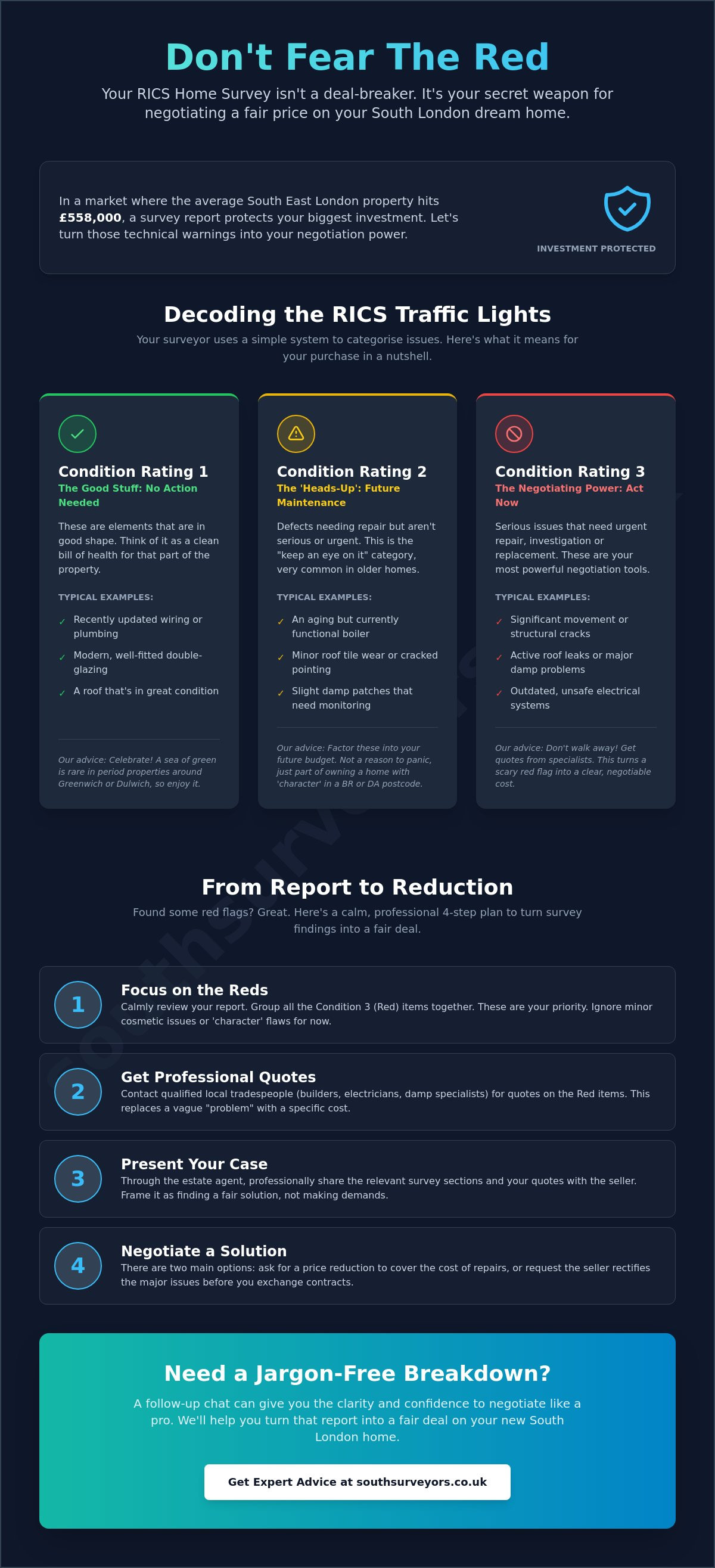
The RICS report uses a traffic light system that is actually quite intuitive once you get past the initial shock of seeing red. When explaining survey results to seller, you need to understand that these colors aren’t a judgement on their home’s soul; they’re a standardized way to measure maintenance needs. Most sellers in South London are used to the idea that older properties have “quirks,” but the traffic lights help put those quirks into a professional context. Grouping these results before you pick up the phone to the estate agent is the best way to keep the conversation productive.
Condition Rating 1 (Green) means no repair is currently needed. In the world of Victorian terraces in Dulwich or Greenwich, these are about as rare as a free parking spot on a Saturday afternoon. Most sellers know their period homes aren’t perfect, so don’t expect a sea of green. Condition Rating 2 (Amber) is the “keep an eye on it” category. These are defects that need repairing or replacing but aren’t urgent. If you’re buying a 1950s semi in Sidcup or a flat in Croydon, you’ll see plenty of these. They shouldn’t spook a seller, and they usually aren’t grounds for a massive price chip.
Condition Rating 3 (Red) indicates serious defects that require urgent attention. This is where the calm, evidence-based conversation happens. It’s vital to define Condition 3 correctly: it’s a prompt for professional repair or replacement, not an automatic deal-breaker. When you bring these up, focus on the facts rather than the “fear factor.”
Translating Jargon into Plain English
Sellers often get defensive because they don’t understand the technical vocabulary. If you tell a seller in Peckham their house has “spalling brickwork,” they might panic. Instead, explain it’s just the surface of the brick flaking off due to the weather. Similarly, “efflorescence” is just a fancy word for salty white powder left behind by moisture. When a report suggests “further investigation,” it isn’t a code word for “the house is falling down.” It often just means the surveyor couldn’t see behind a massive fitted wardrobe or needs a specialist, like a registered electrician, to sign off on an older fuse box.
Separating the ‘Must-Haves’ from the ‘Nice-to-Haves’
Not every “Red” item is a reason to renegotiate. Some are actually standard for the age of the property, like a lack of modern damp-proofing in a 120-year-old cottage. Using a RICS Level 2 Survey helps you benchmark modern home standards against what’s actually in front of you. Focus your energy on the top three issues that genuinely impact the property’s market value, such as structural movement or active timber rot. If you’re feeling overwhelmed by the technical bits, our team at South Surveyors can help you prioritize the findings before you talk to the vendor.
Common South London Defects: What’s a ‘Money Pit’ vs. ‘Character’?
When you buy a home in South London, you’re often buying a slice of history. Whether it’s a sprawling Edwardian semi in Sutton or a trendy Victorian conversion in Peckham, these properties have survived world wars and countless winters. However, history comes with baggage. When explaining survey results to seller, the trick is distinguishing between charming “character” and a genuine “money pit.” You want to keep the deal alive while ensuring you aren’t inheriting a financial disaster.
In SE and SM postcodes, the elephant in the room is often subsidence. South London sits on a thick layer of clay that expands and contracts with the seasons. A crack in the plaster might just be a sign of the house breathing, but to a nervous seller, it sounds like a catastrophe. By framing these as common regional quirks, you keep the negotiation grounded in reality. Similarly, damp issues in Brixton flats or leaky gutters on a 1930s semi in Bromley (BR) are often just the result of age, not neglect. These are the #1 overlooked issues in DA and BR suburban semis, yet they’re often the easiest to fix.
The London Clay Conundrum
Seasonal movement is a fact of life in this part of the world. If your report mentions cracks, don’t panic. A comprehensive building survey is usually enough to determine if the movement is historic or active. We look for signs of past repairs, like repointing or internal bracing, which actually prove the house has been well-cared for. You only need to suggest a structural engineer if the evidence points to a current, progressive issue. Explaining this distinction to the seller shows you’re being reasonable, not just looking for a discount. It turns a potential argument into a collaborative health check of the property.
Modern vs. Period Property Expectations
A 1990s flat in Croydon (CR) has a completely different set of red flags than an Edwardian villa in Sutton (SM). For modern builds, we look for “non-standard construction” or cladding issues that might affect your mortgage. For the older stock, a Level 3 Building Survey is the gold standard. It digs deep into the fabric of these historic homes to find what’s hiding behind the Farrow & Ball paint. When explaining survey results to seller, use the property’s age as a benchmark. A roof that’s lasted 80 years in Sidcup (DA) is bound to need a few tiles replaced; that’s just part of the suburban semi experience. Presenting these as “expected maintenance” helps the seller feel less attacked and more inclined to agree to a fair price adjustment.
The Step-by-Step Guide to Raising Issues with Your Seller
Negotiating after a survey can feel like a high-stakes game of poker, but it’s actually more like a collaborative project. You aren’t trying to “win” against the seller; you’re trying to reach a fair price that reflects the home’s true condition. Before you send a panicked WhatsApp to your partner or a fiery email to the agent, follow these steps to keep the deal on track. Explaining survey results to seller requires a cool head and a solid plan.
- Step 1: Digest the report fully. Read every page, then read them again. If a particular “Condition 3” item looks scary, call your South Surveyors expert for a chat first. We can explain if that damp in the Brixton basement is a quick fix or a major project.
- Step 2: Get independent quotes. Don’t guess the costs. Call a few local tradespeople in the SE or CR postcodes for big-ticket items like roof repairs or timber treatment. Having real numbers prevents the seller from dismissing your concerns as “exaggerated.”
- Step 3: Draft a collaborative email. Avoid ultimatums. Frame the findings as a shared hurdle you need to clear together to reach completion.
- Step 4: Offer choices. Would the seller prefer to reduce the price, fix the issue before exchange, or offer a credit? Most sellers in South London prefer a price reduction to avoid the hassle of managing builders themselves.
- Step 5: Stay professional. Keep your eyes on the finish line. You want this house, and they want to sell it. Don’t let a minor disagreement over a £500 guttering job kill the deal.
The ‘Knowledgeable Friend’ Script
When you’re explaining survey results to seller, the way you phrase things matters. If you say, “Your house is damp,” they’ll get defensive. Instead, try building rapport by saying, “We absolutely love the house and can really see ourselves living here, but our surveyor highlighted some rising damp in the front room that we weren’t expecting.” This keeps the vibe positive while addressing the problem. If you need to ask for a reduction for a roof in a DA postcode semi, try this: “We’re still 100% committed to the purchase, but the survey found the roof needs about £4,000 of urgent work to be watertight; would you be open to a price adjustment of £3,500 so we can address this immediately after we move in?”
Managing the Estate Agent
Estate agents in SE19 or CR0 want the sale to go through just as much as you do. They are your bridge to the seller, so give them the ammunition they need to be on your side. An agent can’t argue with a buyer’s “hunch,” but they can certainly take a RICS-backed report and a professional repair quote to their client. When you provide clear excerpts from your survey, the agent can explain to the seller that these issues will likely come up with any future buyer too. This makes a price reduction feel like a logical market correction rather than a personal attack. If you haven’t booked your inspection yet, get a professional RICS survey quote today to ensure you have the facts you need for a smooth negotiation.
How South Surveyors Provides the Clarity You Need to Negotiate
At South Surveyors, we understand that a property purchase isn’t just a transaction; it’s the start of a new chapter in a vibrant neighborhood like Peckham or Crystal Palace. Our RICS-regulated surveyors are more than just technical experts; they’re South London locals who genuinely understand the “neighborhood quirks” that define our streets. Whether it’s the specific behavior of the clay soil in the SE and SM postcodes or the common roofing patterns of DA suburban semis, we bring a level of hyperlocal insight that a national firm simply can’t match. This expertise is your biggest asset when it comes to explaining survey results to seller, as it allows you to speak with the authority of someone who knows the local market inside out.
We don’t just send you a digital PDF and leave you to figure it out. We know that RICS jargon can be overwhelming, which is why every one of our reports comes with the offer of a follow-up call. We’ll sit down with you and translate those findings into plain English. If you’re looking for the data to back up a price reduction, our detailed RICS valuation is a powerful tool. It provides a professional, unbiased assessment that justifies your negotiation stance to even the most stubborn vendor. We empower you with the facts so you can buy with confidence and total peace of mind.
The South Surveyors Difference
Our bespoke service delivery prioritizes your emotional security throughout the entire process. We know the stress of buying a home, especially in a competitive market like South East London. By adhering to the highest industry standards, we ensure your report isn’t just a document; it’s a powerful negotiation tool. For those eyeing an older Victorian terrace or a unique conversion in the BR or CR postcodes, our “Level 3” deep dives are the gold standard. They offer the thoroughness required to navigate South London’s unique property jungle with total confidence, ensuring you don’t inherit a “money pit.”
After successfully navigating the property jungle and securing your investment, you might be looking for a different kind of adventure to celebrate. For a truly unique experience, Elite Global Tours offers the chance to explore Hunting 7 Days (5 Days Hunting & 6 Nights) – Limpopo Rugged African Bush Camp – 3 to 9 Hunters for a luxury escape in the African wild.
Next Steps: From Report to Keys
Booking your follow-up consultation is simple. Once you receive your report, you can schedule a chat with the expert who actually walked the halls of your potential new home. Our clients frequently recommend us for our patience and clear communication, two traits that make explaining survey results to seller much less daunting. We believe in providing the tools for sound decision-making, helping you move from the initial report to holding your new keys. Don’t leave your purchase to chance; get the clarity and professional backing you deserve. Book your RICS survey with South Surveyors today and take the next step toward your new home with absolute certainty.
Securing Your South London Home with Confidence
Negotiating your purchase in postcodes like SE22 or BR1 doesn’t have to feel like a high-stakes standoff. By now, you’ve seen that a RICS report is simply a tool for transparency rather than a reason to walk away. Whether you’re navigating the typical clay-related movement of the South London basin or the quirky maintenance needs of a Peckham conversion, having the right facts makes all the difference. Master the art of explaining survey results to seller by focusing on collaboration rather than conflict, and you’ll find that most vendors are happy to reach a fair deal to keep the sale moving.
Our mission is to ensure you don’t just receive a technical PDF, but a clear, actionable path toward your moving day. As RICS-regulated specialists across the SE, BR, and CR postcodes, we’ve built a 5-star reputation for providing the patient, jargon-free communication that keeps you in the driver’s seat. Ready to take the next step toward your new home with absolute certainty?
Get an instant quote for your RICS survey in South London
You’ve got this, and we’re right here to make sure your South London dream is built on a solid foundation. For readers who may also be exploring property opportunities in Southern California, you can visit County Properties to receive the same level of personalized real estate guidance.
Common Questions About Survey Negotiations
Do I have to show the full survey report to the seller?
No, you aren’t legally required to share the entire document. The report is your private property, paid for by you. However, sharing specific excerpts or the summary page is often the most effective way of explaining survey results to seller. It proves that your requests for price reductions or repairs are based on professional RICS findings rather than just a personal whim.
What if the seller refuses to lower the price or fix the defects?
You’ll need to decide if the property is still worth the investment at the original price. If the defects are major, like structural movement in an SM postcode terrace, your mortgage lender might even insist on repairs. You can try offering a middle ground, such as a smaller credit at completion, but be prepared to walk away if the “money pit” potential outweighs your budget.
Can the estate agent tell me the survey results are ‘just standard’?
Agents often use this tactic to minimize concerns and keep the sale moving. While some wear and tear is expected in older South East London homes, “standard” doesn’t mean the issue is invisible or cheap to fix. Always rely on your surveyor’s expert rating. If they’ve marked an item as “Condition 3,” it needs urgent attention regardless of how common the agent claims it is.
Is a roof leak a deal-breaker in a Level 3 survey?
A leaky roof is a serious “red” item, but it doesn’t have to kill the deal. In suburban areas like Bromley or Sidcup, many 1930s semis still have original tiles that are simply reaching the end of their natural life. Use the survey’s findings to negotiate a price reduction so you can fund the replacement yourself after you move in.
How much of a price reduction should I ask for based on survey results?
Your request should always be backed by real-world data. Don’t just pull a number out of thin air; get two or three quotes from local tradespeople in the CR or DA postcodes. When explaining survey results to seller, presenting a professional repair quote alongside the RICS report makes it much harder for them to argue against a fair price adjustment.
Should I get a specialist damp or timber survey after my main RICS report?
Only proceed with a specialist if your RICS surveyor specifically flags a concern that requires a deeper dive. If we find evidence of active woodworm or rising damp in a Brixton conversion, a specialist can provide a detailed treatment plan. This extra layer of information gives you even more leverage during the final stages of your price negotiation.
What happens if the survey valuation is lower than my agreed purchase price?
This is known as a down-valuation, and it can affect your mortgage offer. If the RICS valuation comes in lower than your agreed price, you’ll usually need to negotiate the price down to that level or increase your deposit to cover the shortfall. Most sellers are willing to talk at this stage, as they know other buyers will likely face the same issue.