

What if those tiny, pin-sized holes in your potential new home in Crystal Palace or Bexley aren’t just “period charm” but a sign of something much hungrier? It’s the nightmare scenario every buyer in the SE or DA postcodes fears: finding out your dream property is being slowly eaten from the inside out. We know that the mere mention of timber-boring beetles can send your stress levels through the Victorian rafters, especially when you’re caught between a seller’s “it’s historic” shrug and your own fear of structural collapse.
The good news is that woodworm is rarely the dealbreaker people think it is; you just need the right perspective. This guide provides the clear, independent surveyor’s advice on woodworm that cuts through the noise and pressure of the South London property market. You’ll discover how to distinguish between a long-dead infestation and an active House Longhorn threat (a specific local risk in the SM and CR areas), why an estimated 20% of UK homes share this issue, and exactly how a professional RICS survey gives you the leverage to negotiate in Bromley or Sutton with total peace of mind before you exchange contracts.
Key Takeaways
- Learn why “woodworm” is actually a beetle’s larval phase and which specific species are most likely to be snacking on floorboards in areas like Greenwich and Blackheath.
- Master the art of spotting active infestations using the “five red flags,” including how to tell the difference between historic scars and fresh, powdery frass.
- Get professional surveyor’s advice on woodworm to understand why an independent RICS report is the only way to avoid biased, expensive repair quotes from treatment firms.
- Discover why “Dulwich Damp” and localized moisture issues in SE21 or SE22 are often the real culprits behind timber decay in period properties.
- Follow a clear, stress-free action plan that prioritizes fixing the root cause, which is usually moisture, rather than jumping straight to aggressive chemical treatments.
What is Woodworm? A Surveyor’s No-Nonsense Definition
Let’s start by clearing up a bit of biological confusion. Despite the name, woodworm isn’t actually a worm at all. When people ask What is woodworm?, they’re usually surprised to find it’s the larval stage of several different wood-boring beetles. These little guys spend the majority of their lives hidden inside your floorboards or joists, munching away in the dark. In our corner of the world, particularly in period properties across Croydon (CR) and Bromley (BR), we mostly encounter the Common Furniture Beetle. While it sounds domestic and harmless, it’s responsible for about 75% of all woodworm damage in the UK.
If you’re lucky, you’ll only ever see the exit holes. If you’re unlucky, you might run into the Deathwatch Beetle, which prefers the chunky, damp oak beams often found in older South London pubs or grander Victorian villas. The key piece of surveyor’s advice on woodworm is to understand that the presence of holes doesn’t always mean your house is falling down. Most damage is purely cosmetic, but if left to feast in damp conditions, these larvae can eventually turn structural timber into something resembling a digestive biscuit.
The Lifecycle: From Egg to Exit Hole
The process is a slow burner. Adult beetles lay their eggs in the cracks of unsealed timber. Once they hatch, the larvae burrow deep, where they stay for anything from two to five years. This is the “worm” phase, and it’s entirely invisible. You won’t hear them, and you won’t see them. The holes you eventually spot are actually the “departure lounges” created when the larvae transform into beetles and fly away to find a mate. By the time you see the hole, the resident has already checked out. Getting professional surveyor’s advice on woodworm is the first step to figuring out if you’re looking at a historic scar or a live buffet.
Why South London Homes are Targets
Our housing stock in the SE postcodes is a prime target for a few reasons. Many Victorian and Edwardian terraces were built with original, untreated softwoods. Over a century later, these timbers have often absorbed just enough moisture to become a five-star resort for beetles. Poor sub-floor ventilation is a classic issue we see during RICS level 2 surveys. When homeowners in areas like Crystal Palace or Sydenham install modern, non-breathable flooring or block up old air bricks, they trap humidity. Whether you are in a leafy street in Dulwich or a busy road in Sutton (SM), this moisture softens the wood, making it easier for larvae to chew through. It’s this combination of old wood and modern, sealed-in dampness that often triggers a dormant infestation to wake up and start eating.
How to Spot Woodworm: The 5 Red Flags
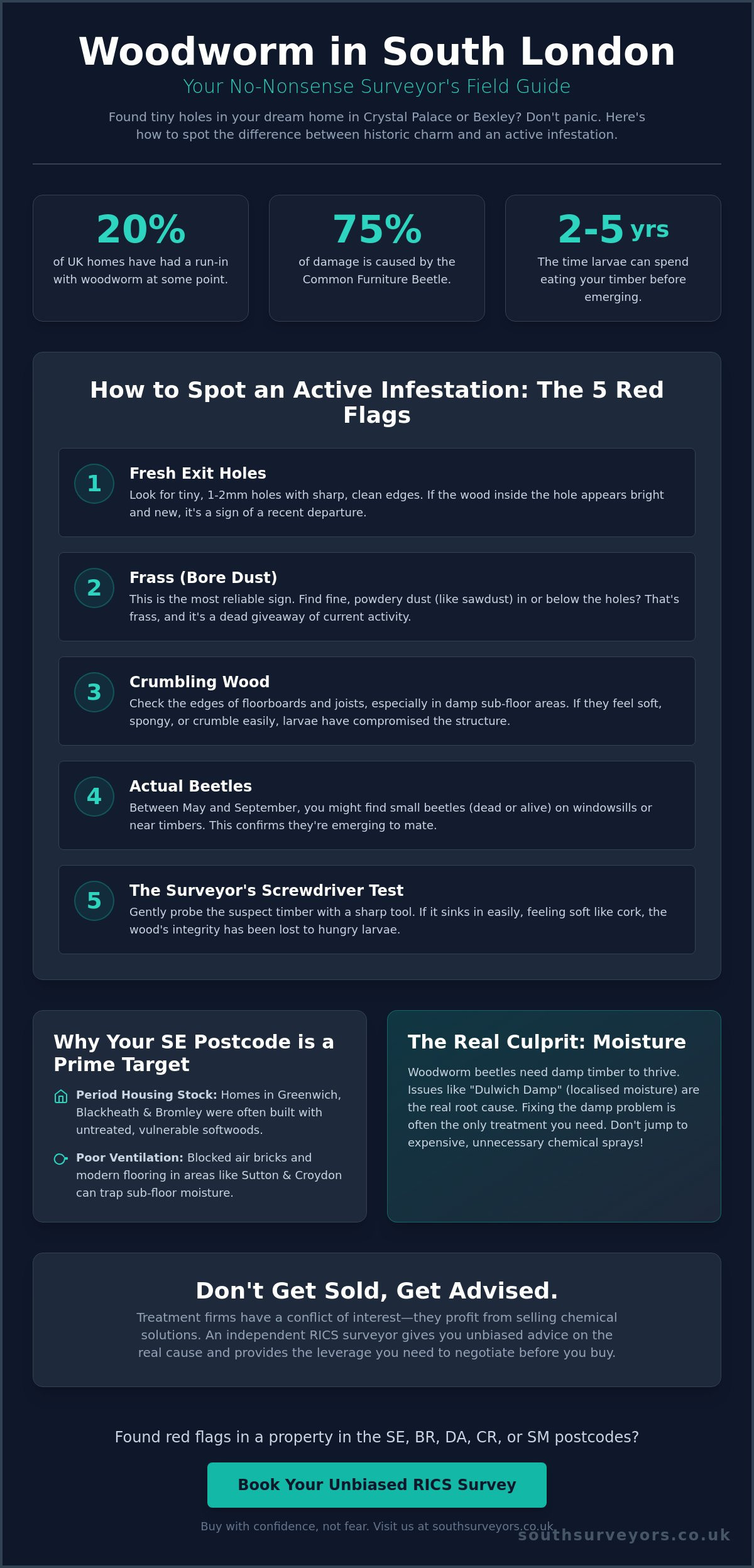
Spotting woodworm is a bit like being a detective in a tweed jacket. You’re looking for clues that the residents haven’t just left the building, but are actively paying rent in your floorboards. If you’re walking through a Victorian terrace in Sidcup (DA) or a 1930s semi in Bexley, don’t just admire the high ceilings. You need to look closer at the timber. Identifying these pests early can save you a fortune in unnecessary anxiety.
First, check for fresh exit holes. These look like someone has been very busy with a 1mm drill bit. If the edges are “clean” and the wood inside the hole is light in colour, you’ve got a recent departure. Second, look for frass. This is the fine, powdery bore dust larvae leave behind. If you see little piles of it on the floor or stuck to the underside of a joist, the infestation is very likely active. It looks a bit like lemon-shaped pellets under a magnifying glass, but to the naked eye, it’s just suspicious sawdust.
Third, watch for crumbling wood. This usually happens at the edges of boards where the larvae have chewed through the structural integrity. Fourth, keep an eye out for the beetles themselves. Between May and September, you might find dead ones on windowsills as they try to head outside. Finally, there’s the “Screwdriver Test”. This is a classic piece of surveyor’s advice on woodworm: we gently probe the timber with a sharp tool. If the wood is solid, it’s likely fine. If it feels like cork or the tool sinks in without resistance, the structural integrity is compromised.
Active vs. Historic: The Big Question
The most important thing to determine is whether the damage is historic or active. Historic woodworm is incredibly common in South London’s older housing stock and usually requires no treatment at all. It’s essentially a badge of honour for a house that has survived a century. To be sure, you can follow guidance from building conservation experts who suggest the “Paint Test”. Simply paint over a small area of holes and wait. If no new holes appear through the paint over the next flight season, the beetles are long gone and you can breathe easy.
Where to Look During a Viewing
Don’t be afraid to get your hands dirty. In a typical semi-detached in Bromley (BR) or Sutton (SM), the loft is your first stop. Check the timbers near the eaves where moisture levels are higher. In the living areas, peel back the carpet corners, especially if there are signs of damp on the walls. We often find activity in the undersides of stairs or wooden lintels above windows in older SE terraces. If you’re unsure about what you’re seeing, booking an RICS level 2 survey can provide the professional clarity you need to move forward with confidence.
The Conflict of Interest: Independent Surveyors vs. Treatment Firms
If you’ve ever been offered a “free woodworm survey” by a specialist treatment company, you’ve likely felt that little prickle of skepticism. It’s for a good reason. These firms are often less about neutral diagnosis and more about a sales pitch in a hi-vis vest. Their business model relies on finding a problem they can fix with a spray gun. This is where getting independent surveyor’s advice on woodworm becomes your most valuable asset during a property purchase. You need someone who isn’t trying to sell you a gallon of pesticide before they’ve even put their boots on.
Unlike a contractor, a RICS chartered surveyor has zero financial interest in whether you spend thousands on chemical treatments. Our only job is to give you the cold, hard truth. In many cases, those terrifying “active” infestations are actually historic; or better yet, easily solved by fixing a bit of damp. Jumping straight to heavy-duty chemicals can be environmentally nasty and, quite frankly, a waste of your hard-earned cash. For older or more complex properties, a RICS level 3 building survey is the gold standard for getting an unbiased verdict on timber health and structural integrity.
Unbiased Advice is Your Best Currency
We focus on the cause, not just the symptom. A beetle is just a symptom of a moisture problem. If you’re looking at a Sutton (SM) maisonette and discover woodworm in the floorboards, the “cure” might not be a professional chemical blitz. It might just be a leaky pipe under the kitchen sink or a blocked air brick in the back garden. By cutting off the water supply, you make the timber too dry and unappetizing for the larvae to survive. An independent report gives you the evidence you need to negotiate a price drop with the seller, armed with facts rather than a biased quote from a company trying to sell you a “guaranteed” five-figure solution.
When a Specialist is Actually Needed
There are, of course, times when a specialist is the right call. If we identify genuine structural failure in primary load-bearing joists, you’ll need more than a dehumidifier and a bit of hope. In cases where an infestation is so widespread that it’s threatening the safety of the building, professional “fogging” or deep-penetration pastes are necessary. We use our findings to brief these specialists correctly. This ensures they only quote for the specific areas that actually need help, rather than spraying your entire house from top to bottom just because they have a quota to meet.
Woodworm in South London: Local Risks and Postcode Trends
South London’s property market is as varied as the stalls at Brockley Market. When you’re hunting for a home in the SE, BR, or CR postcodes, you’re not just looking at floor plans; you’re looking at a specific geological and architectural history. In leafy spots like SE21 and SE22, we often talk about the “Dulwich Damp” factor. These areas are lush and green, but that moisture translates into a higher prevalence of Deathwatch Beetle in the grander, oak-timbered villas. It’s a localized quirk that requires specific surveyor’s advice on woodworm to ensure you aren’t buying a structural headache alongside those period features.
Down in Greenwich and Blackheath, the risk shifts toward basement flats. These sub-level homes are high-risk zones for timber decay simply because they’re often fighting a losing battle against ground moisture. Meanwhile, in Peckham, the rapid “flipping” of Victorian terraces presents a different danger. A fresh coat of paint and some trendy industrial lighting can easily hide active infestations behind brand-new plasterboard. If a deal looks too good to be true in SE15, it’s worth checking what’s happening beneath the surface before you commit your life savings.
Period Properties and Original Joists
Victorian suspended timber floors are essentially an all-you-can-eat buffet for beetles. The sapwood in original joists is particularly delicious to larvae. Interestingly, when people replace old timber with new, untreated wood, they often make the problem worse. New wood lacks the natural resins of old heartwood, making it even more susceptible to attack. You can find more detail on how these issues interact with other common local problems in our guide to South London property defects. Understanding the difference between a cosmetic hole and a structural failure is vital for any buyer in the SM or DA areas.
Negotiating in the South London Market
Don’t let a few holes scare you away from a Herne Hill gem. If our survey uncovers an issue, it’s a powerful tool for negotiation. In areas like Bromley (BR) or Croydon (CR), where high water tables can contribute to damp sub-floors, we often suggest requesting a “retention” in the sale price. This means a portion of the funds is held back until the seller pays for specialist damp-proofing or necessary repairs. It’s about being smart, not being scared. If you’ve spotted something suspicious in a property you’re eyeing up, you should book an RICS building survey to get the facts before you exchange.
Next Steps: What to Do if Woodworm is Found
So, you’ve spotted those tell-tale pinholes or your surveyor has flagged a potential issue in the report. Before you start mourning your deposit, take a breath. Finding timber-boring insects is a routine part of our work across South East London; it’s a common finding in our RICS level 2 surveys. The secret to handling it like a pro is following a logical, evidence-based plan rather than reacting out of fear. Most cases are manageable, provided you have the right surveyor’s advice on woodworm to guide your next move.
- Step 1: Don’t Panic. Remember that an estimated 20% of UK homes have some level of infestation. It’s often historic and inactive.
- Step 2: Identify the moisture source. Beetles need damp wood to survive. Check for leaky roofs in your Bexley semi or blocked air bricks in that Croydon terrace. If you fix the damp, you often kill the problem.
- Step 3: Consult your surveyor on severity. We’ll tell you if those holes are just a cosmetic quirk of an old Herne Hill house or a genuine structural threat to the floor joists.
- Step 4: Get a quote for treatment only if active. If we find fresh frass (that powdery dust), seek a PCA-accredited specialist. Don’t pay for chemical “protection” on wood that isn’t actually at risk.
- Step 5: Negotiate. Use the professional findings to adjust your offer or ask the seller to carry out necessary repairs before you exchange contracts.
The RICS Level 3 Deep Dive
When we conduct a thorough inspection, we don’t just glance at the attic. We’re looking for the type of beetle, the density of the holes, and the presence of live larvae. In a professional report, we categorize the risk clearly. If the floorboards are covered by heavy furniture or carpets, we might recommend a further “invasive” inspection where boards are lifted to check the hidden joists. A RICS Level 3 Building Survey is the gold standard for period homes with timber concerns. It moves beyond a simple checklist to provide a detailed narrative on the health of your home’s skeleton.
Empowered Decision Making
The goal is to move you from being an anxious buyer to an informed homeowner. There is a huge amount of mental ease that comes from knowing exactly what you’re buying, especially when dealing with the high-stakes property market in the SE or BR postcodes. You shouldn’t have to guess if your roof is safe or if your floorboards are sound. With a clear action plan and professional oversight, you can proceed with confidence. Book your South London survey today and let’s check those floorboards together to ensure your new home is as solid as it looks.
Moving Forward with Confidence
Woodworm might feel like a dealbreaker when you’re standing in a dusty loft in Bromley or Bexley, but it’s usually just a manageable chapter in a period home’s history. By focusing on moisture control and distinguishing active infestations from historic scars, you can protect your investment without falling for unnecessary chemical sales pitches. The most important step is ensuring you have unbiased, professional eyes on the property before you commit. This expert surveyor’s advice on woodworm is designed to put the power back in your hands during negotiations.
As an RICS Regulated Firm with over 1,000 local surveys completed across the SE and BR postcodes, we have expert knowledge of South London period properties and know exactly what to look for. Don’t let timber anxiety stall your move. Get an Independent RICS Survey Quote for Your South London Home and gain the clarity you need to cross the finish line. Your dream home in Sidcup or Sutton is waiting; let’s make sure it’s as solid as it looks.
Frequently Asked Questions
Is woodworm a reason to pull out of a house sale?
No, it is rarely a reason to abandon a purchase. Most infestations in South London’s period housing are either historic or easily managed by fixing a damp issue. It is a point for negotiation rather than a catastrophe. Getting independent surveyor’s advice on woodworm allows you to ask for a price reduction or a retention fee to cover any necessary repairs before you exchange.
How much does it cost to treat woodworm in a standard UK home?
Professional treatment for a standard home usually falls between £500 and £1,000. If you are just looking at a loft in a typical three-bed semi, expect to pay roughly £400 to £900. For smaller, targeted areas, boron treatments can be quite affordable, often costing around £30 per 25 square metres. It is a small price to pay to stop your floorboards from becoming a snack.
Does a RICS Level 2 survey always find woodworm?
A Level 2 survey identifies visible evidence like exit holes or bore dust in all accessible areas. However, it is a non-invasive check. If you are buying a particularly old property in Sydenham or a “fixer-upper” in Croydon, we might suggest a Level 3 survey. This allows for a deeper look into the property’s skeleton where beetles love to hide away from prying eyes.
Can woodworm spread from a piece of furniture to the house structure?
Yes, beetles aren’t picky and will happily migrate from a vintage wardrobe to your structural joists. If you’ve just picked up a “shabby chic” bargain from a market in Lewisham or Deptford, check it for tiny holes before bringing it inside. If your home’s timber is slightly damp, it’s an open invitation for those beetles to start a new colony in your floorboards.
Is woodworm covered by standard buildings insurance?
Standard buildings insurance almost never covers woodworm damage because it is viewed as gradual deterioration. Insurers expect you to maintain the property, which includes keeping it dry and beetle-free. This is why our surveyor’s advice on woodworm is so important during the buying phase. It helps you catch existing problems that an insurance company will later refuse to pay for.
How long does woodworm treatment take to work?
Chemical treatments work on contact to kill adult beetles, but the full effect takes a little longer. While the surface residents die instantly, larvae deep inside the wood are poisoned as they continue to feed or attempt to emerge. You’ll usually see a total stop to new activity within one full flight season, which typically runs from May to September in the UK.
What happens if I ignore woodworm in my loft?
Ignoring active larvae in your loft is a recipe for a sagging roof and a massive repair bill. In the South East, including parts of the SM and CR postcodes, the House Longhorn Beetle is a genuine threat. This specific pest eats through sapwood much faster than the common furniture beetle. It can compromise the structural integrity of your roof in years rather than decades.
Can I treat woodworm myself with DIY products?
You can use DIY boron-based products for small furniture items, but leave the structural joists to the professionals. Specialist contractors have the equipment to ensure chemicals actually penetrate the heart of the timber. It isn’t worth risking the safety of your home on a cheap spray bottle when a professional pest expert only costs between £30 and £70 per hour.